PiCK
Solana Korea Head Says Stablecoins Will Become Global Standard for Payments
Summary
- Solana said it aims to become the new standard infrastructure for global payments and settlement based on stablecoins.
- Visa, PayPal and Western Union are using Solana’s stablecoin infrastructure, and issuance on the network expanded from $5 billion to $15 billion, the company said.
- Solana said it will strengthen cooperation with South Korean financial firms through CONTRA, a solution for financial institutions, and links to South Korea’s STOs and won-denominated stablecoins.
Forecast Trend Report by Period


Interview with Lee Seong-san, Solana Foundation’s Korea head
Targets global payments and settlement infrastructure
Working with global companies including Visa and PayPal
Launches compliance-focused solution CONTRA for financial institutions
“South Korea is a key Asian market … we will deepen cooperation with financial firms”
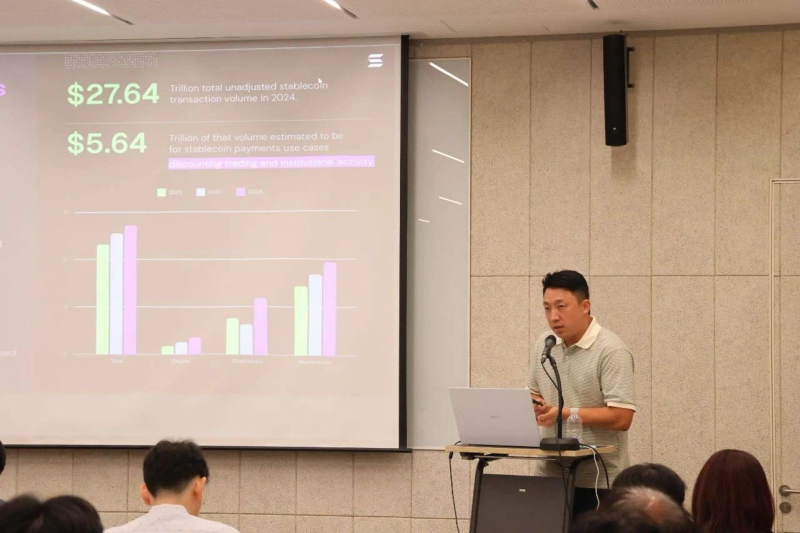
“Blockchain is at an inflection point, moving beyond a simple technology experiment and becoming real financial infrastructure. Solana wants to become a new standard for global payments and settlement with ultra-fast, low-cost infrastructure.”
Lee Seong-san, Solana Foundation’s Korea head, made the remarks in a June 10 interview with Bloomingbit. He is scheduled to attend the Crypto Investment Show 2026, or CIS 2026, on June 17, where he will present Solana’s stablecoin strategy and its CONTRA solution in detail. The event, hosted by Xangle with Hanwha Investment & Securities as title sponsor, is aimed at exploring convergence between finance and Web3.
“Working with Visa and PayPal … the key is real-world use”
Lee pointed to broader adoption by global financial institutions as the biggest recent shift in the Solana ecosystem. Visa, PayPal and Western Union have begun using Solana’s stablecoin infrastructure, he said. He attributed that to Solana’s ability to process thousands of transactions per second, deliver sub-second finality and maintain extremely low fees.
The numbers have risen sharply as well. Stablecoin issuance on the Solana network expanded to $15 billion last year from about $5 billion in 2024.
Lee said adoption of Solana-based stablecoins by global companies has significantly increased liquidity tied to real-world use cases such as decentralized finance, or DeFi, and payments. Stablecoins are no longer just an asset, he said, but core infrastructure for the global financial system. Solana’s goal is to serve as the layer for real-time cross-border payments and settlement, he added.
Solana introduces CONTRA for financial institutions
One reason financial institutions have hesitated to adopt stablecoins is the transparency of public blockchains. Wallet addresses and transaction histories are publicly visible, creating potential conflicts with financial regulation and corporate confidentiality. To address that, Solana recently introduced CONTRA, a private-layer solution.
Lee said the full transparency of public blockchains can be burdensome for both individuals and companies. In particular, exposing fund flows does not align with many parts of the existing financial regulatory framework. Solana developed CONTRA to address that issue.
CONTRA preserves access to Solana’s on-chain liquidity while providing the level of privacy financial institutions require, he said. Sensitive data such as transaction amounts and counterparty information is encrypted and protected, while authorized parties including financial regulators can review it when necessary. The system was designed to support regulatory compliance.
“South Korea is the most dynamic market in Asia … real use cases will surge”
Lee described South Korea as the most dynamic market in Asia, citing not only high digital-asset trading volumes but also stronger willingness among traditional financial firms to enter the sector than in other countries.
South Korea has strong developer talent and highly developed financial infrastructure, he said. With tokenized securities, or STOs, scheduled to be institutionalized next year, practical blockchain use cases are set to expand rapidly. If a legal framework such as the Digital Asset Basic Act is put in place, stablecoin issuance could also accelerate. That could create a path for won-denominated stablecoins built on Solana infrastructure to connect with global markets.
Solana plans to expand cooperation with domestic banks and securities firms. It will pursue projects with financial institutions that lead to actual services, Lee said. As blockchain becomes a foundational layer of finance, much like the internet, Solana aims to play a central role.

Doohyun Hwang
cow5361@bloomingbit.ioKEEP CALM AND HODL🍀