BOK Holds Benchmark Rate at 2.50% for Seventh Straight Meeting
Summary
- The Bank of Korea’s Monetary Policy Board held the benchmark rate at 2.50% for a seventh straight meeting, maintaining a wait-and-see stance amid inflation and exchange-rate instability stemming from the war with Iran.
- Markets see the latest decision as reinforcing views that the easing cycle is over, bringing the possibility of rate hikes in the second half into sharper focus.
- Jang Min and Ahn Jae-kyun said the benchmark rate could reach 3.00% and be raised once in the fourth quarter, marking an upward revision from earlier forecasts for no change this year.
Forecast Trend Report by Period


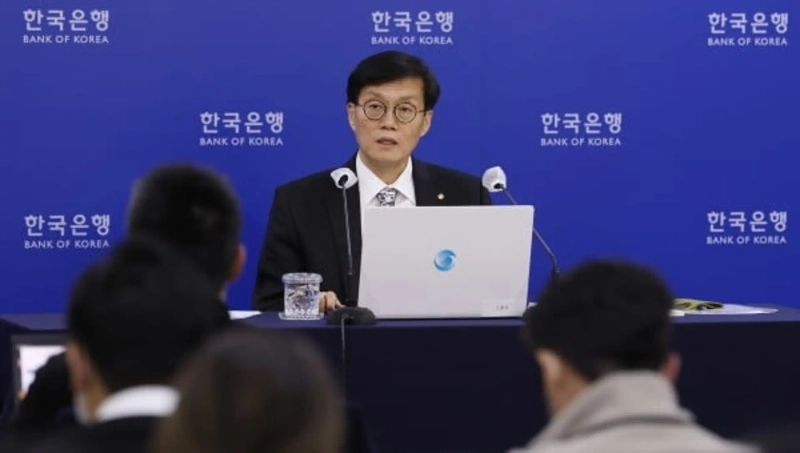
The Bank of Korea’s Monetary Policy Board held its benchmark interest rate at 2.50% on April 10.
The decision underscores the central bank’s limited room to maneuver as the war with Iran, which began in late February, fuels volatility in the exchange rate, inflation and growth. A wait-and-see stance was effectively the only option.
Consumer inflation has moved back above 2%, led by oil prices since the conflict began, while the won recently weakened to the 1,520-per-dollar range. In that environment, the board had little reason to cut rates, a move that would inject more liquidity into the economy and widen the rate gap with the US, potentially worsening price and currency pressures.
Raising rates to curb inflation was also difficult because of the economic slowdown. It also risked blunting the effect of the government’s fiscal stimulus, including a supplementary budget.
The board shifted toward easing in October 2024, cutting the benchmark rate by 25 basis points. It then surprised markets with another cut the following month, the first back-to-back reduction since the global financial crisis.
In the first half of last year, it maintained that easing bias with two cuts, in February and May, out of four policy meetings.
That reflected a focus on supporting growth as political uncertainty tied to impeachment proceedings, weak domestic demand and the impact of US tariffs dragged expected economic growth into the 0% range.
But the board paused in the second half, holding rates in July, August, October and November. It then kept rates unchanged at all three meetings this year, in January, February and April.
With the latest decision, the benchmark rate will stay at 2.50% for more than 10 months, from July 10 last year until the next meeting on May 28.
The board’s prolonged inability to adjust rates reflects conflicting economic and financial pressures, and the war with Iran has deepened that dilemma.
A rate cut could further stoke prices and the exchange rate after the conflict. Consumer inflation rose 2.2% in March from a year earlier, up 0.2 percentage point from the previous month, alongside a jump in global oil prices.
The won-dollar exchange rate fell back to the 1,480 range on April 9, but it had recently surged to the 1,520 range and still remains at a level where it could move back above 1,500.
Seoul home prices also have yet to show a clear break in their upward trend.
At the same time, the war-hit economy and slowing growth make a rate increase hard to justify. Late last month, the Organization for Economic Cooperation and Development cut its forecast for South Korea’s real GDP growth this year by 0.4 percentage point to 1.7% from 2.1%, reflecting the war with Iran and other factors.
If the BOK raises rates, it could weaken the effect of the government’s supplementary budget of more than 26 trillion won ($17.7 billion) and other fiscal measures.
Shin Hyun-song, the nominee for Bank of Korea governor, also struck a cautious tone in remarks after his nomination on March 22. “Recent rapid changes in the Middle East have increased volatility and uncertainty in the financial and foreign-exchange markets,” he said. “I will run a balanced monetary policy that takes into account inflation, growth and financial stability.”
After the seventh straight hold, markets are increasingly solidifying around the view that the easing cycle has ended.
Jang Min, a senior research fellow at the Korea Institute of Finance, said the benchmark rate could still be raised once or twice in the second half, bringing it to 3.00% by year-end.
Ahn Jae-kyun, a research fellow at Korea Investment & Securities, said he had revised his expected rate path to one increase in the fourth quarter from an earlier forecast for no change this year.
Park Sang-kyung, Hankyung.com reporter highseoul@hankyung.com

Korea Economic Daily
hankyung@bloomingbit.ioThe Korea Economic Daily Global is a digital media where latest news on Korean companies, industries, and financial markets.