Trump ‘Very Optimistic’ on Iran Deal as Netanyahu Says No Lebanon Ceasefire
Summary
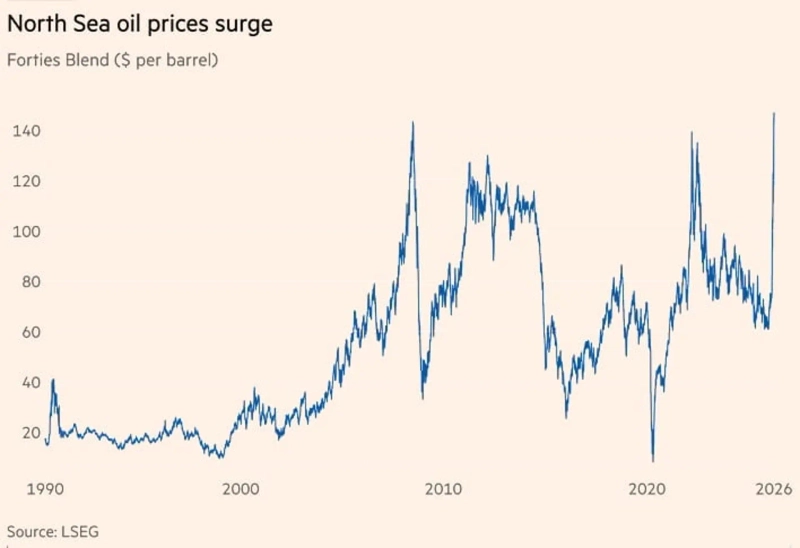
- With efforts to resume traffic through the Strait of Hormuz running into difficulty, spot oil prices and Brent crude prices have surged, sending Forties blend to a record $147 a barrel.
- The halt in CFD trading and the jump in dated Brent show that a worsening supply shortage and intensifying competition to secure crude have effectively “paralyzed” a key part of the oil market.
- Iran’s plan to limit daily vessel traffic, its tariff payable in cryptocurrency or yuan, and confusion over the ceasefire and whether Lebanon is included are helping fuel the surge in oil prices.
Forecast Trend Report by Period


Spot Oil Prices Hit a Record High as Supply Crunch Deepens
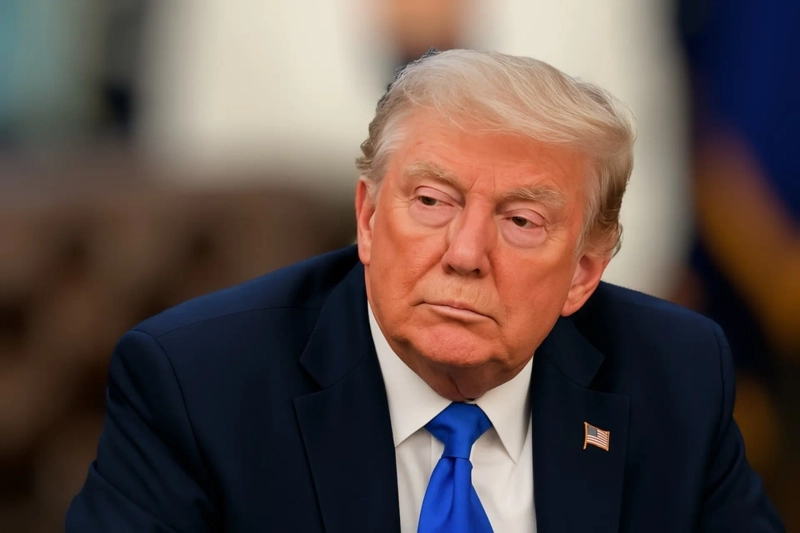
President Donald Trump said on June 9 he was “very optimistic” about the chances of reaching a peace agreement with Iran.
In a phone interview with NBC News, Trump said Iran’s leaders speak very differently in meetings than they do in public. “They’re much more rational,” he said. He added that they were agreeing to everything needed for a deal. “Remember, they’ve already been conquered. They don’t even have a military,” he said. If no agreement is reached, “the consequences will be very painful.”
Even so, continued Israeli airstrikes are making a smooth ceasefire deal and the reopening of the Strait of Hormuz harder to achieve. NBC, citing an administration official, reported that Trump asked Israeli Prime Minister Benjamin Netanyahu in a Wednesday call to scale back the attacks to help ensure upcoming negotiations succeed. Trump also told NBC that he had spoken with “Bibi,” Netanyahu’s nickname, and that the Israeli leader had agreed to reduce the intensity of the strikes. “We also need to show a little more restraint,” Trump said.
A US State Department official told CBS News that Lebanese and Israeli delegations are scheduled to meet next week. CBS said those expected to attend include US Ambassador to Lebanon Michael Issa, Lebanese Ambassador to the US Nada Hamadeh Mouawad and Israeli Ambassador to the US Yechiel Leiter.
More signs have emerged that the US wanted to stop the war from the outset. CNN and other outlets reported that the White House had already reviewed and approved the core terms of Pakistani Prime Minister Shehbaz Sharif’s proposed two-week ceasefire before receiving it formally. CNN said the proposal was “not exactly news” to the White House. The post was also initially reported to include the phrase “Draft — Pakistani prime minister’s X message.” It disappeared within a minute, but that wording would have been hard to explain if Sharif had written the post entirely on his own. That matches earlier reports that the White House had pressed Pakistan to play a mediating role and that the ceasefire was the result.
Lebanon Emerges as the Key Flashpoint
The problem is Israel. Lebanon’s Health Ministry said a preliminary tally from Israeli airstrikes on June 8 showed 303 people killed and 1,150 injured. The ministry said the dead included 71 women, 30 children and nine elderly people. Israel also acknowledged that the attack was its largest-ever offensive targeting Hezbollah.
Netanyahu said in a video posted on X that there would be no ceasefire in Lebanon. “We are continuing to strike Hezbollah with full force, and we will not stop until your security is restored,” he said. The video was posted shortly after Trump told NBC he had spoken with Netanyahu, suggesting the Israeli leader may act against Trump’s wishes.
CBS, citing multiple diplomatic sources, reported that Trump had been briefed that the ceasefire would apply across the broader Middle East and had agreed that Lebanon was included. At the time of the June 7 ceasefire announcement, mediators also believed Lebanon was covered by the deal, CBS reported. Israel had also agreed to the terms of the Pakistan-mediated arrangement, according to the report.
Vice President JD Vance, however, told reporters on June 8 that Lebanon was not included. Vance said Iran appeared to believe Lebanon was part of the ceasefire agreement, but that was “not true at all.” Referring to three alleged violations raised by Parliament Speaker Mohammad Bagher Ghalibaf, Vance mocked him by saying he questioned whether Ghalibaf understood English properly.
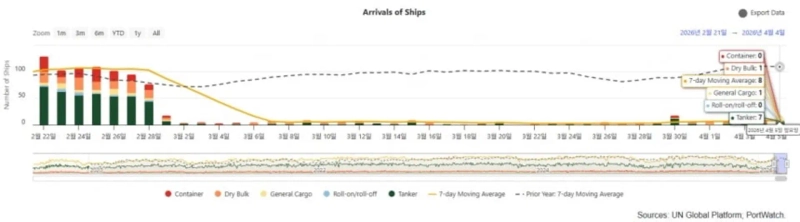
Traffic through the Strait of Hormuz rose to as many as 15 vessels a day over the weekend, but did not increase meaningfully after the ceasefire began on June 7. According to MarineTraffic, only five bulk carriers passed through the strait on June 8. By noon on June 9, just two had crossed. The Wall Street Journal and TASS reported that Iran plans to cap daily crossings at about 10 vessels. An Iranian official told the Financial Times that ships would have to pay what he described as a “tariff” of about $1 a barrel in cryptocurrency or yuan. Empty vessels could pass without charge, the official said.
Spot Oil Hits a Record High
Oil prices are surging again as it becomes clear that restoring normal traffic through the Strait of Hormuz will be harder than initially expected. Hopes that vessels stranded in the waterway could resume movement have faded. Spot prices for immediate crude delivery are now spiking.
The Financial Times, citing LSEG data, reported that Forties blend for immediate delivery rose to a record $147 a barrel on June 9. That is higher than levels reached during the 2008 financial crisis.
Forties blend is produced by mixing crude from 70 oil fields in the North Sea. It is a light, low-sulfur crude similar to Brent and is known for a high yield of naphtha and gasoline.
The FT said a scramble to secure crude had “paralyzed” a key pillar of the oil market. With Brent rising above $97 a barrel, traders said contracts for difference linked to Brent for next week were not traded because prices breached thresholds set by Intercontinental Exchange. CFDs reflect the gap between prompt crude delivery and future delivery and are used for hedging. Dated Brent, a benchmark for physical crude cargoes, climbed as high as $131.96 a barrel, the FT said.
Amos Hochstein, a former energy adviser to President Joe Biden, told the FT this was not simply a matter of high prices. “There’s an actual severe supply shortage.”
Iran Parliament Speaker Says ‘Time Is Running Out’
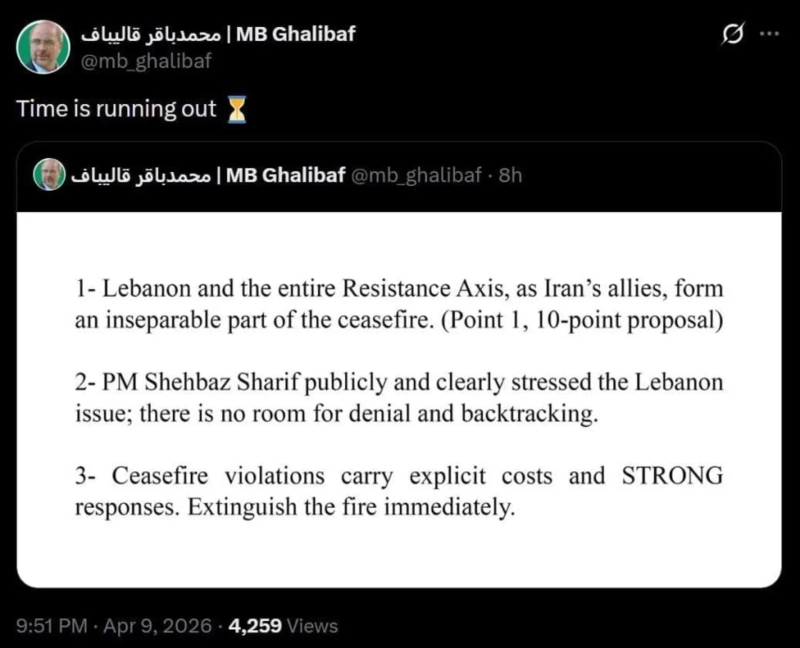
Iranian Parliament Speaker Mohammad Bagher Ghalibaf said in two posts on June 9 that “time is running out” and called for attacks on Lebanon to stop.
At about 3 p.m. Iran time, Ghalibaf wrote that “Lebanon and the entire Resistance Axis, as allies of Iran, form an inseparable part of the ceasefire. (Item 1 of the 10-point proposal).” He added that Pakistani Prime Minister Shehbaz Sharif had “publicly and clearly emphasized the Lebanon issue. There is no room for denial or retreat.”
He also wrote that violations of the ceasefire would bring a clear price and a strong response. “Put out the fire immediately.” At about 11:30 p.m. Iran time, he shared the post again and stressed that “time is running out.”
In a separate message marking the 40th day since the death, or martyrdom, of Ayatollah Ali Khamenei, Ghalibaf said the leader had made domestic missile production a central pillar of national defense by trusting younger generations. “We do not believe in separating the battlefield from diplomacy,” he said. “There is only one battlefield, the one defending the rights of the Iranian people.” The remarks indicate that Iran views attacks on Hezbollah in Lebanon as attacks on Iran itself.
Sang-eun Lee, Washington correspondent, Hankyung.com selee@hankyung.com

Korea Economic Daily
hankyung@bloomingbit.ioThe Korea Economic Daily Global is a digital media where latest news on Korean companies, industries, and financial markets.