PiCK
Hashed’s Kim, Circle’s Allaire Say AI-Led ‘B2A’ Crypto Payment Era Is Coming, Urge Korea to Act
Summary
- Allaire and Hashed CEO Kim Seo-jun said stablecoins will become core infrastructure as the AI agent economy, B2A, and A2A markets grow.
- Allaire said Circle is expanding transactions built around USDC, X402, and Arc, and plans to establish a formal local branch and obtain licenses if South Korea passes legislation for foreign stablecoin issuers.
- Both sides said South Korea could become isolated if it fails to move quickly on legal and institutional reform, even as USDC gains traction in global payments and payroll, and Circle expands partnerships with local exchanges and financial firms while supporting infrastructure for a won-denominated stablecoin.
Forecast Trend Report by Period


AI agent economy gains traction
B2A and A2A markets move into focus
Stablecoins gain ground as a payment method
Korea risks isolation if regulation lags
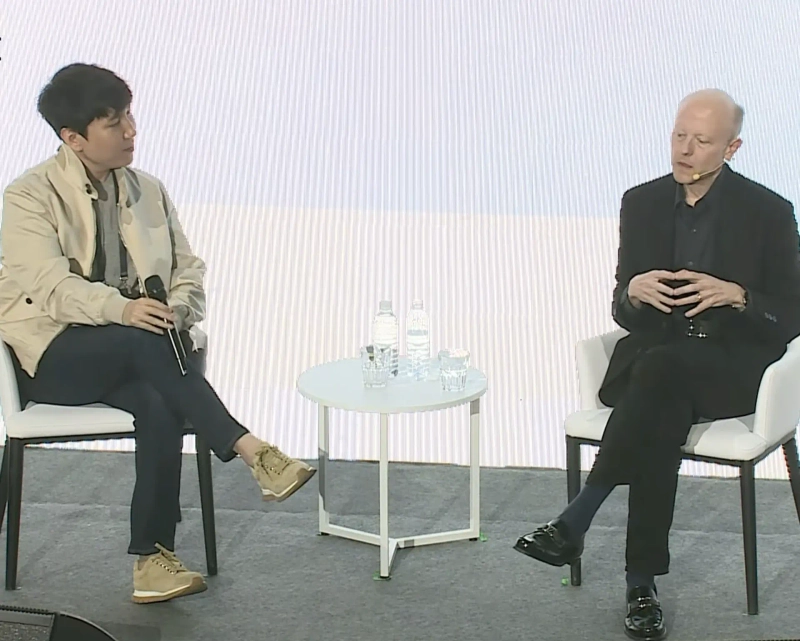
Circle Chief Executive Officer Jeremy Allaire and Hashed CEO Kim Seo-jun said stablecoins will be core infrastructure for the emerging AI agent economy. They called for South Korea to move quickly on regulation as B2A, or business-to-agent, markets expand, with companies increasingly doing business with AI agents.
At the Circle in Seoul event held on June 13 at SJ Kunsthalle in Seoul’s Gangnam district, Allaire said in a conversation with Kim that an era is emerging in which AI agents interact with one another and execute payments themselves.
‘AI as a core customer’ as B2A and A2A gain momentum
Allaire said 99% of transactions on Circle’s AI-focused payment protocol X402 are already conducted in USDC. Arc, the company’s next-generation operating system, is designed not only for businesses but also for AI itself as a core customer, he added.
Kim said the economy will be reorganized around AI agents. Markets once centered on B2C and B2B, he said, but B2A markets, where companies do business with AI agents, and A2A, or agent-to-agent, models will become mainstream across industries.
He also underscored the importance of KYA, or Know Your Agent, a new security and authentication standard. Going beyond KYC, or Know Your Customer, KYA verifies an AI agent’s identity and permissions. Kim said Korea is one of the markets best suited to the convergence of the agent economy and stablecoins because of its strong adoption of new technology, including ranking first globally in OpenAI payment users.
Allaire also outlined a roadmap for Korea. Circle is evaluating what structure would be most appropriate in the country. If pending legislation on foreign stablecoin issuers allows global companies to participate, Circle plans to establish a formal local branch and operate with the necessary licenses.
USDC is already growing in Korea as a trading and investment asset, he said. If Korean legislation properly supports cross-border transactions between the won and the dollar, Circle will expand its activities under those rules while maintaining the highest compliance standards.
‘Stablecoins are becoming a payment method’
The discussion also turned to practical use cases for stablecoins. After Kim said they are still widely viewed mainly as tools for virtual-asset trading, Allaire said the shift is already under way.
Stripe and Shopify already offer USDC payments by default, he said. Global payroll companies such as Deel and Gusto have also introduced USDC payout options. Stablecoins are quickly establishing themselves as both an alternative to the dollar and a key tool for cross-border payments.
He said passage of South Korea’s proposed Digital Asset Basic Act is a precondition for broader adoption. Just as the US GENIUS Act defines stablecoins as legitimate digital dollars, Korea also needs to recognize them as digital money. Passage of the bill will be decisive, he said, adding that the longer Korea waits, the further it risks falling behind in global financial innovation.
Circle seeks role in Korea’s stablecoin market
During his visit to Korea, Circle also expanded its engagement with local companies. On June 13, the company signed partnerships with major South Korean crypto exchanges including Dunamu and Bithumb. The agreements are aimed at broadening USDC adoption on exchanges while laying the groundwork to integrate Circle’s infrastructure technology.
Its outreach to the financial sector also took shape. At a lunch meeting that day, Allaire met officials from commercial banks and payment companies to discuss improving cross-border payment efficiency through the Circle Payments Network, or CPN, and cooperation in real-world asset tokenization.
Rather than issuing a won-denominated stablecoin directly, Circle wants to support domestic companies by providing issuance, payments and foreign-exchange infrastructure when they build one, Allaire said. If a won stablecoin is defined as part of Korea’s financial system, its expansion into payments and treasury infrastructure could accelerate quickly. Kim said he was excited to see Circle expanding its activities in Seoul and expects deeper cooperation with Korea’s Web3 ecosystem.

Doohyun Hwang
cow5361@bloomingbit.ioKEEP CALM AND HODL🍀