Optical-Communication Stocks Surge 1,575% and 3,518% in a Year as Jensen Huang Backs the Technology
Summary
- Shares of optical-communications companies including Lumentum and Daehan Optical Communication rose 1,575.35% and 3,517.59%, respectively, over the past year.
- Nvidia, Google and Microsoft are racing to secure optical communications and optical technology as they build ultra-fast network infrastructure of more than 1.6TB.
- AT&T’s planned $250 billion investment over five years and the BEAD program are opening long-term order opportunities for South Korean optical-communications parts makers such as Daehan Optical Communication and OE Solutions.
Forecast Trend Report by Period


DEEP INSIGHT
Optical communications, the future technology Jensen Huang has singled out
“Even thousands of supercars will jam if the road is too narrow”
Optical links target AI bottlenecks
Faster AI chips alone are not enough
Legacy networks are choking on traffic
Optical communications transmit data at the speed of light
Google and others are scrambling to secure the technology
AT&T to invest $250 billion over five years
South Korean parts makers seen benefiting
Lumentum Holdings Inc., regarded as a leading US optical-communications stock, has surged 1,575.35% over the past year. Daehan Optical Communication Co., a Kosdaq-listed South Korean company, has climbed 3,517.59%, based on Aug. 14 closing prices.
Optical-communications shares, which started drawing attention early last year, have risen even more sharply since Nvidia Corp. Chief Executive Officer Jensen Huang identified optical computing interconnects, or OCI, as a core future technology at GTC 2026 last month. Some investors are warning that valuations have become overheated. Even so, a growing number of market participants are pointing to optical communications as a next-generation sector that could drive the market’s next rally after semiconductors, secondary batteries and artificial intelligence.
What is optical communication?
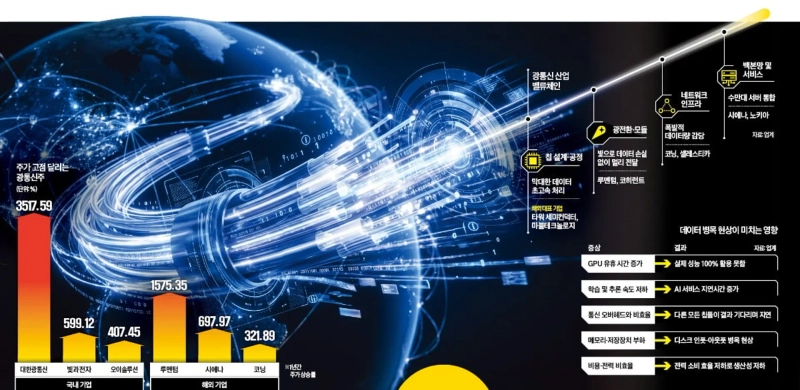
Optical communications use fiber-optic technology to convert electrical signals into light and transmit information at the speed of light, maximizing power efficiency. The technology is increasingly viewed as a way to solve one of the AI era’s biggest bottlenecks.
Global big tech companies have spent enormous sums securing Nvidia’s latest graphics processing units, the core brains of AI systems. But after deploying those GPUs, many found computing speeds fell short of expectations. As AI drove data volumes sharply higher, internal traffic became overloaded. Put simply, companies had thousands of supercars in the form of GPUs, but roads that were too narrow to let them run at full speed.
That is why big tech companies are betting on optical communications to replace legacy copper wiring and relieve network congestion in the AI era. No matter how advanced AI chips become, existing networks have limits in delivering their full performance.
The problem has become more pronounced as AI server architecture has evolved. Systems once relied on a single GPU. They now connect multiple GPUs and switches. As a result, the bandwidth of switches built on technologies such as Ethernet, the most widely used networking technology in local area networks, is reaching saturation as thousands of GPUs exchange data.
Nvidia, Alphabet Inc.’s Google and Microsoft Corp. are treating optical technology as just as critical as chip performance in the push to remove data bottlenecks. They are rushing to build ultra-fast network infrastructure that goes beyond 800 gigabytes to 1.6 terabytes or more. That is fast enough to transmit about 30 Netflix 4K movies in one second.
Optical communications have already become a major trend in the AI industry. Google has cited an efficient optical-communications infrastructure as one reason its in-house AI chips, known as tensor processing units, or TPUs, have succeeded. Nvidia has said its next-generation Spectrum-X network, unveiled recently, uses optical-communications technology to push beyond previous limits in data transmission and reception.
"Conventional copper cables consume a great deal of power over long distances, while fiber is relatively more efficient," a securities analyst said. "When tens of thousands of GPUs need to exchange data in real time, transmission speeds of 1.6 terabytes or more are essential. The optical-communications ecosystem will continue to expand."
Corning and Lumentum among leading companies
The optical-communications industry’s value chain can largely be divided into four segments.
The first is chip design and manufacturing, the part of the industry that builds the brain. These companies design chips that optimize AI computing and manage data traffic, allowing massive volumes of data to be processed at ultra-high speed. The segment includes technologies such as high-bandwidth switches and silicon photonics, which converts electrical signals into light on silicon substrates for transmission. Tower Semiconductor Ltd., a silicon-photonics foundry, and Marvell Technology Inc., which makes high-speed interconnect chips for data centers, are among the representative companies. Fabrinet specializes in precision contract manufacturing for optical-communications and laser components. Its role in optical communications is often likened to Taiwan Semiconductor Manufacturing Co. in semiconductors. Demand for its products rises as AI optical-transceiver demand increases.
The second is the optical conversion and module segment, which acts as the industry’s blood vessels by carrying data. These companies make products such as optical transceivers, which convert electrical signals into light and send them over long distances without data loss. Lumentum and Coherent Corp., where Nvidia has made multibillion-won investments, are leading the market.
Another group builds the network infrastructure that acts as a dedicated highway for surging data volumes. Corning Inc., which evolved from a display company into the world’s largest optical-fiber producer, is a key player, along with server and storage solutions provider Celestica Inc.
The last segment is the backbone network and service layer, which serves as the peripheral nervous system by easing bottlenecks at the edge of next-generation wireless infrastructure. The basic idea is to integrate tens of thousands of servers into a single network. Ciena Corp. makes optical networking equipment that connects data centers. It also produces next-generation fiber-optic cables for ultra-low-latency connections and is known for standardizing high-density connector infrastructure. Nokia Oyj is also emerging as a notable player in next-generation network infrastructure.
South Korean optical parts makers also draw attention
A number of South Korean component makers have also entered the optical-communications business. They are participating in the US telecom-infrastructure reinvestment cycle and major government-backed projects to build ultra-fast internet networks across the country, including the Broadband Equity, Access, and Deployment program, or BEAD. That has opened the door to long-term order opportunities, market participants say.
A leading example is AT&T Inc.’s recent announcement that it plans to invest $250 billion over five years to expand 5G, fiber and satellite network infrastructure.
Daehan Optical Communication has built a vertically integrated system spanning basic materials such as optical fiber to finished optical-communications products. OE Solutions stands out in optical transceivers and laser diodes. RF Materials makes compound semiconductors used in optical communications and telecom base stations. Lightron produces optical components such as optical modules and optical amplifiers, while Opticore specializes in 800-gigabyte optical transceivers.
"No matter how powerful next-generation GPUs become, overall computing efficiency falls sharply if the network connecting them cannot keep up," an industry official said. "The race for leadership in AI infrastructure is shifting from who has more chips to who can connect those chips faster and without interruption. That is why optical communications are drawing attention."
Bae Seong-su, Hankyung reporter baebae@hankyung.com

Korea Economic Daily
hankyung@bloomingbit.ioThe Korea Economic Daily Global is a digital media where latest news on Korean companies, industries, and financial markets.