DoubleZero Says Crypto Needs Dedicated Networks for Wall Street-Level Data Fairness
Summary
- DoubleZero said its high-performance fiber network and multicast technology can help bring blockchain to institutional-grade infrastructure.
- The company said applying multicast cut Solana data propagation bandwidth use by 99.96% and can improve trading fairness by reducing information asymmetry.
- DoubleZero said its real-time market data platform DoubleZero Edge offers permissionless data feeds through USDC payments and is building an incentive model that shares revenue with data providers and developers.
Forecast Trend Report by Period


“The public internet has too much latency and volatility for high-performance financial systems. Through DoubleZero Edge, we can ensure fairness in data delivery and help bring blockchain to institutional-grade infrastructure.”
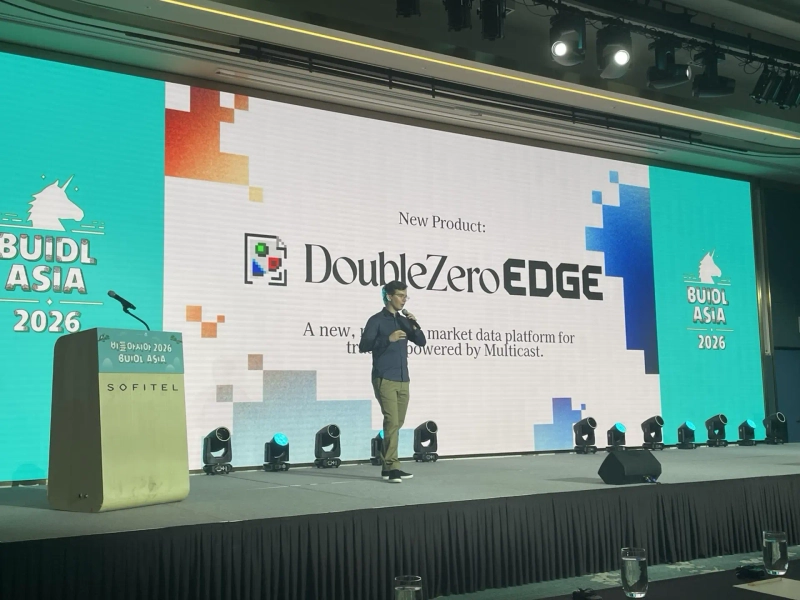
Austin Federa, co-founder of DoubleZero, made the remarks during a keynote on April 17 at Sofitel Ambassador Seoul on the second day of the BUIDL Asia 2026 conference, as he outlined structural limitations in blockchain financial infrastructure and called for innovation in physical networks.
Federa said the crypto industry's reliance on the public internet is a fundamental problem. The internet does not deliver data with consistent timing, and transmission speeds can suddenly slow or accelerate, he said.
He described that instability as jitter, or fluctuations in signal delivery speed, and said it is especially damaging in financial trading, where speed and consistency are critical.
The internet's non-deterministic architecture also increases delays, he added, because data can take different routes each time it is transmitted. As a result, identical data may arrive at different times.
That is why major technology companies such as Google and Meta, along with traditional financial institutions, operate their own dedicated networks, according to Federa. Blockchain will need the same approach to achieve institutional-grade performance, he said.
DoubleZero is a high-performance fiber-optic network built to address that issue. More than 17 independent partners jointly operate the physical infrastructure, a structure the company says gives the network decentralization and reliability unlike conventional private lines.
Federa identified multicast as the core technology. On the conventional internet, data must be sent repeatedly to each user, while multicast allows multiple recipients to receive the same data simultaneously from a single transmission, he said.
Using that technology reduced bandwidth consumption in Solana data propagation by 99.96%, he said. Beyond efficiency, it also reduces information asymmetry by allowing all participants to receive data at the same time.
Federa said fairness in data delivery is a central value proposition. In existing blockchain networks, some nodes can receive data earlier than others and gain a trading advantage. Multicast can improve fairness by delivering the same data simultaneously, he said.
At the event, he also introduced DoubleZero Edge, a real-time market data platform. The platform uses multicast to transmit block data generated by validators and provide it to market participants in real time.
Federa described DoubleZero Edge as a blockchain-based permissionless data-feed system. Users can subscribe immediately by paying a smart contract in USDC, without creating an account or going through authentication, he said.
More than half of Solana validators are now participating in the platform, according to Federa. The system is also building a new incentive model that shares revenue with data providers and developers.
DoubleZero will serve as infrastructure that helps blockchains operate at speeds closer to their theoretical performance, Federa said.

Minseung Kang
minriver@bloomingbit.ioBlockchain journalist | Writer of Trade Now & Altcoin Now, must-read content for investors.