Ethereum Foundation Says ‘Never-Stopping Chain’ Remains Core Design Principle, Targets Sub-Minute Finality
Summary
- The Ethereum Foundation said Ethereum has maintained a dynamic availability structure that has kept block production running without interruption for the past 10 years.
- The Ethereum Foundation said it is studying a structure that separates block production from finality to cut finality speed from about 15 minutes currently to under 1 minute.
- Ethereum said it aims to propose a restructuring plan between 2029 and 2030 while ensuring security and finality through economic mechanisms such as slashing and inactivity leak.
Forecast Trend Report by Period


“Ethereum was designed to keep producing blocks even if participation drops. The next challenge is to preserve that feature while reducing transaction finality to less than one minute.”
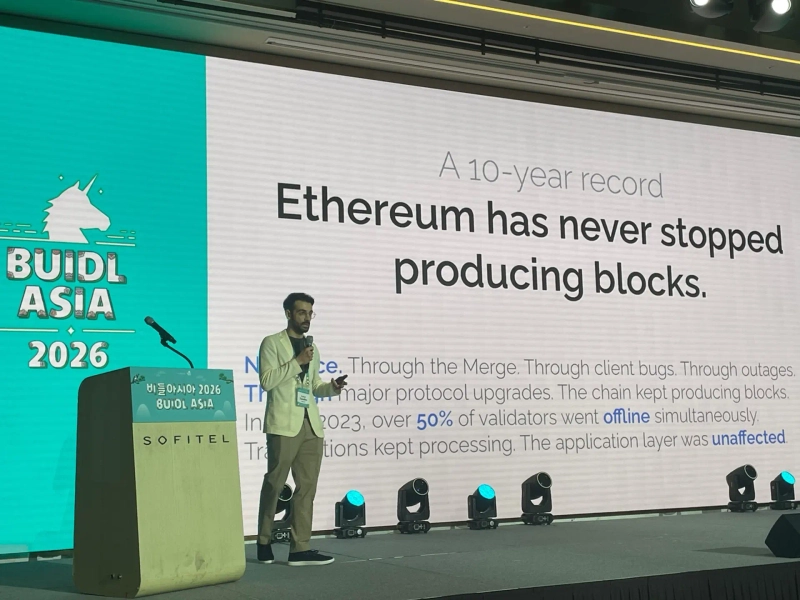
Luca Zanolini, a researcher at the Ethereum Foundation, outlined the core structure of Ethereum’s consensus design and the direction of future improvements on April 17 at the Sofitel Ambassador Seoul during the second day of BUIDL Asia 2026.
Zanolini emphasized that Ethereum has not stopped producing blocks even once over the past decade. He said the network was designed to keep running through network disruptions or the loss of some validators, a structural feature he described as dynamic availability.
Dynamic availability means block production can continue with the remaining active participants even if some validators go offline. In 2023, the network kept producing blocks without interruption even after client errors left more than half of all validators offline.
That design feature is separate from transaction finality. Zanolini said Ethereum faces a structural constraint that makes it difficult to optimize block production and finality at the same time. As a result, the network currently separates the block-building process from the process that grants finality.
Under Ethereum’s current structure, transactions take about 15 minutes to become fully finalized because the process requires agreement from the full validator set.
To address that, the Ethereum Foundation is studying a structure that would separate block production from finality. Rather than waiting for all validators, a small committee could handle block production and voting. If adopted, that model could reduce finality to less than one minute and potentially even faster.
Zanolini said the goal is to present a completed restructuring proposal to the community between 2029 and 2030. That overhaul would aim to bring finality below one minute.
Ethereum also relies on economic mechanisms to reinforce security. Validators that violate network rules are penalized through slashing, which cuts their staked assets. Zanolini said Ethereum’s finality is guaranteed not only by technical consensus but also by economic cost.
He also highlighted the system’s self-recovery design. The inactivity leak mechanism gradually reduces a validator’s stake if it fails to participate for a certain period. That removes the influence of participants that remain offline for an extended time and allows the remaining validators to restore finality.
“Ethereum is designed as a system that can sustain and recover itself without external intervention,” Zanolini said. “Finality is somewhat slow, but that was a tradeoff to secure both availability and security.” He added that future upgrades are intended to preserve those characteristics while sharply improving speed.

Minseung Kang
minriver@bloomingbit.ioBlockchain journalist | Writer of Trade Now & Altcoin Now, must-read content for investors.