Samsung Group Market Value Tops 1,800 Trillion Won as Non-Electronics Affiliates Surge
Forecast Trend Report by Period


Electro-Mechanics, SDI and Heavy Industries lead gains
Samsung group enters the 1,800 trillion won ($1.24 trillion) market-cap era
From AI and batteries to biotech
Five affiliates now belong to the 50 trillion won ($34.4 billion) club
Samsung Electro-Mechanics' market value jumps more than 15-fold in a decade
Biologics, SDI and Heavy Industries also expand more than sevenfold
Samsung Electronics rises on record earnings
Poised to drive further gains in group market value this year
Growth story extends beyond the semiconductor cycle
Samsung Group has driven the biggest shift in South Korea's stock market this year. In addition to Samsung Electronics and Samsung Biologics, three more affiliates — Samsung Electro-Mechanics, Samsung C&T and Samsung SDI — have newly joined the 50 trillion won ($34.4 billion) market-cap club. Six Samsung companies, including Samsung Life Insurance, are now among the market's top 15 by value. The old self-deprecating label for smaller, weaker-performing affiliates outside Samsung Electronics no longer fits.
Samsung Quadruples Market Value Over 10 Years
According to the Korea Listed Companies Association and the Korea Exchange, the combined market capitalization of Samsung Group companies stood at 1,802.82 trillion won ($1.24 trillion) as of April 24. That was more than four times the 394.79 trillion won ($272.2 billion) at the end of 2016.
Samsung Electronics, the group's flagship, led the increase. Its market capitalization reached 1,406.58 trillion won ($967.5 billion), including preferred shares, up by about 1,100 trillion won from 282.90 trillion won ($194.6 billion) in 2016.
Samsung Group's total market value could climb further this year as Samsung Electronics earnings move into a clear upswing. EpicAI, an AI-based investment information service, estimates consensus forecasts for Samsung Electronics at 624.53 trillion won ($429.6 billion) in revenue and 30.53 trillion won ($21.0 billion) in operating profit this year. That would represent jumps of 87.2% and 600.1%, respectively, from last year. Forecasts for next year call for revenue of 734.63 trillion won ($505.4 billion) and operating profit of 37.75 trillion won ($26.0 billion).
Samsung Electronics shares closed at 219,500 won on April 24, up 84% this year. Chae Hyun-sook, an analyst at Korea Investment & Securities, said the current memory upcycle appears durable because it is being driven by a structural shift in demand. With supply constraints colliding with rising AI demand, the stock's advance is likely to continue at least through year-end, she added.
Strength Beyond Electronics
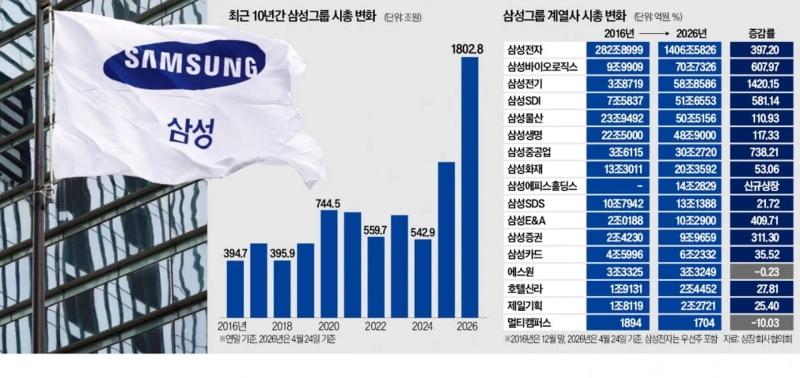
Samsung's affiliates beyond Electronics have also posted strong gains. Over the past decade, seven affiliates, including Samsung Electronics, have increased their market value by more than fourfold. Samsung Electro-Mechanics stood out the most, with its market capitalization surging 15.68 times to 58.86 trillion won ($40.5 billion). Samsung Biologics rose 7.39 times to 70.73 trillion won ($48.6 billion), Samsung SDI gained 7.18 times to 51.66 trillion won ($35.5 billion), Samsung Heavy Industries climbed 7.57 times to 30.27 trillion won ($20.8 billion), Samsung Securities advanced 4.02 times to 9.97 trillion won ($6.9 billion), and Samsung E&A increased 4.87 times to 10.29 trillion won ($7.1 billion). Samsung Life Insurance, with a market value of 48.9 trillion won ($33.6 billion), and Samsung C&T, at 50.52 trillion won ($34.7 billion), also more than doubled.
That rally is reshaping South Korea's market-cap rankings. Alongside Samsung Electronics, Samsung Biologics and Samsung C&T, which have long held top-tier positions, Samsung Electro-Mechanics now ranks 11th, Samsung SDI 13th and Samsung Life Insurance 15th by market value.
Samsung Electro-Mechanics shares closed at 788,000 won on April 24, up about 190% from January. The company, which ranked around 30th by market value in the early 2020s, has recently delivered standout gains. It has benefited from major technology companies' expanding investment in AI infrastructure. Demand for its flagship products — flip-chip ball grid array, or FC-BGA, and multilayer ceramic capacitors, or MLCC — is outstripping supply.
Samsung SDI shares have also surged. The move followed reports on April 20 that the company would supply Mercedes-Benz with several trillion won worth of high-nickel nickel-cobalt-manganese, or NCM, prismatic batteries. Expectations for a recovery in the electric-vehicle market during a period of high oil prices and for stronger demand for energy storage systems have added support.
Samsung Biologics, which at one point became the second-most valuable stock on the benchmark market, has cemented its position as the global leader in production capacity among contract development and manufacturing organizations, or CDMOs. Samsung C&T, while serving as a key pillar of the group's governance structure, also posted more than 3 trillion won ($2.1 billion) in operating profit last year, supported by its construction and fashion businesses. Samsung Heavy Industries rejoined the 10 trillion won ($6.9 billion) revenue club last year for the first time since 2014. Samsung SDS, whose shares had stagnated for years, recently formalized its shift toward becoming an AI full-stack company.
Bae Seong-su and Lee Seon-a, Hankyung reporters baebae@hankyung.com

Korea Economic Daily
hankyung@bloomingbit.ioThe Korea Economic Daily Global is a digital media where latest news on Korean companies, industries, and financial markets.