

Powell to Stay on Fed Board After Warsh Takes Over, Setting Up Unusual Power Struggle
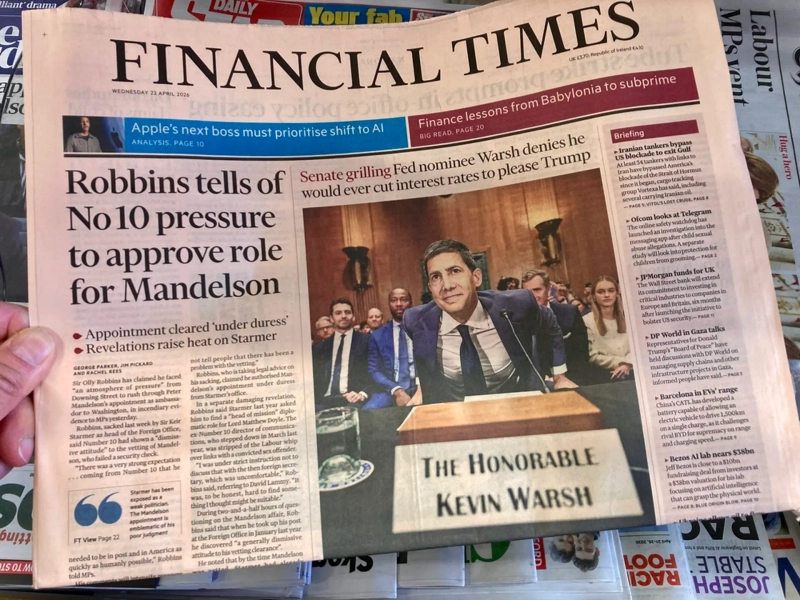
Federal Reserve Chair Jerome Powell said he plans to remain on the Fed’s Board of Governors after Kevin Warsh takes over next month, an unusual decision that would leave the incoming chair and his predecessor weighing interest-rate decisions side by side.
Warsh is set to begin presiding over Federal Open Market Committee meetings in June, putting him in the awkward position of discussing rate policy with former Chair Powell. The FOMC left its benchmark rate unchanged Wednesday, but several officials took a hawkish line by opposing language that hinted at possible future rate cuts. Markets interpreted that as a sign Treasury yields could move higher.
An Unusual Decision to Stay
Powell said at an April 29 press conference that “today is my last press conference” as chair and offered congratulations to Warsh. His comments came after Warsh’s nomination cleared the Senate Banking Committee. Powell’s term as chair ends on May 15, and Congress is set to hold a full Senate vote on Warsh before then.
Powell also said he intends to remain on the Board of Governors, citing concern about what he called “a series of illegal attacks” on the Fed. His term as a governor runs through January 2028. He said those attacks threaten the central bank’s ability to set monetary policy without regard to politics, and that he would step down when he judges the timing appropriate.
Fed chairs have traditionally left the central bank when their term as chair ends, even if they still had time remaining as a governor. Former Chairs Paul Volcker, Ben Bernanke and Janet Yellen all resigned from the board when their chair terms expired. Alan Greenspan’s terms as chair and governor ended at the same time. The last comparable case of a chair staying on despite conflict with an administration dates back to Marriner Eccles in the early 1950s.
US Treasury Secretary Scott Bessent criticized Powell’s decision in a post on X, saying a self-described institutionalist had acted in direct violation of tradition. President Donald Trump mocked Powell, saying he was staying because he “couldn’t find another job.”
A Hawkish Trio Emerges
The FOMC voted to keep the policy rate at 3.5% to 3.75%. After cutting rates three times last year, the Fed has now left policy unchanged at three straight meetings this year. The hold reflects mounting inflation concerns tied to a war with Iran, particularly through oil prices.
Still, four of the FOMC’s 12 members dissented. It was the first time since 1992 that four officials had opposed the outcome at a single meeting.
Governor Stephen Miran, appointed by Trump last year, pushed for a quarter-point rate cut. Neil Kashkari, Beth Hammack and Lorie Logan objected to language in the statement saying the Fed stood ready to adjust monetary policy to an appropriate level if risks emerged that could hinder progress toward its goals. In their view, that wording signaled an easing bias. With the effects of the Iran war still unfolding, they saw it as inappropriate to suggest the Fed remained inclined to cut rates.
Bob Michele, chief investment officer at JPMorgan Asset Management, told Bloomberg the emergence of the “hawkish trio” amounted to a message for Warsh. “They’re saying, ‘We may dissent. Be ready for it,’” he said.
Fed Independence Faces Its Biggest Test
The next chair will inherit a crowded agenda. The biggest question is how Warsh, elevated with Trump’s backing, responds to the president’s demands.
The Economist said a president’s persistent calls for lower rates, even as inflation has run above the Fed’s 2% target for five years, mean the central bank is facing its biggest crisis in 50 years. In the 1970s, former Chair Arthur Burns cut rates under pressure from then-President Richard Nixon, helping to fuel a surge in inflation. Volcker, appointed by President Jimmy Carter, later raised rates sharply to restore price stability. The reference to 50 years points to a renewed challenge to the Fed’s independence, a core pillar of market confidence in both the central bank and US Treasuries.
Even as chair, Warsh would command only one vote on the FOMC. The power of the job lies in persuading officials with different views and forging consensus. The question now is whether he can mend divisions inside the committee.
The Powell Era: Covid-19 and Central-Bank Independence
Jerome Powell will step down on May 15 after eight years as Federal Reserve chair.
Powell joined the Board of Governors in 2012 after being appointed by former President Barack Obama. He became chair in February 2018 during Trump’s first term and was later reappointed by former President Joe Biden.
Two themes define the Powell era: Covid-19 and central-bank independence. During Trump’s first term, the president repeatedly complained that Powell, despite being his own nominee, would not cut rates. Powell resisted and kept policy tight.
The defining crisis of his tenure was the supply-chain disruption and inflation surge unleashed by the pandemic. As the crisis intensified in March 2020, the Fed quickly cut rates to near zero and expanded liquidity support.
But when inflation began rising in 2021, the Fed judged it to be “transitory.” That mistake delayed the start of rate hikes. By June 2022, US inflation had climbed to 9.1%, while the policy rate stood at just 1.5% to 1.75%, even though tightening had begun in March that year.
The Fed then raised rates step by step to 5.25% to 5.5% by 2024. Even so, Powell continued to face criticism that he had moved too late. His supporters, however, point to unemployment staying below 4% during his tenure and to gains in real wages for lower-paid workers.
In Trump’s second term, Powell also came to be seen as a fighter for central-bank independence. That image hardened after the Justice Department opened an investigation into him over cost overruns in the renovation of Fed buildings. In January, he also released a video signaling his determination to resist.
Lee Sang-eun, Washington correspondent, Hankyung.com, selee@hankyung.com

Korea Economic Daily
hankyung@bloomingbit.ioThe Korea Economic Daily Global is a digital media where latest news on Korean companies, industries, and financial markets.