Hashed Says AI-Coded Startups Are Rewriting the Founder Playbook as Nitro Seoul 2026 Ends
Summary
- Hashed said it rebranded its accelerator as 'Nitro by Hashed' and announced plans to expand the program.
- Lee Jae-hong said AI-based queries, a structure in which brands are embedded in AI-generated answers, April revenue of 1 billion won ($724,000) and the addition of about 100 clients were key milestones.
- Park Jung-hwan said character chat services, 10,000 monthly active users and 300 million won ($217,000) in monthly revenue show how performance improvements translate directly into sales.
Forecast Trend Report by Period


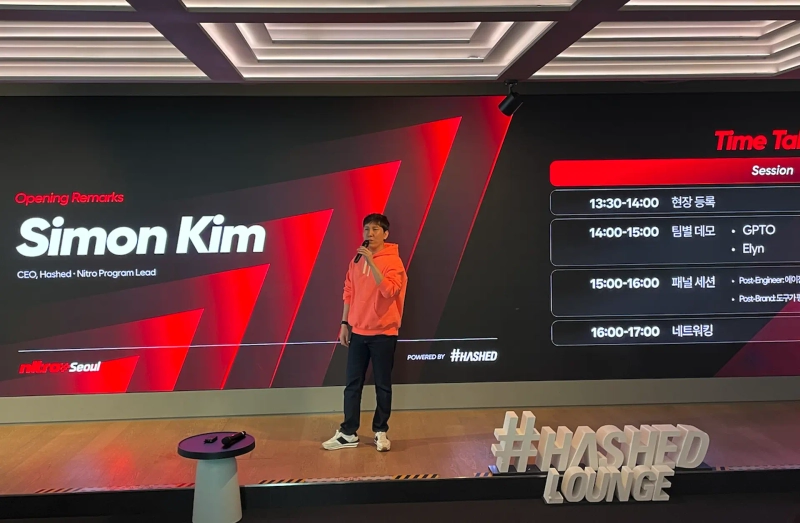
Hashed, the global Web3 venture capital firm, held Game Day for Nitro Seoul 2026, its AI-native founder accelerator, on April 30 at Hashed Lounge in Seoul's Gangnam district.
The event showcased the results of teams selected over the past eight weeks based solely on their products and metrics. Alongside the event, Hashed rebranded its existing Hashed Vibe Labs as Nitro by Hashed and announced plans to expand the program.
In welcoming remarks, Hashed Chief Executive Officer Kim Seo-jun said the spread of natural language-based "vibe coding" is changing how startups are built. Solo founders are increasingly using AI agents to handle both development and operations.
The key competitive advantage ahead will be deciding what to build rather than how to build it, Kim said. He cited his experience building services using blockchain data as an example of the speed of technological change.
Four teams that took the stage disclosed the services they built during the eight-week program and their main performance metrics.
Lee Jae-hong, chief executive of GPTO, which develops an AI optimization engine, said AI-based queries will surpass search next year. Creating a structure in which brands are embedded in AI-generated answers will become the new marketing standard, he added. Lee said the company has secured about 100 clients through its solution and posted April revenue of 1 billion won ($724,000).
Park Jung-hwan, chief executive of Elyn, an AI character-based role-playing platform, said character chat services are structured so improvements in AI model performance translate directly into revenue. That direct link between performance gains and business metrics is a defining feature of the business. Elyn currently has 10,000 monthly active users and monthly revenue of 300 million won ($217,000).
Ahn Jung-woo, chief executive of KYRO, a running platform, said the company drove engagement by gamifying running. More than 80,000 users signed up within three months of launch, and the service also spread quickly in Japan.
Lim Wan-seop, chief executive of GGUI, which develops generative user interface technology, said agents need to be able to generate interfaces directly based on user context. That would help overcome the limitations of existing text-based interfaces.
A panel session that followed focused on how developers' roles and brand strategy are changing in an AI environment.
Lim said designing overall system architecture is becoming more important than writing code directly. Park said productivity is constrained the moment people assume AI cannot do something, adding that it is important to use the technology without imposing limits.
Ahn said that as AI-generated content becomes more widespread, a founder's narrative and authenticity matter more. Lee added that lean teams have an advantage because they can respond quickly to customer demands.
After the program ends, Hashed plans to begin accepting applications on May 11 for Nitro NS (Network School) 2026, a follow-up program scheduled to start in August.

Minseung Kang
minriver@bloomingbit.ioBlockchain journalist | Writer of Trade Now & Altcoin Now, must-read content for investors.