Russia-Ukraine War Enters 51st Month, Closing In on World War I and Extending Korea's Economic Pain
Summary
- The Russia-Ukraine war has entered its 51st month and is on track to be recorded as a protracted war that outlasts World War I.
- The Russia-Ukraine war has dealt South Korea an indirect blow through higher energy and raw-material prices, while also imposing longer-term costs through weaker exports to Russia and corporate activity.
- The World Bank and the IMF said the overlap of the Russia-Ukraine war and the Middle East conflict could trigger a surge in energy prices and intensify pressure from high inflation and weak growth.
Forecast Trend Report by Period


Russia-Ukraine war nears World War I in duration, approaching the 10 longest interstate wars
Russia-Ukraine war enters its 51st month
One more month would make it longer than World War I
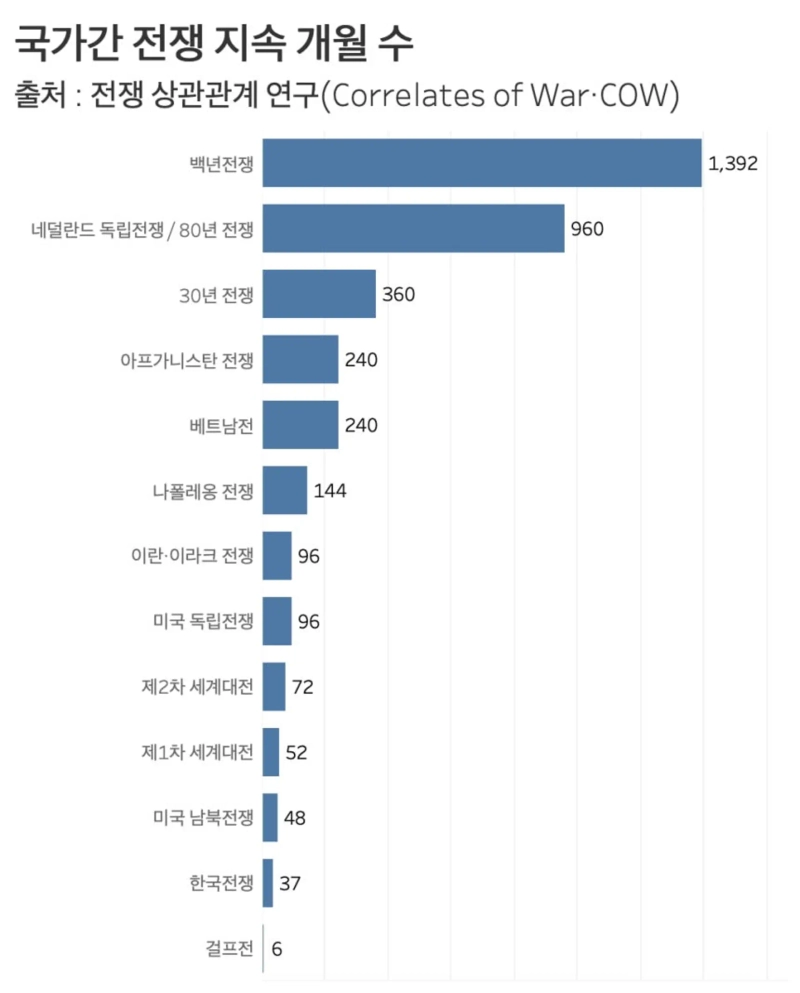
The Russia-Ukraine war, which set off disruptions in energy prices as well as food and raw-material supplies, is nearing the point at which it would outlast World War I.
An analysis by Hankyung.com on May 1, based on data compiled from the Correlates of War project and other sources, found that the conflict has now stretched into its 51st month.
Correlates of War, or COW, is an international conflict research project launched at the University of Michigan in 1963. It classifies wars and conflicts by type dating back to 1816 and tracks major indicators including duration, participating countries and deaths. The database is widely used in international relations research.
The war, which began on Feb. 24, 2022, has entered its 51st month. If it continues for one more month, it will exceed World War I's 52-month duration.
That would place the Russia-Ukraine war among the 10 longest wars in world history by duration. Among conflicts since the 20th century, it would rank as the fifth longest.
For South Korea's economy, the war has been less a direct trade shock than the starting point for an indirect hit through higher energy and raw-material costs. The Bank of Korea cited rising global commodity prices caused by the war as a key factor behind consumer inflation of 5.1% in 2022, the highest since 1998.
More recently, the conflict's impact on South Korea has shifted from the immediate shock to prices and the trade balance seen in 2022 to longer-term costs. Those include a shrinking Russian market, weaker corporate activity due to sanctions on Russia and continued uncertainty over energy prices. South Korea's exports to Russia fell to $4.53 billion in 2024 from $10 billion in 2021, and declined 19.8% year on year in the first half of 2025.
According to the Korea International Trade Association, the number of South Korean companies exporting to Russia exceeded 4,000 in 2021. By 2025, that figure had fallen to about 1,800.
The recent war in the Middle East has added to inflation risks. Even before the fallout from the Russia-Ukraine war had fully faded, a new energy shock from the Middle East was compounding concerns about a renewed rise in inflation.
The World Bank recently warned that the Middle East conflict could trigger the biggest surge in energy prices in four years since the Russia-Ukraine war began. The International Monetary Fund said a prolonged war could increase pressure from high inflation and weak growth at the same time. For South Korea, which depends heavily on imported energy, swings in oil and LNG prices threaten to push up consumer prices and industrial costs again.
Shin Hyun-bo, Hankyung.com reporter greaterfool@hankyung.com

Korea Economic Daily
hankyung@bloomingbit.ioThe Korea Economic Daily Global is a digital media where latest news on Korean companies, industries, and financial markets.