OECD Flags Severe Supply-Chain Risks for Samsung Electronics, LG Energy Solution
Forecast Trend Report by Period


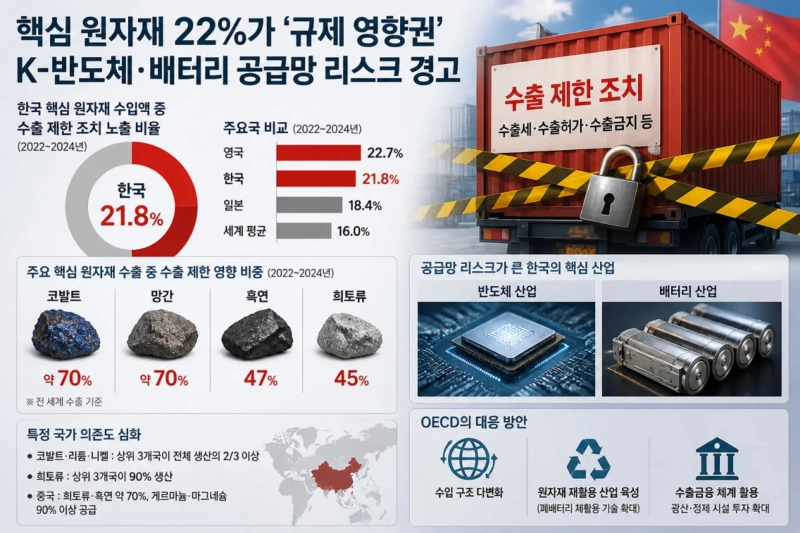
South Korea’s leading chip and battery makers, including Samsung Electronics Co., SK Hynix Inc., LG Energy Solution Ltd., Samsung SDI Co. and SK On Co., face elevated supply-chain risks as export restrictions tighten in key raw materials markets, an OECD report showed.
About 21.8% of South Korea’s imports of critical raw materials from 2022 through 2024 were exposed to export curbs, according to the Organization for Economic Cooperation and Development’s “Export Restrictions on Industrial Raw Materials 2026” report published on May 5. The measure tracks the share of imports among 65 OECD-designated critical raw materials that came from countries imposing export taxes, licensing requirements or export bans.
South Korea’s exposure exceeded the global average of 16.0% and Japan’s 18.4% over the same period. Among OECD members, it ranked near the top with the U.K. at 22.7%.
A large share of critical minerals is already subject to restricted trade. From 2022 to 2024, about 70% of global cobalt and manganese exports were affected by export restrictions. The share was 47% for graphite and 45% for rare earths.
The trend reflects the concentration of production in a small number of countries, including China. The top three producers account for more than two-thirds of global output of cobalt, lithium and nickel, while their share in rare earths reaches 90%.
China supplies about 70% of rare earths and graphite and more than 90% of germanium and magnesium, effectively dominating the market for critical raw materials.
The structure leaves South Korea’s battery, semiconductor and electronics industries vulnerable because they rely heavily on imported raw materials. Further tightening of export controls by major producing countries would hit those industries directly.
The OECD recommended diversifying import sources away from heavy dependence on specific countries and building up raw-material recycling industries to ease supply-chain instability. Expanding technologies that recover cobalt, lithium and nickel from used batteries would help reduce reliance on primary materials, it said.
Over the medium to long term, the OECD also called for increased investment in mines and refining facilities for critical raw materials, using government export-finance systems to help build more stable supply chains.
Kim Ik-hwan, Hankyung.com reporter, lovepen@hankyung.com

Korea Economic Daily
hankyung@bloomingbit.ioThe Korea Economic Daily Global is a digital media where latest news on Korean companies, industries, and financial markets.