Steelmakers, Shipbuilders and Petrochemical Firms Find New Growth in AI Power Boom
Summary
- Surging demand for artificial-intelligence data centers is giving traditional smokestack industries such as steel, petrochemicals and shipbuilding new growth opportunities by putting idle land and power infrastructure to use.
- HD Hyundai Heavy Industries, Hanwha Engine, STX Engine, HD Hyundai Construction Equipment and Samsung Heavy Industries are expanding businesses tied to engines for data centers and floating data centers, with related order backlogs and plant utilization rising sharply.
- The three major power-equipment makers — HD Hyundai Electric, Hyosung Heavy Industries and LS Electric — have posted record revenue, operating profit and order backlogs, while shares of HD Hyundai Group and OCI Holdings have surged as AI-driven investment in power infrastructure accelerates.
Forecast Trend Report by Period


Leveraging power infrastructure and plant expertise
Supplying stable electricity to data centers
HD Hyundai Heavy signs US ship-engine deal
Samsung Heavy advances floating data center plan
HD Hyundai Construction Equipment to build ultra-large engine plant in Gunsan
Dongkuk Steel, Hyundai Steel weigh leasing idle land
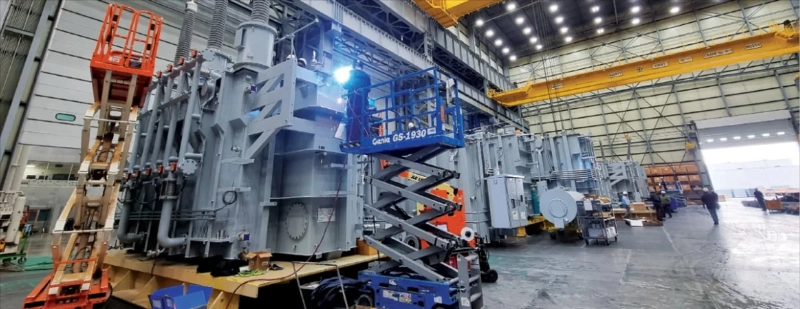
Exploding demand for artificial-intelligence data centers is opening a new growth avenue for South Korea’s traditional smokestack industries, including steel, petrochemicals and shipbuilding. Idle land, power infrastructure and plant-operating expertise at legacy manufacturers are gaining fresh attention as valuable assets in the AI era. AI data centers need uninterrupted electricity around the clock because even a brief outage can wipe data stored on servers. Against that backdrop, order backlogs at South Korea’s three largest power-equipment makers have climbed to record highs.
A new opening for smokestack industries
As AI drives up electricity demand, ship engines are emerging as an alternative power source for data centers, industry officials said on May 4. More companies are weighing engines because gas turbines, long used to power data centers, have become more expensive and are subject to long delivery delays. Large gas-turbine makers are quoting deliveries only from the second half of 2029, while engine manufacturers can supply products about a year earlier, the officials said.
HD Hyundai Heavy Industries signed a 627.1 billion won ($453 million) contract on April 22 to supply ship engines to a US AI data center. A company official said inquiries linked to AI have surged, leaving the company with 2 1/2 years of order backlog for power-generation engines. Its domestic facilities, with annual production capacity of 5 million horsepower, are running at full capacity.
Hanwha Engine is also seeking to enter the market for medium-speed engines used in data centers after expanding its facilities. Production at the new capacity is set to begin in 2027. The company already makes medium-speed engines for ships. Market participants say a broader push by Hanwha Group into AI data-center power generation could create synergies because Hanwha Energy has extensive experience as an energy provider in the US.
STX Engine is also being mentioned as a candidate for the data-center engine business. Samsung Heavy Industries has proposed another model: floating data centers. The concept calls for building data centers on rivers or at sea rather than on land to maximize site availability, power supply and cooling efficiency. The approach points to a new industrial model combining energy, infrastructure and technology.
Idle land emerges as another option
HD Hyundai Construction Equipment, which makes engines for excavators, industrial vehicles and ships, is building a new engine plant in Gunsan, North Jeolla Province, and is expected to start producing ultra-large engines for AI data centers next year. The move is aimed at broadening its business portfolio as its partners Mesa and IRAQ focus on building data centers in the US.
AI data centers can shut down or suffer data damage if voltage shifts even slightly during disruptions in the power grid. That is why ship engines are drawing attention as emergency generators or distributed power sources.
Steelmakers and chemical companies are also trying to capitalize on the AI boom. Their strategy is to attract data centers by using spare power infrastructure tied to energy-intensive industries. Dongkuk Steel is reviewing a plan to build data centers on idle land at its steelworks in Incheon and Dangjin, South Chungcheong Province, and lease them out. The company plans to draw electricity from substations and other power infrastructure already built near the mills. It has been keeping utilization at its Incheon steel plant at about 50% as global rebar demand weakens. Hyundai Steel, which shut its Incheon rebar steel plant and small-section rolling mill in January, is also discussing ways to use idle land for data centers.
HD Hyundai Group market value tops 200 trillion won
Chemical and energy companies are moving quickly as well. OCI Holdings has announced plans to enter a Texas data-center project based on its solar-materials value chain. OCI Energy has already presented a mid- to long-term roadmap aimed at becoming a leading US energy company by securing 15 gigawatts of development assets and more than 2 gigawatts of operating assets by 2030.
SGC Energy is targeting the market with a power-supply model built around its combined heat and power plants in areas including Gunsan. The company said it will focus its companywide capabilities on advancing the AI data-center business as a new growth pillar.
The trend may go beyond simple business diversification and reshape the broader industrial landscape, industry officials said.
Investors are also assigning higher valuations to related companies. HD Hyundai Group’s market capitalization topped 200 trillion won ($145 billion) for the first time on April 27. Brokerage firms attributed the move to HD Hyundai Heavy Industries’ contract to supply ship engines to a US AI data center. On April 22, the day the company disclosed the order, HD Hyundai Heavy Industries shares jumped 11.3% to 641,000 won from 576,000 won. OCI Holdings closed at 368,000 won on April 30, up more than 200% this year.
AI sparks golden age for Korean power equipment as first-quarter sales hit records
Capacity expansion gathers pace as orders pour in
Surging demand for AI data centers is also lifting earnings at South Korea’s three major power-equipment makers: HD Hyundai Electric, Hyosung Heavy Industries and LS Electric. After posting record results last year, all three extended that momentum into the first quarter with double-digit growth. Transformers and switchgear made by the trio have become scarce enough that the companies can choose higher-value orders.
HD Hyundai Electric posted first-quarter revenue of 1.0365 trillion won ($752 million), up 2.1% from a year earlier. Operating profit rose 18.4% to 258.3 billion won ($187 million). Growth was especially strong in the power-equipment division. Revenue from that business climbed 21.6%, helped by stronger sales of power transformers in North America. Revenue from rotating machinery also rose 10.8% on strong demand for ship-related products. North America sales increased 26.6% from a year earlier, leading the company’s overall growth.
HD Hyundai Electric booked a record $1.797 billion of new orders in the first quarter, reaching 42.6% of its full-year target of $4.222 billion in just three months. The company is a leading maker of ultra-high-voltage transformers and was the first South Korean power-equipment manufacturer to enter the US market. It said momentum in North American demand remains strong and it is continuing a selective, profitability-focused order strategy.
Hyosung Heavy Industries, the largest of the three by industry standing, posted first-quarter revenue of 1.3582 trillion won ($985 million) and operating profit of 152.3 billion won ($110 million). That was up 26.2% and 48.7%, respectively, from a year earlier. New orders reached a quarterly record 4.1745 trillion won ($3.03 billion) in the first quarter. Its order backlog now stands at 15.1 trillion won ($10.9 billion).
LS Electric reported record first-quarter revenue of 1.3766 trillion won ($998 million) and operating profit of 126.6 billion won ($91.7 million). The company specializes in medium- and low-voltage transformers and switchgear used inside data centers. In the first quarter, it signed a switchgear supply contract worth about 170 billion won ($123 million) with Amazon Web Services. LS Electric’s order backlog stands at 5.6425 trillion won ($4.09 billion). Combined backlogs for the three companies exceed 32.35 trillion won ($23.4 billion).
With orders surging, power-equipment makers are expanding capacity at home and abroad. HD Hyundai Electric is building a second plant to produce additional ultra-high-voltage transformers at its North American manufacturing site in Montgomery, Alabama, with a $200 million investment. Hyosung Heavy Industries also plans to expand its Memphis plant, which makes ultra-high-voltage transformers, by 2028 and lift production capacity by more than 50%. LS Electric is expanding its Utah plant, which produces switchgear in the US.
Shin Jeong-eun, Hankyung.com reporter, newyearis@hankyung.com

Korea Economic Daily
hankyung@bloomingbit.ioThe Korea Economic Daily Global is a digital media where latest news on Korean companies, industries, and financial markets.