Wall Street Strategist Says War’s Real Shock Will Hit in 6 to 12 Months, Favors AI, Power and Commodities
Summary
- Nicholas Bohnsack said a second wave of inflation is increasingly likely toward year-end because of the Middle East war and disruption in the Strait of Hormuz.
- He said US stocks still have room to rise despite higher oil prices, with S&P 500 EPS projected to rise 20%.
- He emphasized strategic portfolio diversification into AI stocks, power shares, commodities, gold and agricultural products.
Forecast Trend Report by Period


Nicholas Bohnsack, co-founder of Strategas
Hormuz disruption could lift energy costs
US earnings growth leaves room for stocks to climb
Investors should add AI, power shares and commodities
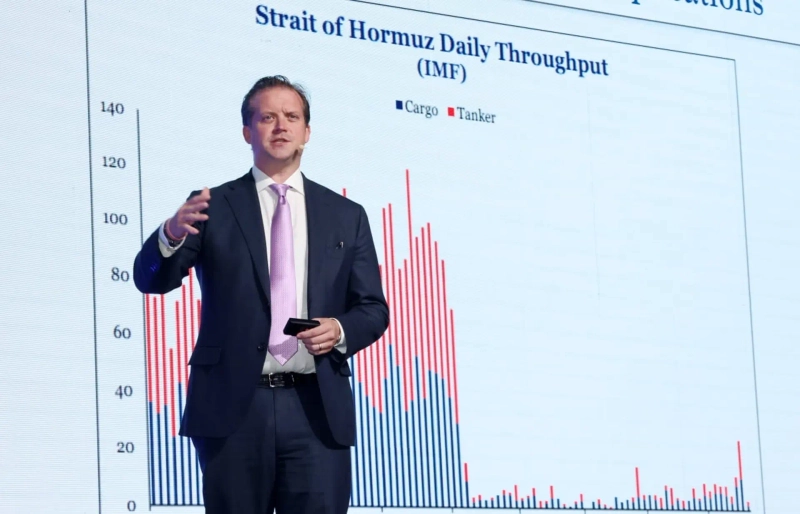
“The real risk from war is not the fighting itself, but the shock to energy supply chains that could emerge over the next six to 12 months. A second wave of inflation could hit the real economy late this year or next year.”
Nicholas Bohnsack, co-founder and president of Strategas, delivered that warning on May 13 at Korea Investment Week 2026 at the Shilla Hotel in Seoul’s Jangchung-dong district. He said inflation could intensify toward year-end as the war in the Middle East sharply reduces traffic through the Strait of Hormuz. Strategas is a Wall Street investment strategy firm that provides macroeconomic, policy and equity-market research to US institutional investors.
‘US stocks have further to climb’
Higher oil prices are driving the inflation risk. Bohnsack said the floor for crude prices, which had averaged about $65 a barrel, has recently risen to $80. That would lift annual US energy spending by 18% to 20%.
US inflation surged above 9% after the pandemic and has since fallen to the mid-2% range. But underlying price pressures are building, he said, raising the chances of a second inflation wave late this year or next year.
He pushed back on calls that US stocks have already peaked, citing still-solid earnings growth at American companies. Bohnsack said S&P 500 companies’ earnings per share are projected to rise about 20% this year from a year earlier. He also forecast improving profitability not only for technology companies, including the Magnificent Seven that have led the market rally, but for energy companies as well.

A polyfragile market calls for diversification
Bohnsack described the global economy as a “polyfragility” market. Geopolitics, supply chains, interest rates and debt are increasingly intertwined, amplifying their effects on markets. That makes it harder to rely solely on the traditional 60/40 stock-bond strategy, he said, and strengthens the case for broader portfolio diversification.
For navigating volatile markets, he highlighted “cash-flow aristocrats” with stable free cash flow, along with AI shares, power stocks and assets tied to deglobalization. He especially stressed investment in the power industry, which he called the biggest bottleneck of the AI era.
He also advised investors to buy commodities as a response to deglobalization. Portfolios should be strategically diversified across a broad range of commodities, including gold, which he described as a key hedge against geopolitical risk, and agricultural products.
Yang Ji-yoon, Korea Economic Daily reporter yang@hankyung.com

Korea Economic Daily
hankyung@bloomingbit.ioThe Korea Economic Daily Global is a digital media where latest news on Korean companies, industries, and financial markets.