Lee Says Kim's AI Dividend Proposal Was About Extra Tax Revenue, Not Corporate Profits
Forecast Trend Report by Period


President rebuts opposition criticism directly on social media
Market focus grows as the debate intensifies
Political attacks continue, including from Han Dong-hoon
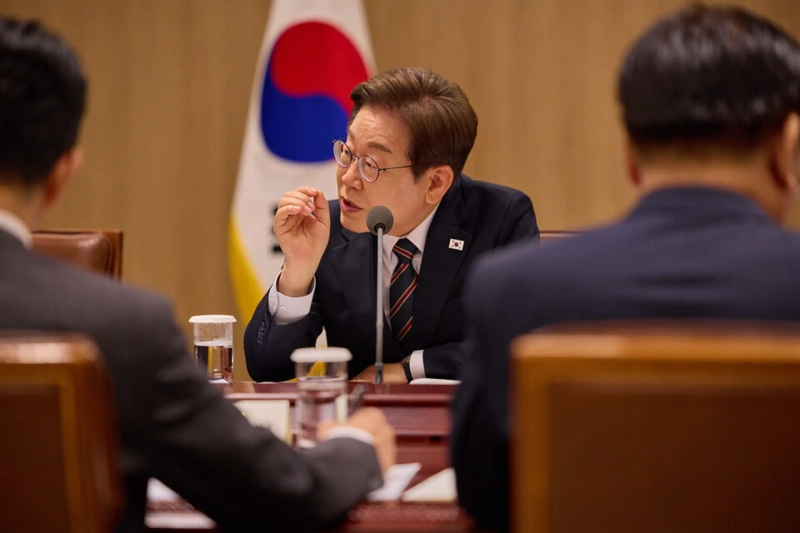
President Lee Jae-myung said Kim Yong-beom, the presidential policy chief, was referring to a plan to review distributing additional state tax revenue generated from the artificial intelligence sector to the public when he floated the idea of an AI dividend for all citizens.
Lee was defending Kim's position that the source of the payout would be tax revenue the government collects from companies, not corporate profits themselves. The presidential office had previously described the matter as Kim's personal view. Lee's direct intervention has now pushed it into a broader policy debate.
On May 13, Lee shared on X, formerly Twitter, a news report on criticism from People Power Party lawmaker Park Soo-young, who had characterized Kim's proposal as a system for distributing corporate profits. "Fake news aimed at manipulating public opinion is unacceptable," Lee wrote.
Lee said some media outlets had edited Kim's remarks and spread what he called "malicious fake news" claiming Kim had proposed distributing companies' excess profits to the public. Kim had already denied that interpretation and explained that he was discussing distributing extra tax revenue, Lee wrote. "Why are they still reporting this in such a malicious way?" he wrote. "Political criticism or attacks that are not based on facts end up damaging democracy."
Still, in a Facebook post uploaded around midnight on May 11, Kim repeatedly used terms including "excess profit" and "surplus earnings" as well as "extra tax revenue." That led the opposition and some market participants to interpret the proposal as a call to use the huge profits of semiconductor companies. Kim wrote that using part of excess profits to support social stability for the current generation and ease transition costs "is not simple redistribution but part of the cost of maintaining the system." He also wrote that "the gains of the AI infrastructure era are not the result of specific companies alone" and that "part of those gains should be structurally returned to all citizens."
Investors were especially sensitive because the debate comes as arguments continue over Samsung Electronics Co.'s bonus payouts after record earnings. As the controversy widened, Kim told some media outlets that the proposal was about tax revenue, not corporate profits. The presidential office also said it was a personal opinion unrelated to any internal discussion or policy review.
Han Dong-hoon, former leader of the People Power Party, said Kim's argument was premised on the idea that "excess profits" exist. He said the concept itself was dangerous because it raises the question of what standard would be used to distinguish normal profits from excess profits. Lee Byung-tae, an honorary professor at KAIST and vice chairman of the presidential Regulatory Rationalization Committee, said it would directly conflict with the basic principles of shareholder capitalism for the state to push corporate governance improvements in the name of protecting shareholder rights while also trying to determine the use of corporate profits for policy purposes.
Han Jae-young, Hankyung.com reporter, jyhan@hankyung.com

Korea Economic Daily
hankyung@bloomingbit.ioThe Korea Economic Daily Global is a digital media where latest news on Korean companies, industries, and financial markets.