Will Trump-Xi Ease Chip Curbs? Beijing Summit Puts Korean Stocks in Focus
Summary
- Conflicts over AI, semiconductors and rare earths are set to be key agenda items at the U.S.-China summit.
- If China secures looser semiconductor export restrictions, that would be a negative scenario for South Korean memory-chip makers.
- If the talks end in little more than a freeze, South Korean companies including Samsung Electronics and SK Hynix could see spillover gains.
Forecast Trend Report by Period


"A bigger concession from China would be negative for Korean companies"
"Even a freeze could benefit Samsung, SK Hynix; a deal will be hard to reach"
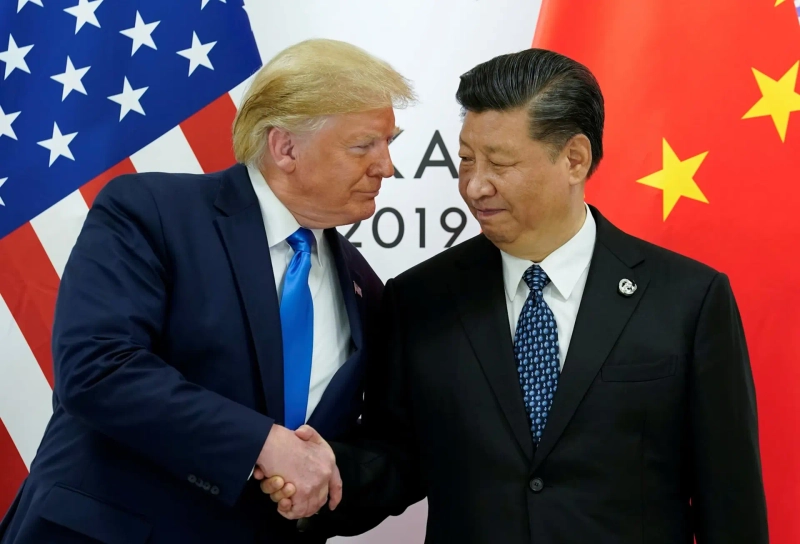
With a summit between U.S. President Donald Trump and Chinese President Xi Jinping a day away, attention is turning to how the meeting could affect South Korean stocks. Rare earths and semiconductors are set to feature in behind-the-scenes negotiations, putting Korean memory-chip makers and rare-earth-related companies on alert.
On South Korea's stock market on May 13, a day before the U.S.-China summit, Samsung Electronics and SK Hynix rose 1.79% and 7.68%, respectively. SK Hynix climbed as high as 1.99 million won during the session, putting the stock within reach of the 2 million won mark.
Union Materials, a South Korean producer of rare-earth substitutes, surged 8.5%. The company mainly produces ferrite magnets, which are viewed as an alternative to rare earths. Union and Dongkuk R&S, also considered rare-earth theme stocks, rose 3.64% and 1.8%, respectively.
Technology issues including artificial intelligence and semiconductors are poised to be among the main agenda items at the Trump-Xi summit in Beijing on May 14, according to the financial investment industry.
The Trump administration has treated AI and semiconductors as central to its strategic rivalry with China, responding with expanded domestic investment and tighter export controls. Beijing has answered with steps including restrictions on rare-earth exports to the U.S., keeping Korean chipmakers and rare-earth-related stocks in focus.
Any easing in semiconductor tensions between Washington and Beijing at this summit could ripple through South Korea's industry and stock market.
Cho Yeon-joo, an analyst at NH Investment & Securities, said China demonstrated overwhelming leverage at last year's summit, reinforcing the view that Beijing is in a position to extract bigger concessions by wielding the rare-earth card, including looser semiconductor export restrictions. That would be a negative scenario for Korean memory-chip makers. If the talks end only in a freeze, however, Korean companies could still benefit.
Trump said in December 2025 that he would allow Nvidia's H200 chips to be sold in China, but exports have yet to begin. Nvidia said in February 2026 that shipments of the H200 into China were still not permitted.
U.S. Commerce Secretary Howard Lutnick told a recent congressional hearing that Chinese companies still have not been able to buy the chips. He also argued that the Chinese government is not allowing those purchases as it seeks to foster domestic industry.
The inclusion of Nvidia Chief Executive Officer Jensen Huang in the economic delegation has fueled speculation that restrictions on AI semiconductors could be eased. Carlos Gutierrez, a former U.S. commerce secretary, told CNBC that an agreement on export controls remained a long way off, but Huang's inclusion in the delegation was itself a positive sign.
Rare earths, another critical mineral issue, are also set to be discussed.
China said in October 2025 that it would introduce new export controls on rare earths and on products containing even small amounts of Chinese rare earths. Xi later agreed in talks with Trump to delay the measure for one year.
Even so, it remains unclear whether the two sides will agree at this summit to extend that delay as the expiration approaches. Existing export restrictions introduced in April 2025 also remain in place.
Rare earths are essential materials for electronics, semiconductor equipment, electric vehicles and military goods. China effectively dominates refining, giving it control over a major bottleneck for Western manufacturers.
The New York Times reported that after China effectively halted most rare-earth exports in April 2025, prices for some rare earths surged by as much as 100-fold.
Noh Jeong-dong, Hankyung.com reporter dong2@hankyung.com

Korea Economic Daily
hankyung@bloomingbit.ioThe Korea Economic Daily Global is a digital media where latest news on Korean companies, industries, and financial markets.