Kospi Market Cap Tops 6,135 Trillion Won, Surpassing Seoul-Area Home Values on Chip Rally
Summary
- The Kospi’s market capitalization was estimated at about 6,135 trillion won, surpassing the Seoul metropolitan area’s housing market capitalization of 4,914 trillion won.
- Led by semiconductor shares, the Kospi’s market capitalization increased by about 4,171 trillion won in roughly one year and five months, for a gain of 212.5%.
- The total market capitalization of South Korea’s stock market reached 7,204 trillion won, close to the nationwide housing market capitalization of 7,158 trillion won, highlighting shifting liquidity flows.
Forecast Trend Report by Period


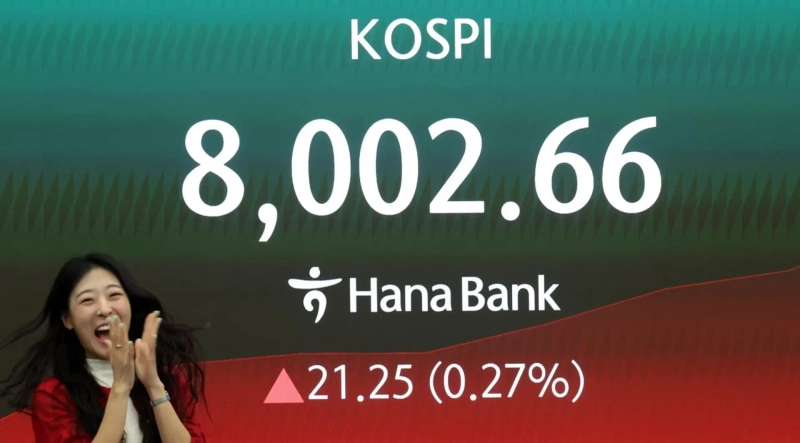
A semiconductor-driven rally in South Korean equities has likely pushed the Kospi’s market capitalization above the value of homes in the greater Seoul area.
Data from the KRX Data Marketplace showed the Kospi’s market capitalization at about 6,135 trillion won as of the May 15 close. That was roughly 1,220 trillion won more than the 4,914 trillion won market value of housing in the Seoul metropolitan area at the end of 2024, based on provisional figures published by the Bank of Korea and the National Data Portal. The Kospi figure was 24.8% higher.
Housing market value is not tracked in real time like the stock market. The latest comparable housing figure is a provisional estimate for the end of 2024. Even so, given the recent rise in home prices and the much steeper gain in equities, the Kospi has likely overtaken the capital region’s housing market in value.
The Korea Real Estate Board’s nationwide housing price trend survey showed the composite home sale price index rose 1.9% nationwide last month from December 2024, while the increase was 4.4% in the greater Seoul area. Seoul posted a 9.8% gain over the same period, but that rise was still modest compared with the jump in the Kospi’s market capitalization.
The Kospi’s market value has swelled rapidly. At the end of 2024, when the shock from the emergency martial law declaration was affecting the broader economy, the benchmark’s market capitalization stood at about 1,963 trillion won. That was down 163 trillion won from 2,126 trillion won a year earlier and amounted to only about 40% of the greater Seoul housing market’s value at the time. Since then, a rally led by semiconductor shares has added about 4,171 trillion won in roughly one year and five months, a 212.5% increase.
The combined market capitalization of South Korea’s stock market reached 7,204 trillion won as of the May 14 close. That was roughly in line with the nationwide housing market’s 7,158 trillion won value at the end of 2024. Whether the overall stock market will decisively surpass the value of homes nationwide is now also drawing attention.
The reversal is even clearer when looking only at apartments, though the comparison is not a standard one. A simple calculation using the number of apartments in the capital region from the Apartment Housing Management Information System and average sale prices from the Korea Real Estate Board put the value of greater Seoul apartments at about 4,704 trillion won last month. Over the same period, the arithmetic average of the Kospi’s closing market capitalization was about 4,978 trillion won. That was roughly 237 trillion won higher than the estimated value of apartments in the capital region.
The calculation has limitations. The Apartment Housing Management Information System covers only multi-family housing complexes that meet certain requirements, including mandatory disclosure of maintenance fees, so it does not include every apartment. Average prices in the nationwide housing price trend survey are also affected by sample composition and weighting adjustments, making direct comparisons of price levels over time difficult.
Still, the stock market’s market capitalization has clearly grown far faster than home prices. The semiconductor supercycle, the government’s housing-market stabilization stance and policies aimed at channeling money into productive finance appear to have reshaped liquidity flows.
Lee Song-ryeol, Hankyung.com reporter yisr0203@hankyung.com

Korea Economic Daily
hankyung@bloomingbit.ioThe Korea Economic Daily Global is a digital media where latest news on Korean companies, industries, and financial markets.