Korea-Made Ultrapure Water to Be Used in SK Chip Production for First Time
Forecast Trend Report by Period


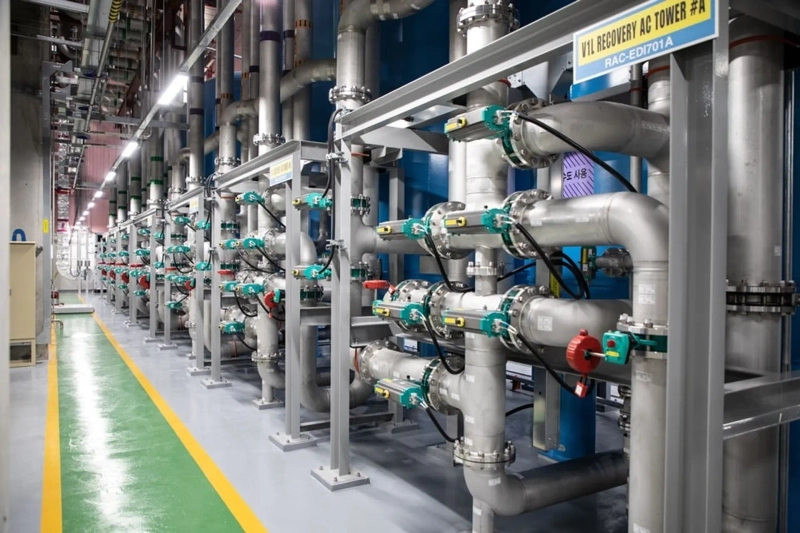
Ultrapure water produced with South Korean technology will be supplied to a semiconductor manufacturing process for the first time, marking a localization breakthrough in a field long dominated by foreign companies. The move lays the groundwork for greater self-reliance in water infrastructure for advanced industries.
The Ministry of Climate, Energy and Environment said on May 19 that it held a ceremony at SK Siltron's Gumi plant in North Gyeongsang Province to sign an agreement on using the results of a project to develop domestically produced high-purity industrial water, or ultrapure water. It also plans to transfer technology from the demonstration facility.
Ultrapure water is ultra-high-purity industrial water with ions, organic matter and dissolved oxygen removed to trace levels. It is essential in precision semiconductor processes such as cleaning wafer surfaces and diluting chemicals, earning it the nickname the blood of semiconductors. Even tiny amounts of contamination can affect yields and quality, making advanced water treatment technology critical.
South Korea's semiconductor industry has relied heavily on overseas companies, particularly from Japan and France, for ultrapure water production technology. In facility design, Japan's Kurita Water Industries and Nomura Micro Science hold most of the domestic market. Construction and operations have also been led by global companies including France's Veolia.
The ministry has pushed a program to localize ultrapure water production technology since 2021 to reduce that dependence and strengthen the competitiveness of South Korea's water industry. The demonstration facility stands out because domestic technology was used across the full process, from design and construction to operations.
The facility was installed at SK Siltron's Gumi site and has completed performance verification. It uses equipment and materials developed by South Korean companies in key ultrapure water processes, including ultraviolet oxidation systems to remove organic matter, degassing membranes to eliminate dissolved oxygen and ion-exchange resins to remove ions.
The ultrapure water produced there will be supplied to an actual semiconductor wafer production process. It is the first time ultrapure water based on domestic design technology will be used on a live semiconductor manufacturing line.
The industry expects ultrapure water to become increasingly important as artificial intelligence and the semiconductor sector expand. The global ultrapure water market is projected to grow to about $25.4 billion in 2028 from about $21 billion in 2022.
The government plans to pursue full localization across the entire ultrapure water production process and develop ultrapure water technology based on wastewater reuse. The goal is to address potential industrial water shortages tied to the climate crisis and build a stable water supply system for advanced industries.
Kim Ri-an, Hankyung.com reporter knra@hankyung.com

Korea Economic Daily
hankyung@bloomingbit.ioThe Korea Economic Daily Global is a digital media where latest news on Korean companies, industries, and financial markets.