“Should’ve Just Bought Samsung Electronics, SK Hynix” as Korean Retail Investors Watch Biotech Stocks Drop 14%
Summary
- South Korean biotech stocks have fallen 13.9% this year, pressured by rising interest rates and a market shift toward the AI sector.
- A string of setbacks at large-cap names including Samsung Biologics, Alteogen and Samchundang Pharm has sharply weakened overall investor sentiment toward the biotech sector.
- Experts said there is room for a rebound in the second half through clinical data, technology transfers and conference presentations, but short-term volatility could remain high because of factors including the possibility of rate hikes.
Forecast Trend Report by Period


South Korean biotech stocks fell sharply on May 18 as rising interest rates and a rush of market money into artificial intelligence plays such as semiconductors weighed on the sector. The group has retreated nearly 14% this year. Analysts say a string of setbacks involving large-cap biotech names has also damped sentiment across the industry.
◇Healthcare Index Drops 4.7%
The Korea Exchange said the KRX Healthcare Index, which tracks biotech-related shares, fell 4.7% to 4,287.49 on May 18. That contrasted with the Kospi, which rose 0.31%.
Among individual stocks, gene-editing company ToolGen tumbled 17.2% on news of a rights offering. Antibody-drug conjugate platform company LigaChem Biosciences dropped 15.4%, while D&D Pharmatech, which is developing an oral obesity drug, slid 9.7%. Heavyweights Samsung Biologics, Celltrion and Alteogen also fell 2% to 3%.
A jump in market interest rates hurt sentiment across biotech shares. The sector is particularly sensitive to rate changes because valuations rely heavily on future earnings discounted to present value. Han Song-hyup, an analyst at Daishin Securities, said selling likely accelerated as higher rates added to pressure on a sector already suffering from weak fund flows.
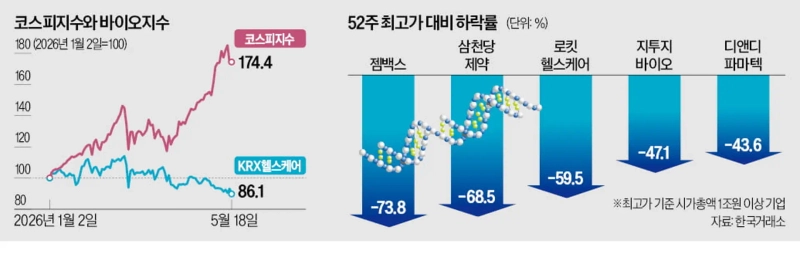
The concentration of market money in AI-related industries has been another drag. The KRX Healthcare Index is down 13.9% this year, widening the gap with the Kospi, which has risen 74.4%, led by AI chip stocks such as Samsung Electronics and SK Hynix. Losses were especially steep among obesity-drug plays. D&D Pharmatech and G2GBio have dropped 43.6% and 47.1%, respectively, from their 52-week highs. One biotech-focused investor said expectations for innovative drug development have partly faded as the global market is increasingly being reshaped around Eli Lilly’s Mounjaro.
Lee Ji-su, an analyst at DAOL Investment & Securities, said the weakness appeared to stem more from macro factors such as rising market rates than from any sector-specific shock. Another biotech analyst, who asked not to be identified, said biotech shares become less attractive during periods of rising oil prices and interest rates caused by the war between the US and Iran because the sector is effectively a bet on future value.
◇String of Setbacks in Large Caps Further Erodes Sentiment
Analysts say a series of setbacks this year involving large-cap stocks such as Samsung Biologics, Alteogen and Samchundang Pharm has left investors broadly more cautious on biotech shares.
A prominent example came in January, when Alteogen disclosed a royalty rate that fell well short of market expectations. Merck, known as MSD in Korea, is developing a subcutaneous version of Keytruda and said the royalty rate it would pay Alteogen was 2%, triggering heavy shareholder selling. In the same month, ABL Bio’s out-licensed candidate prompted another wave of disappointment after news that its development priority had been lowered. Samchundang Pharm shares halved over the month from late March as doubts grew over its ability to develop a highly anticipated oral obesity drug. Investors were also rattled by valuation concerns over Samsung Epis Holdings after its relisting following a spinoff, as well as a full-scale strike by Samsung Biologics’ labor union.
Changes in deal structures at global drugmakers have also weighed on the sector. After aggressively buying early-stage technologies in the period immediately after the Covid-19 pandemic, big pharma companies have recently shifted toward demanding human clinical data before pursuing deals. That means only companies with enough financial strength to withstand relatively expensive late-stage trials are likely to survive. China’s rise as a new hunting ground for big pharma technology deals has also been viewed negatively for Korean biotech firms. Lee said there is still room for a rebound in the second half on catalysts including clinical data, technology transfers and conference presentations. Still, short-term volatility could remain high because of macro factors including the possibility of further rate increases.
Lee Min-hyung / Lee Woo-sang, Korea Economic Daily reporters meaning@hankyung.com

Korea Economic Daily
hankyung@bloomingbit.ioThe Korea Economic Daily Global is a digital media where latest news on Korean companies, industries, and financial markets.