South Korea Ship Orders Top $20 Billion as Shipbuilding Supercycle Enters Second Phase
Forecast Trend Report by Period


South Korean shipbuilders have secured more than $20 billion of orders so far this year, as they sharpen their focus on higher-value vessels such as liquefied natural gas carriers to counter China’s low-price competition.
Big Three Alone Booked $19.96 Billion This Year
Container Ship Orders Decline as LNG, Specialty Vessels Rise
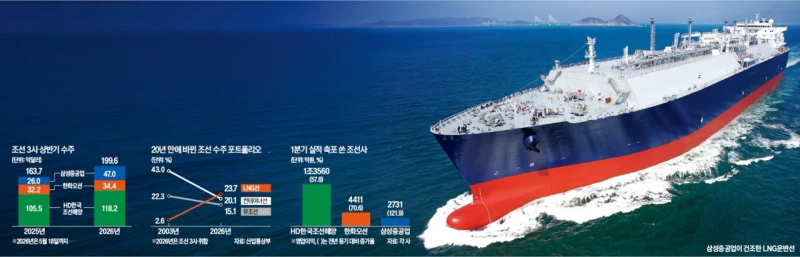
As of May 18, South Korea’s three biggest shipbuilders — HD Korea Shipbuilding & Offshore Engineering, Hanwha Ocean and Samsung Heavy Industries — had won a combined $19.96 billion of orders this year, according to industry figures. Including mid-sized shipbuilders such as Daehan Shipbuilding and HJ Shipbuilding & Construction, total orders at South Korean yards exceeded $20 billion.
The big three have already surpassed the $16.37 billion they recorded in the first half of last year. HD Korea Shipbuilding & Offshore Engineering booked $11.82 billion of orders this year, up 12% from $10.55 billion in the first half of last year. Hanwha Ocean’s orders reached $3.44 billion, topping $3.22 billion a year earlier, while Samsung Heavy Industries booked $4.7 billion, above $2.6 billion in the first half of last year.
The latest shipbuilding boom marks the industry’s second upcycle since its first supercycle in 2003-2007. The order mix has changed sharply over the past two decades. More than 20 years ago, container ships accounted for 43% of total orders, but this year LNG-related vessels led bookings at the big three with 33 ships, ahead of 28 container ships. Orders have also continued for ultra-high-value specialty vessels, including wind turbine installation vessels and icebreaking ships, each costing more than $362 million.
Still, the industry is not uniformly optimistic. Competition with China, the world’s largest shipbuilding market by order volume, is intensifying. China delivered a domestically designed large LNG carrier last month, rapidly narrowing its technology gap with South Korea. An industry official said the key challenge is to stay ahead of China in vessels powered by cleaner fuels such as ammonia, which are expected to become more widely used.
Yoo-jung Roh and Jeong-eun Shin, Korea Economic Daily reporters yjroh@hankyung.com

Korea Economic Daily
hankyung@bloomingbit.ioThe Korea Economic Daily Global is a digital media where latest news on Korean companies, industries, and financial markets.