Brent Hits $110, Won Stays Above 1,500 as Bond Yields Surge on Fears Oil Could Reach $180
Summary
- Concern that the war in the Middle East will drag on has driven a simultaneous surge in Brent crude to $110, the won-dollar exchange rate above 1,500 won, and global government bond yields.
- Aberdeen said Brent crude could surge to $180 a barrel if the closure of the Strait of Hormuz, falling inventories and rising demand overlap.
- Government bond yields in the US, Japan and South Korea have climbed to their highest levels in more than two decades, stoking concern over inflation, policy rate hikes and increased bond supply.
Forecast Trend Report by Period


Oil, currency and bond yields jump together
Brent at $110, won-dollar rate holds above 1,500
Inflation fears rattle sovereign debt markets
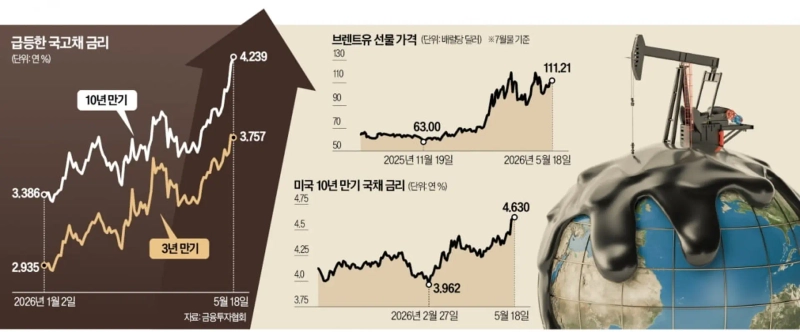
Global financial markets were jolted by concern that the war in the Middle East could drag on. International oil prices, global government bond yields and the won-dollar exchange rate all climbed in tandem.
Brent crude futures for July delivery traded at about $110.93 a barrel on London's ICE Futures Europe exchange on May 18. Brent returned to the $110 range for the first time in 12 days, since May 6. The rise came as the prolonged closure of the Strait of Hormuz turned supply shortages in the global oil market into a reality. Expectations for stronger summer demand for air conditioning and air travel added to the pressure.
Inflation fears also rippled through global bond markets. The 30-year US Treasury yield rose to 5.129% on May 18, the highest level in more than two decades. Japan's 30-year government bond yield climbed above 4% for the first time since 1999. Britain's 30-year government bond yield also hit its highest level in 28 years. South Korean government bond yields rose across the curve. The 10-year yield stood at 4.239% and the 30-year yield at 4.196%, both the highest since October 2023.
The won-dollar exchange rate stayed above 1,500 won for a second straight session. In Seoul trading, the won ended the daytime session at 1,500.3 per dollar on May 18, down 0.5 won from the previous day.
Brent tops $110, won-dollar rate moves above 1,500
Inflation shock fuels rate-hike fears as fiscal expansion adds pressure on bonds
Brent crude could surge to $180 a barrel
That is the latest forecast from global asset manager Aberdeen. The firm said the oil market has so far absorbed the supply shock from the Iran war, but an unprecedented energy crisis could follow if shrinking supply and rising demand intensify at the same time. The jump in crude prices is adding to inflation concerns and pushing up sovereign bond yields in major economies.
Oil market faces supply crunch
The Financial Times reported on May 17 that the global oil market is facing a severe supply shortage. The closure of the Strait of Hormuz has removed 2 billion barrels from the market, equivalent to about 5% of annual global crude supply. The supply shortfall is growing by 14 million barrels a day.
Before the war, global crude inventories were at their highest level in a decade. Those stockpiles are now falling quickly as importing countries tap reserves to offset supply disruptions from the Gulf region. The International Energy Agency said global crude inventories have fallen by about 380 million barrels since the war began, excluding volumes stranded in the Gulf. Some market participants fear inventories could fall to a record low by June.
Oil has held near $100 a barrel so far because the US increased crude exports. US net exports of crude and refined products rose to 9 million barrels a day, more than 4 million barrels a day higher than a year earlier.
The problem is that oil demand will rise sharply as summer approaches. Cooling demand in the Northern Hemisphere and peak-season air travel could leave inventories short across crude, gasoline, diesel and jet fuel.
The biggest risk is that US President Donald Trump could move to restrict oil exports. That would remove the buffer that has helped offset the global supply shortfall. Morgan Stanley said an escalation scenario in which oil rises above $150 a barrel could trigger physical supply shortages, supply-chain disruptions and a recession.
Global government bond yields keep climbing
Global sovereign bond yields are also marching higher. Inflation concerns are building, increasing the chance that central banks maintain tight monetary policy. Governments in major economies are also continuing to expand fiscal spending.
The 10-year US Treasury yield rose as high as 4.63% on May 18, pushing well above the 4.5% psychological threshold. The move followed a shock US inflation reading last month that fueled concern the Federal Reserve could raise rates. A surge in US war spending also deepened worries about a wider fiscal deficit. Larger deficits force governments to issue more bonds, putting upward pressure on yields.
Bond yields outside the US are also rising sharply. Japan's 10-year government bond yield climbed as high as 2.80% intraday on May 18, the highest since 1996. Japan's 30-year yield also moved above 4% for the first time since 1999. Investors sold bonds after the Japanese government said it would draw up a supplementary budget to respond to the Middle East crisis, adding to concern over fiscal expansion.
South Korea is no exception. The yield on the country's three-year Treasury bond, which was in the 2.9% range late last year, rose above 3.7% on May 15 and then climbed past 3.8% intraday on May 18. The 10-year yield also jumped from the 3.3% range to the 4.2% range over the same period, an increase of nearly 1 percentage point. It closed at 4.239% on May 18, the highest level since Oct. 6, 2023.
Kang Seung-won, an analyst at NH Investment & Securities, wrote in a report on May 18 that an economic recovery, rising interest rates and increased government bond supply are all driving yields higher at the same time. In that environment, buying interest has largely disappeared, leaving South Korean government bond yields elevated.
Shim Seong-mi, Lee Hye-in and Kim Dong-hyun, Korea Economic Daily reporters smshim@hankyung.com

Minseung Kang
minriver@bloomingbit.ioBlockchain journalist | Writer of Trade Now & Altcoin Now, must-read content for investors.