China Deploys Carrier Group to Western Pacific Days After Trump-Xi Summit
Forecast Trend Report by Period


China sent an aircraft carrier group into the western Pacific four days after agreeing with the US at a leaders’ summit to build what both sides called a “constructive strategic stability relationship.” The deployment underscores Beijing’s push to expand its military reach across the western Pacific, including the Taiwan Strait, Japan and Southeast Asia.
The Chinese People’s Liberation Army Navy said on social media on May 19 that the Liaoning carrier group, centered on China’s first aircraft carrier, began drills that day in “relevant waters of the western Pacific.” The navy said the exercise would include blue-water tactical flights, live-fire drills, support and cover operations, and comprehensive search-and-rescue missions to assess and improve the unit’s combat training level.
China’s military described the exercise as a routine drill under its annual plan. It added that the operation was meant to steadily improve mission capabilities and complied with international law and international practice. The western Pacific includes waters adjacent to South Korea, Japan, Taiwan and Australia and is also part of the US Seventh Fleet’s area of operations.
China has recently stepped up efforts to project naval power beyond the first island chain, which stretches from Okinawa to Taiwan, the Philippines and the Strait of Malacca, into the western Pacific. In May and June last year, the Liaoning and China’s second carrier, the Shandong, conducted their first dual-carrier exercise, operating in the Yellow Sea, East China Sea, South China Sea and western Pacific. During that deployment, they also crossed the second island chain linking Japan’s Ogasawara Islands and the US territory of Guam.
The western Pacific was also part of China’s military activity in December last year during drills encircling Taiwan and in maritime exercises in April this year that followed a Japanese Maritime Self-Defense Force escort ship’s transit of the Taiwan Strait. China’s military has also continued regular joint operations with Russia under the banner of “joint patrols in the western Pacific.”
Taiwan’s Defense Ministry previously drew up a report saying China spent 110 billion yuan, or about $17.3 billion, on western Pacific training in 2023, equivalent to 7% of its total defense budget, as it sought to secure control inside the first island chain. Taiwan’s government criticized China’s military activity for raising tensions in the region.
Taiwan Premier Cho Jung-tai told a press conference on May 19 that China continues military drills in the Taiwan Strait, the Indo-Pacific region, the South China Sea and waters near Japan. “These actions, which affect the safety of navigation, are the biggest source of damage to regional stability,” he said.
Cho called the Republic of China’s status as a sovereign and independent state “a fact and a reality.” He also said he hoped for healthy and orderly cross-strait exchanges and dialogue based on equality and dignity.
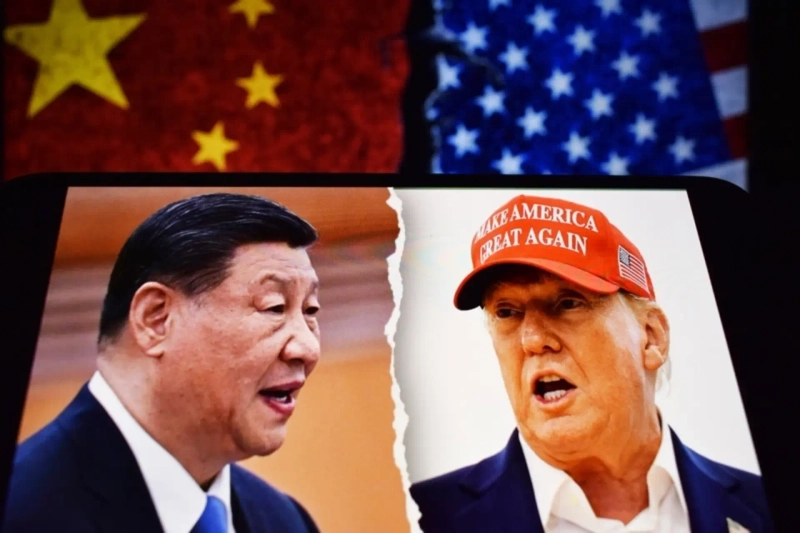
The announcement came shortly after a summit in Beijing between US President Donald Trump and Chinese President Xi Jinping. During talks on May 14 and May 15, the two leaders agreed to establish a “constructive strategic stability relationship” as a new framework for bilateral ties.
The concept was described as positive stability centered on cooperation, sound stability with restrained competition, normalized stability capable of managing differences, and lasting stability that is peaceful and predictable. Some interpreted the agreement as reflecting Xi’s intent to continue competing with the US on equal footing while seeking mutual recognition of spheres of influence, with Trump accepting that approach.
Oh Se-seong, Hankyung.com reporter sesung@hankyung.com

Korea Economic Daily
hankyung@bloomingbit.ioThe Korea Economic Daily Global is a digital media where latest news on Korean companies, industries, and financial markets.