Exclusive: Nearly Half of South Korea Funeral-Service Firms Lack Assets to Repay Customers After One Lost $36 Million on Crypto Bet
Forecast Trend Report by Period


42.7% have fewer assets than the prepaid funds they owe customers
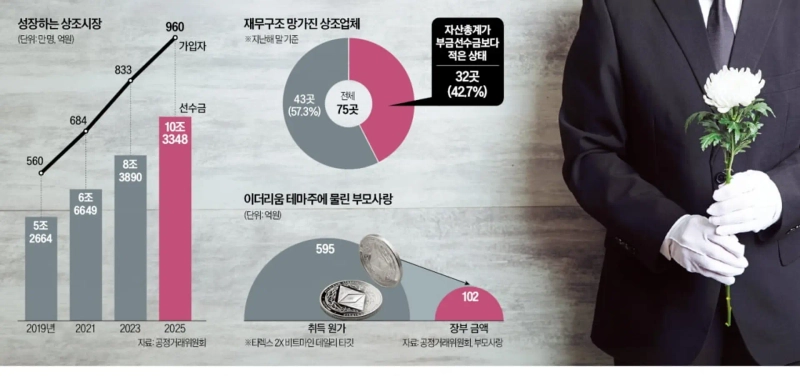
Nearly half of South Korea’s funeral-service companies have total assets worth less than the prepaid funds they owe customers, a Korea Economic Daily review found. Losses on cryptocurrency-linked investments and poor asset management, including cases in which operators functioned like private cash boxes for controlling shareholders, were among the causes.
A Korea Economic Daily review of 2025 audit reports from 75 funeral-service companies nationwide, published on May 18, found that 32 firms, or 42.7%, had total assets below customer prepaid balances. That means the companies would not have enough money to refund customers if all of them tried to cancel at once.
The decline in assets underscores severe moral hazard in the industry. Bumo Sarang, the sector’s seventh-largest operator, invested 59.5 billion won ($43 million) in an exchange-traded fund that seeks to deliver twice the daily return of Bitmine, an Ethereum-themed stock, and recorded a 49.3 billion won ($35.6 million) loss on a book-value basis.
The funeral-services business resembles insurance and other financial industries because it raises and manages customer money over long periods. But prepaid funeral operators face almost no rules on financial soundness or the management of customer advance payments. They are legally classified as prepaid installment transaction businesses, putting them under the Fair Trade Commission rather than financial regulators. Experts say the market has grown to about 10 trillion won ($7.2 billion) and should be subject to appropriate financial regulation.
‘Zombie’ funeral firms survive by burning through customer money as a regulatory gap persists
No solvency or asset-management oversight, and no restrictions on lending to controlling shareholders
Bumo Sarang invested 59.5 billion won ($43 million) last year in the leveraged ETF tied to Bitmine. After the cryptocurrency market slumped, the product’s carrying value had fallen to 10.2 billion won ($7.4 million) by the end of the year.
Mideumui Gajok posted a net loss of 500 million won ($361,000) last year. Its accumulated deficit over 18 years has topped 2.3 billion won ($1.7 million). Over the past two years, customers paid in just 2.39 million won ($1,730) in prepaid funds, while 93 million won ($67,000) was paid out through contract cancellations.
A regulatory vacuum because they are not classified as financial companies
As of May 18, oversight of prepaid-fund management and financial soundness at funeral-service companies was effectively nonexistent, according to the Fair Trade Commission. Unlike insurers, which must meet solvency-ratio requirements under financial regulators, funeral-service operators have no capital-adequacy standards and no rule allowing authorities to force controlling shareholders to inject capital. The commission’s role is largely limited to posting financial indicators such as solvency and debt ratios on its website.
If an insurer’s finances had deteriorated as badly as Mideumui Gajok’s, the Financial Services Commission could demand corrective steps including a capital injection. If the company failed to comply, the regulator could designate it a troubled financial institution and replace the controlling shareholder.
Banks face higher capital-ratio requirements under Bank for International Settlements standards when they invest in risky assets. Funeral-service operators face no comparable rule. Even when they manage customer money, the only requirement is to preserve 50% of prepaid balances. If they join a mutual aid association, pay fees and obtain a payment guarantee, they can operate with more than 50% of those funds.
The lack of solvency and asset-management rules stems from the industry’s legal status outside the financial sector. In 2010, the government revised the Installment Transactions Act and classified funeral-service operators as prepaid installment transaction businesses. As a result, oversight shifted to the Fair Trade Commission rather than financial authorities.
Another chronic problem is the lack of restrictions on credit support for controlling shareholders, allowing some funeral-service companies to operate like private vaults for owners. Industry officials say the practice is common not only at smaller firms but also at major operators, which routinely lend customer funds to controlling shareholders and related parties. Sono Station, the No. 3 operator by prepaid balances, with 1.4531 trillion won ($1.05 billion), came under scrutiny in 2024 after lending 50 billion won ($36.1 million) to affiliate Sono International during its acquisition of T’way Air.
Among smaller operators, loans to controlling shareholders and related parties sometimes exceed customer prepaid balances. Hanyang Sangjo, which held 570 million won ($412,000) in prepaid balances, lent 2.2 billion won ($1.6 million) to its chief executive. Jeju Ilchul Sangjo, which held 450 million won ($325,000) in prepaid balances, lent 1.6 billion won ($1.2 million) to its controlling shareholder.
Some cannot return prepaid funds when customers ask to cancel
The funeral-services industry argues that companies should not be labeled distressed simply because they have high debt ratios or negative equity. Prepaid balances are booked as liabilities and recognized as revenue only when services such as funerals are actually provided. Until then, losses can accumulate and erode equity, the industry says.
Some operators have delivered solid results by diversifying into bonds, real estate, infrastructure and corporate finance, including The-K Yedaham, which is run by the Korean Teachers’ Credit Union. But warning signs are mounting among smaller firms. Daeno Welfare Foundation, whose total assets of 40.7 billion won ($29.4 million) trailed prepaid balances of 70.6 billion won ($51 million) at the end of last year, failed to refund customers after they sought to cancel contracts.
As of March, unpaid cancellation claims totaled 130 million won ($93,900). Daeno Welfare Foundation said it planned to pay customers seeking cancellations through additional borrowing. A Bumo Sarang official said the losses were short-term unrealized losses caused by volatility in global markets and remained manageable within the company’s financial buffer.
Park Jong-gwan, Korea Economic Daily reporter pjk@hankyung.com

Korea Economic Daily
hankyung@bloomingbit.ioThe Korea Economic Daily Global is a digital media where latest news on Korean companies, industries, and financial markets.