Korean Retail Investors Return to US Stocks as Kospi Volatility Deepens
Forecast Trend Report by Period


More South Korean retail investors are turning back to US equities as the domestic market slips into a correction. With Samsung Electronics Co. and SK Hynix Inc., the country’s benchmark chipmakers, losing momentum, money is flowing into US semiconductor shares such as Micron Technology Inc. At the same time, the average balance in the government’s Return to the Domestic Market Account, or RIA, has reached only 16.7% of the contribution limit.
As of May 15, there were 235,000 RIA accounts with total deposits of 1.96 trillion won ($1.42 billion), according to the Ministry of Trade, Industry and Energy and other agencies. The average balance was 8.34 million won ($6,040) per account. Introduced in March, the RIA program grants a capital-gains tax deduction of up to 100% for investors who sell overseas shares, convert the proceeds into won and reinvest in the domestic stock market. The government introduced the tax break to lure retail investors back to local equities and help stabilize the exchange rate. Even so, with the tax-free contribution cap set at 50 million won ($36,200), the average account balance remains below 20% of the ceiling.
About two weeks remain before the deadline for the full capital-gains tax deduction. Still, the recent Kospi pullback has made retail investors more cautious about shifting money back into local stocks. Domestic equities have seen wider swings recently as foreign investors continued heavy net selling. As of May 19, Samsung Electronics shares were down 6.93% from May 14, while SK Hynix had fallen 11.42%.
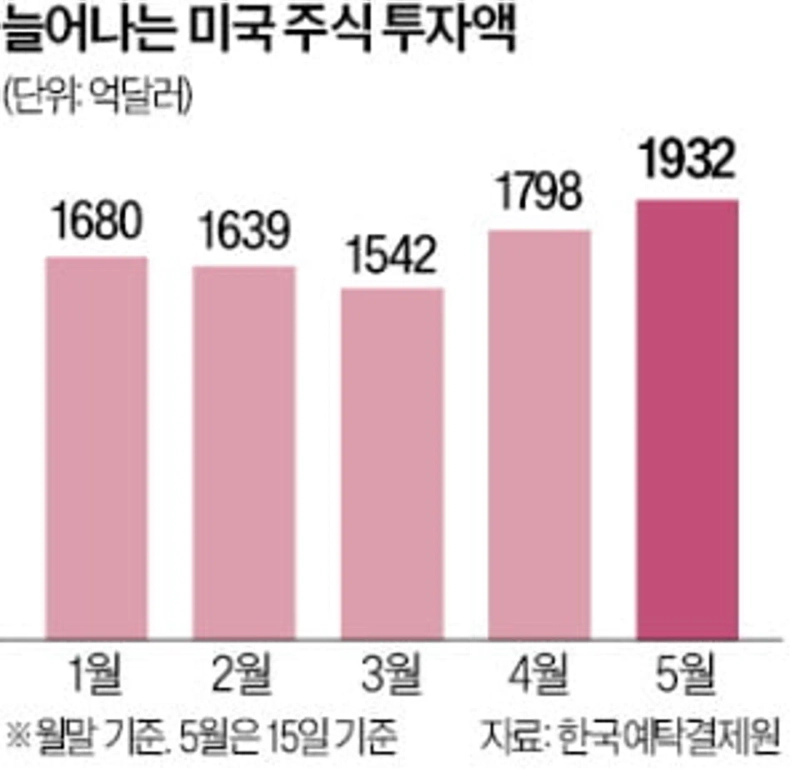
As Korean chip shares weakened, retail investors again turned to the US market. As of May 15, South Korean investors held $193.1 billion in US stocks, according to the Korea Securities Depository. That is just shy of 300 trillion won.
Their US stock holdings fell from $168 billion at the end of January to $154.2 billion at the end of March, then climbed to $179.8 billion in April and moved above $190 billion this month. On May 14, the total briefly topped $200 billion. Higher dollar-won exchange rates boosted portfolio values, while net selling by Korean retail investors remained limited. From May 1 to May 15, net sales of US stocks amounted to just 0.11% of total assets held in custody.
Since May 15, when the Kospi began to correct, individual investors have concentrated their buying on semiconductor-related stocks. From May 15 through May 18, their top net purchases were Nvidia Corp. at $195.09 million, Sandisk 2x Leveraged at $81.75 million and Micron at $79.93 million, according to Korea Securities Depository data. Investors are turning to high-growth US big tech and the semiconductor value chain as a refuge from rising volatility in the domestic market.
The next two weeks of Kospi trading may determine whether the RIA program gains traction. Securities firms broadly expect the benchmark index to maintain its longer-term uptrend. But opinions differ on when it will rebound, with concerns lingering over near-term overheating after the recent rally and macroeconomic risks such as rising global government bond yields.
Lee Sun-a, Hankyung.com reporter suna@hankyung.com

Korea Economic Daily
hankyung@bloomingbit.ioThe Korea Economic Daily Global is a digital media where latest news on Korean companies, industries, and financial markets.