Foreigners Sell $81 Billion of Korean Stocks, but Brokerages Still See Rebound
Forecast Trend Report by Period


Foreign ownership remains near record highs despite a selling wave
Brokerages say this cycle differs from past crises
Net selling this year has reached 112 trillion won, 3.3 times the 2008 financial crisis
KOSPI market capitalization has surged 3.5-fold over the past year
The selloff follows a sharp short-term rally that inflated the value of sales
KOSPI operating profit this year is projected at triple last year’s level
Brokerages see a rebound in June and July
Foreign investors’ periodic “Sell Korea” trades have long been a difficult challenge for the country’s stock market. Because South Korea’s export-heavy economy is highly sensitive to global macro indicators such as oil prices and exchange rates, doubts about growth have tended to grow whenever domestic or external conditions turned shaky. That is why foreign money rushed out during the 2008 global financial crisis, when foreigners sold 34 trillion won, and during the 2020 Covid-19 pandemic, when they sold 25 trillion won.
This year is different. More than 100 trillion won has left the KOSPI market, far exceeding the scale seen in past crises, yet brokerages are showing little concern. Unlike in earlier downturns, they say, South Korea’s flagship companies led by chipmakers remain fundamentally strong, while the artificial-intelligence value chain driving the index is still in its early stages. Industry participants point to an American depositary receipt listing for SK Hynix and easing US bond yields as potential catalysts for the KOSPI.
Foreign ownership at 39.4%, near a record
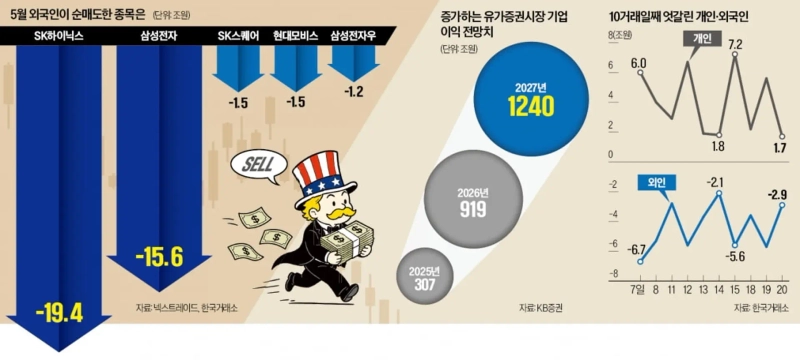
According to the Korea Exchange and Nextrade, foreign investors were net sellers of KOSPI-listed shares for 10 straight trading days from May 7 through May 20. Cumulative net sales during that period topped 51 trillion won. Selling was concentrated in semiconductor-related stocks including SK Hynix, Samsung Electronics and SK Square.
Brokerages view the move as different from earlier waves of foreign selling in Korean assets. “The absolute value of net selling has risen because KOSPI market capitalization has jumped 3.5-fold over the past year,” said Lee Kyung-min, an analyst at Daishin Securities. Relative to market capitalization, foreigners appear to be selling less than they did in past crises, he added.
Foreign ownership is also approaching the record high of 44.12%. As of May 20, foreigners held 39.48% of KOSPI market capitalization, according to the Korea Exchange. That reflects the fact that the value of shares they still own has risen faster than the pace of their selling.
The outlook for semiconductors, which have led the Korean stock market, also remains intact. “US hyperscalers use Nvidia chips, and those chips contain Korean high-bandwidth memory,” said Kim Young-hwan, head researcher at NH Investment & Securities. If Korea’s fundamentals were weakening, that would imply AI investment was weakening as well. US technology stocks and economic growth data do not point in that direction, he said.
Brokerages see June-July rebound catalyst
Earnings forecasts for Korean companies are also rising. KB Securities, which recently set a KOSPI target of 10,500, expects operating profit at KOSPI-listed companies to reach 919 trillion won this year and 1,240 trillion won next year. Other brokerages with more conservative forecasts also expect operating profit to exceed 800 trillion won this year. That would be roughly triple last year’s 307 trillion won. KOSPI-listed companies already posted consolidated operating profit of 156.3194 trillion won in the first quarter.
Still, profit-taking in large semiconductor stocks has increased volatility in the KOSPI. After touching 8,000 on May 15, the index closed at 7,208.95 on May 20. Forced selling has also surged as the benchmark retreats. According to the Korea Financial Investment Association, forced liquidation totaled 91.7 billion won as of May 18, the highest since Oct. 24, 2023, when the Young Poong Paper stock-manipulation scandal pushed the figure to 548.7 billion won, the most in two years and seven months.
Brokerages say the KOSPI has catalysts for a rebound in June and July. Kim said SK Hynix could lift its Korea-listed shares if the company secures a higher valuation in the US than at home, triggering a gap-closing trade. While full inclusion in the MSCI developed-market index is still a long way off, being added next month to the watch list for possible developed-market status could change fund flows by drawing in capital tied to developed markets, he said. Lee Choong-heon, chief executive officer of ValueFinder, said recent foreign net selling has been driven mainly by institutions. If securities firms expand foreign omnibus-account services in earnest, overseas retail investors could enter the market and turn flows back to net buying.
Lee Sun-a / Ko Song-hee, Hankyung.com reporters suna@hankyung.com

Korea Economic Daily
hankyung@bloomingbit.ioThe Korea Economic Daily Global is a digital media where latest news on Korean companies, industries, and financial markets.