Nvidia Outlook Set to Test Samsung, SK Hynix Chip Rally
Summary
- The key question is whether Nvidia’s first-quarter earnings and second-quarter guidance will be strong enough to justify the recent rally in semiconductor stocks.
- Expectations for HBM4 shipments from Samsung Electronics and SK Hynix could grow depending on Nvidia’s HBM demand and the revenue outlook for the Blackwell and Vera Rubin platforms.
- Risks including China export restrictions, intensifying AI chip competition and concerns over a labor union strike could limit further gains in Samsung Electronics and SK Hynix shares.
Forecast Trend Report by Period


Samsung, SK Hynix Retail Investors Brace for Nvidia Results
Focus Shifts to Nvidia Guidance
Nvidia to Report on May 21
Second-Quarter Outlook Is Key
HBM Demand at Samsung, SK Hynix in Focus
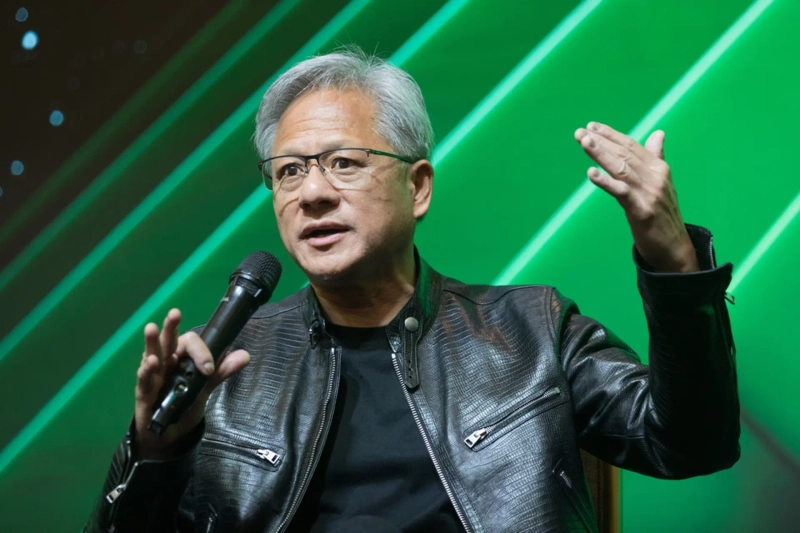
Nvidia will release its fiscal first-quarter results early on May 21 in South Korea. The report is drawing close attention from the country’s semiconductor industry and investors because it may offer clues on global artificial intelligence spending and demand for high-bandwidth memory, or HBM, used by Samsung Electronics Co. and SK Hynix Inc.
All Eyes on Second-Quarter Guidance
According to AI-based investment information platform Epic AI, market consensus for Nvidia’s fiscal first quarter, which covered February through April 2026, stood at revenue of $78.7 billion to $78.9 billion and earnings per share of $1.75 to $1.77 as of May 20. That would represent increases of 79% and 83% from a year earlier, respectively.
The focus this time is less on the first-quarter figures than on guidance for the second quarter. Nvidia has beaten profit estimates in 18 of its past 20 earnings reports and topped revenue forecasts 19 times. Investors are looking not just for another beat, but for results strong enough to justify the recent rally in semiconductor shares and an aggressive outlook for the current quarter.
Supply trends for Blackwell, Nvidia’s latest AI accelerator, are also under scrutiny. Any sign that Blackwell shipments are proceeding as planned could strengthen expectations for AI server investment and memory demand in the second half. Investors are also watching Vera Rubin, the company’s next-generation platform after Blackwell. Brokerage analysts say projected cumulative revenue from the Rubin and Blackwell architectures for 2025 through 2027 has been raised to $1 trillion from $500 billion.
Another key question is whether big tech companies will maintain AI capital spending in the second half. Markets are watching how much of that spending outlook is reflected in Nvidia’s results and guidance. Nvidia’s main AI accelerator customers include Amazon, Microsoft, Alphabet, Meta Platforms and Oracle. Brokerage firms project capital expenditure by the top five cloud and hyperscale companies will reach nearly $700 billion this year, up $120 billion from estimates at the start of the year.
HBM Supply Chain Also in Focus
South Korea’s memory-chip makers are watching Nvidia’s earnings closely because of the supply chain structure. HBM is an essential component in Nvidia’s AI accelerators. As a result, shipment volume and guidance feed directly into the outlook for HBM demand.
SK Hynix is viewed as the most direct beneficiary in Nvidia’s HBM supply chain. After supplying most of the HBM3E volume, the company is also set to provide large quantities of next-generation HBM4 to Nvidia. According to semiconductor research firm SemiAnalysis, SK Hynix and Samsung Electronics are projected to account for 70% and 30%, respectively, of Nvidia’s Vera Rubin supply chain.
Samsung Electronics has sold out its initial HBM4 output after becoming the first in the industry to start mass production, with broader supply expansion planned for the second half. Samsung’s HBM4 has also reportedly received top-level marks in Nvidia’s internal testing.
Both stocks have paused after sharp recent gains. Samsung Electronics climbed as high as 296,500 won in intraday trading on May 15, but closed at 276,000 won on May 20, down 6.9% from that peak. SK Hynix rose to as much as 1.995 million won over the same period before finishing at 1.745 million won, 12.5% below its high. The pullback reflects profit-taking after the rally and a wait-and-see mood ahead of Nvidia’s earnings release.
There are also risks. Export restrictions tied to U.S.-China trade tensions could directly affect Nvidia’s revenue. Competition from AMD and in-house AI chips developed by big tech companies, along with valuation pressure from a jump in long-term US Treasury yields, are also being cited as variables. Samsung Electronics faces concerns over a potential labor union strike. For SK Hynix, questions remain over HBM4 certification, yields and competition for share within customer accounts.
That is why industry participants and investors are closely watching Nvidia’s quarterly report. Epic AI Copilot said strong earnings and guidance from Nvidia could reinforce expectations for increased HBM shipments from Samsung Electronics and SK Hynix. At the same time, it said uncertainty surrounding the China market, intensifying AI chip competition and the burden of the recent rally could limit further gains in the two stocks.
Hong Min-seong, Hankyung.com reporter, mshong@hankyung.com

Korea Economic Daily
hankyung@bloomingbit.ioThe Korea Economic Daily Global is a digital media where latest news on Korean companies, industries, and financial markets.