South Korea to Put Semiconductor Tax Windfall Into Sovereign Wealth Fund
Summary
- The government will make a cash contribution from part of the excess tax revenue generated by the semiconductor super boom to a Korean-style sovereign wealth fund, lifting its seed capital to nearly 30 trillion won ($21.7 billion).
- The Korean-style sovereign wealth fund will be a growth fund that makes long-term investments in promising growth-stage companies in South Korea's strategic industries, with minimal government intervention and returns flowing back to the state.
- Experts said running the sovereign wealth fund alongside the National Growth Fund could create a domestic corporate valuation bubble and lead to overvaluation of companies if investments are misplaced, adding that the key is selecting promising companies with strong technological capabilities.
Forecast Trend Report by Period


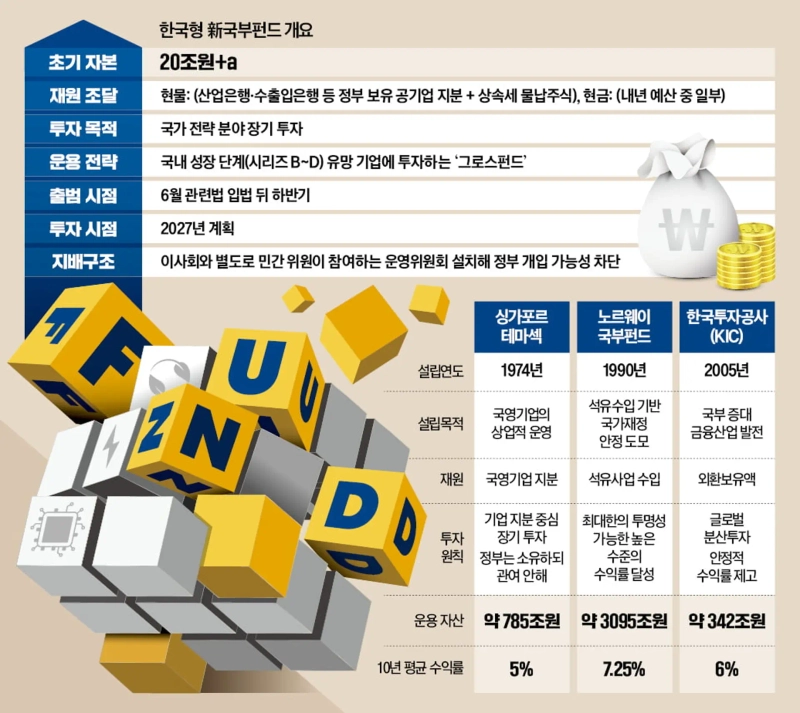
The South Korean government will put part of a tax windfall from the semiconductor boom into a new sovereign wealth fund due to launch in the second half of this year. The fund was initially set to start with 20 trillion won ($14.5 billion) in capital through in-kind contributions, including government stakes in state-owned companies and shares received as inheritance-tax payments. It has now decided to add several trillion won in cash, raising the seed capital to nearly 30 trillion won ($21.7 billion).
The move reflects a decision to save part of the revenue surge for future generations instead of spending it immediately.
Government ministries said on May 21 that the Ministry of Economy and Finance and the Ministry of Planning and Budget are working to include funding for the sovereign wealth fund in the 2027 budget proposal. The administration plans to specify the legal basis for cash contributions in a bill to establish the fund that it will submit to the National Assembly in June.
A sovereign wealth fund is a state-owned investment vehicle that puts money into a range of domestic and overseas assets to generate long-term returns. Norway established one in 1990 to invest oil and gas income from the North Sea for future generations, and it has since grown into the world's largest. South Korean officials have coalesced around the view that revenue generated by the semiconductor supercycle should be set aside in a sovereign wealth fund, rather than exhausted on short-term fiscal spending.
"The super tax haul will last only two to three years at most," a government official said. The view that the money should be "saved" in a sovereign wealth fund from a medium- to long-term perspective, rather than spent entirely by the current generation, has gained traction, the official added.
South Korea's planned sovereign wealth fund would make long-term investments in promising domestic companies in strategic industries that have reached the growth stage, or Series B and beyond. That sets it apart from Korea Investment Corp., or KIC, which invests the country's foreign-exchange reserves across domestic and overseas assets as a financial investor rather than a strategic backer of corporate growth.
Like Norway, Saving Windfall Revenue for the Future Instead of Spending It Now
Bill to Be Submitted in June, Second-Half Launch Targeted; Government Intervention Likely to Be Limited as at KIC
The Netherlands enjoyed an unprecedented boom after discovering a major gas field in 1959. But foreign currency earned from natural gas exports pushed up the value of the Dutch currency, eroded manufacturers' price competitiveness and weakened the country's industrial base. To avoid this so-called Dutch disease, in which a resource boom undermines broader industrial competitiveness, Norway steadily accumulated profits from oil and gas development in its sovereign wealth fund, the Government Pension Fund Global, or GPFG. The aim was to prevent energy income from hollowing out industrial competitiveness and to share the gains with future generations. Norway's GPFG has become a model for South Korea as it looks for a way to deploy surplus funds created by the semiconductor supercycle.
Following Norway's Playbook With Surplus Funds
Government ministries said on May 21 that the administration plans to contribute several trillion won in cash from this year's and next year's semiconductor-driven tax windfall to the sovereign wealth fund. The plan is expected to be reflected in the 2027 budget proposal. Officials are also reviewing the use of this year's surplus revenue base, or fiscal surplus.
The government concluded that it would be unwise to burn through all of the extra tax revenue on short-term fiscal spending because it is difficult to predict how long the semiconductor supercycle will last. A broader consensus has also formed that the state should build resources in advance, given the massive future spending South Korea's rapid aging will require in welfare and health care.
One model is Norway's GPFG, the world's largest sovereign wealth fund, with about 3,000 trillion won ($2.17 trillion) in assets. South Korea's semiconductor industry is not directly comparable to Norway's oil sector, but the logic is the same: park today's windfall in a sovereign wealth fund for future generations. The idea also aligns with the "structural return of AI gains" previously mentioned by Kim Yong-beom, the presidential chief of staff for policy.
"When South Korea's sovereign wealth fund was first designed, Singapore's Temasek was one of the models, and it pays the government an annual cash dividend of about 20%," a government official said. Returns generated by the sovereign wealth fund flowing back to the state were also a major consideration in drafting the budget plan, the official said.
Choosing the Right Companies Is Key
If the bill to establish the sovereign wealth fund is submitted to the National Assembly in June and funding is included in the 2027 budget proposal, the Korean-style sovereign wealth fund will start with more than 20 trillion won in assets plus additional capital. That would still leave it far smaller than GPFG, the Abu Dhabi Investment Authority, or ADIA, with about 1,787 trillion won ($1.29 trillion), and Temasek, with about 785 trillion won ($569 billion). The government wants to use the tax windfall to increase the initial capital base and then expand it further through investment returns. Canada's recently launched Canada Strong Fund also started with C$25 billion, or about 27 trillion won ($19.6 billion), in initial capital.
The fund's investment strategy is a growth fund. It aims to invest in companies with strong growth potential and become a medium- to long-term partner. Its governance structure could be modeled on KIC, which has an operating committee with private-sector members above its board, limiting room for direct government intervention. Because the fund's success will hinge on identifying promising companies, the government also plans to focus on recruiting talent. One option under discussion is to offer compensation at least on par with KIC. KIC's average employee salary last year was 131.4 million won ($95,000).
The Korean-style sovereign wealth fund also faces concerns. With the 150 trillion won ($109 billion) National Growth Fund already in place, some worry that adding another large state-backed investor to the domestic market could fuel valuation bubbles. Another concern is that, unlike Temasek, which actively invests overseas, the new fund would invest only in South Korea. Kim Jung-sik, an emeritus economics professor at Yonsei University, said the key will be selecting companies with genuine technological strength. Investing in the wrong targets could simply inflate valuations, he said, adding that there is no reason to rule out overseas investment if it would help build national wealth.
Nam Jung-min, Kim Il-gyu and Kim Ik-hwan, Korea Economic Daily reporters, peux@hankyung.com

Korea Economic Daily
hankyung@bloomingbit.ioThe Korea Economic Daily Global is a digital media where latest news on Korean companies, industries, and financial markets.