Crypto Tax Repeal Petition Tops 50,000 Signatures, Song Urges Priority Handling in National Assembly
Summary
- A petition to abolish the virtual-asset income tax was referred to the relevant standing committee after drawing support from more than 50,000 people in one week.
- Participants at the policy meeting said that if the virtual-asset income tax takes effect next year, it could increase foreign investor departures and capital outflows, while weighing on domestic exchanges and the competitiveness of the blockchain industry.
- While the government and the National Tax Service are sticking to plans to proceed with virtual-asset taxation as scheduled, Song said discussion of abolishing the virtual-asset income tax should also consider the competitiveness of the virtual-asset industry and investor protection.
Forecast Trend Report by Period


Song Eon-seok, floor leader of the ruling People Power Party, said a bill to abolish South Korea’s tax on virtual-asset income should be handled as a priority in the National Assembly during the second half of this year.
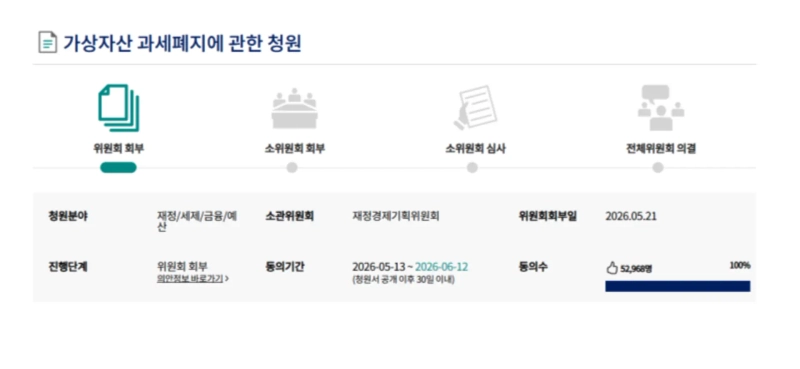
Song’s office said on May 22 that a petition submitted through the National Assembly’s public consent petition system to scrap the virtual-asset income tax drew more than 50,000 signatures in one week and was referred to the relevant standing committee. Under the system, petitions backed by at least 50,000 people are sent to a standing committee, which must report the results of its review to the plenary session within 90 days.
Song submitted the repeal bill in March as its lead sponsor. The People Power Party leadership also held a policy meeting on virtual assets, where industry officials and experts voiced concerns over implementing crypto taxation.
Participants said the virtual-asset income tax, if introduced next year, could heighten the risk of foreign investor outflows and capital flight. They also said it could weigh on the competitiveness of domestic exchanges and South Korea’s blockchain industry. They argued that while global markets are moving ahead with developments such as spot Bitcoin ETF approvals and the institutionalization of stablecoins, domestic policy remains focused on taxation and regulation.
They also raised concerns about tax fairness and structural limits in the system. With the financial investment income tax having been scrapped, keeping a separate tax only on virtual assets could trigger fairness questions. Some also argued that an additional tax could intensify debate over double taxation because value-added tax already applies to exchange fees and other charges.
Practical limits to enforcement were also discussed. As more investors use overseas exchanges, tax authorities may struggle to secure the data needed for taxation. Administrative issues also remain, including how to calculate acquisition costs for foreign investors. Participants also said moving ahead with taxation before investor protections and institutional safeguards are fully in place could add to the burden.
The government, however, has maintained its position that it will proceed with virtual-asset taxation as scheduled. The National Tax Service also plans to prepare related administrative guidelines within this year.
"With public concern and the market’s voice now confirmed, discussion is needed on abolishing the virtual-asset income tax," Song said. "We need to consider both the competitiveness of the virtual-asset industry and investor protection."

Minseung Kang
minriver@bloomingbit.ioBlockchain journalist | Writer of Trade Now & Altcoin Now, must-read content for investors.