Wall Street Bets on Compute, Not GPUs, as AI Era’s New Commodity
Summary
- CME Group and ICE have announced plans to launch an AI compute futures market using GPU rental rates as the underlying asset.
- Meritz Securities said AI infrastructure investment is moving beyond narrative and into the realm of verifiable numbers.
- Analyst Hwang Su-wook said AI infrastructure investment could become spending backed by expectations of specific future returns.
Forecast Trend Report by Period


CME, ICE Plan to Launch AI Compute Futures
GPU rental rates to serve as underlying asset
“Compute is the new oil of the 21st century”

The world’s largest commodity market is oil. Physical demand is strong for crude and refined products such as gasoline, diesel and jet fuel. But futures and options trading grew to many times that size, turning oil into a vast investment market. Since West Texas Intermediate crude futures were listed in New York in 1983, oil has evolved beyond a physical energy resource into a standalone financial asset.
What will be the defining commodity of the AI era? On Wall Street, the bet is not on Nvidia’s graphics processing units, or memory chips. It is on the computing power those chips generate — compute.
CME Group, the world’s largest derivatives exchange, and Intercontinental Exchange, the owner of the New York Stock Exchange, have recently announced plans to launch AI compute futures. The underlying asset would not be GPU prices, but GPU rental rates — more precisely, the price of the compute that can be obtained by running those GPUs. “Compute is the new oil of the 21st century,” CME Chief Executive Officer Terry Duffy said. Everything from training AI models and clearing trades to processing data bytes rests on compute, he said, adding that computing power itself is rapidly emerging as an asset class.
Just as oil was the key input powering the industrial economy, compute is becoming the key input behind the AI economy. Wall Street now wants to put a price on that computing power itself, hedge the risk of sharp swings and create a market that investors can trade directly.
This installment of “Binnam Sae’s Wall Street, Without Gaps” looks at what the arrival of AI compute futures could mean for investors. The point is not simply that traders may soon be able to bet on GPU rental rates. Meritz Securities said AI infrastructure investment is moving beyond the realm of narrative and into the realm of measurable numbers.
The creation of futures contracts would allow the market’s price-discovery function to begin operating. Right now, there is no standardized benchmark for GPU rental rates, cloud compute costs, or the expense of training AI models and running inference. Even GPUs from the same generation can vary widely in price depending on location, reservation status and network quality. Price volatility is also high.
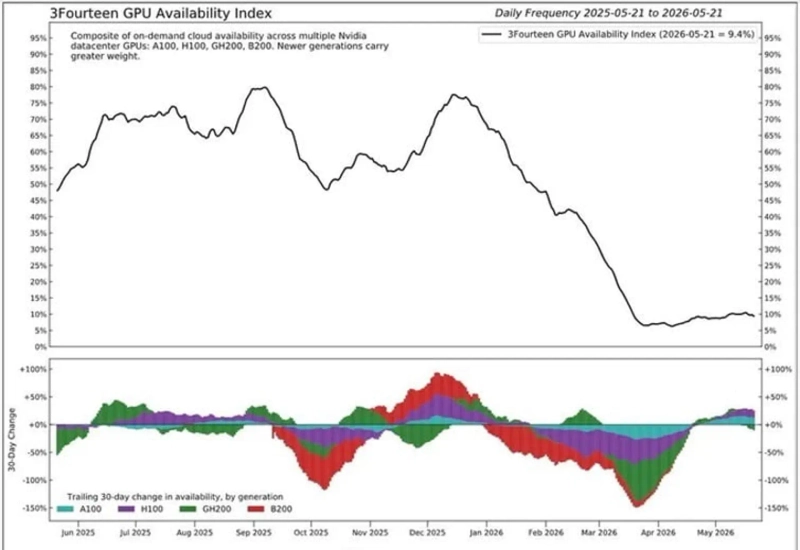
Companies that need to rent GPUs struggle to estimate future costs. Companies that lease them out have difficulty forecasting revenue. Hyperscalers face repeated questions about whether returns justify the cost whenever they invest in large data centers. That is why Ornn Chief Executive Officer Kush Bavaria, whose company produces a GPU compute index, said the computing market has grown into a $1 trillion industry yet still lacks the pricing and risk-transfer infrastructure seen in every other major commodity market.
Once a futures market is in place, AI compute would have prices for three months, six months and one year forward, just as crude oil does. That could give AI companies that rent GPUs more predictable costs, while providing cloud and data-center operators with a benchmark for revenue pricing. Hwang Su-wook, an analyst at Meritz Securities, said AI infrastructure spending could shift from a vague preemptive investment to one backed by expectations of specific future returns.
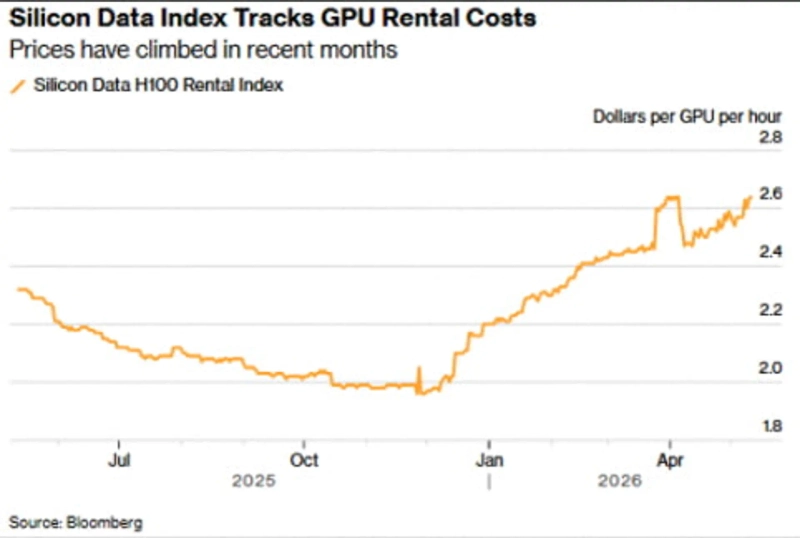
Futures contracts would also give companies and investors a way to hedge the steep volatility in GPU rental rates. Demand has surged in the AI boom, driving rental prices sharply higher, yet there is currently no transparent way to manage that risk. Once futures begin trading, compute costs could be locked in much as utilities or airlines hedge energy prices. Carmen Li, founder of Silicon Data, which provides GPU rental-rate data to CME, said the futures market would help users secure GPU access in a cost-efficient way.
This effort to commoditize computing power rather than GPUs themselves also shows what investors see as most important in the current AI cycle. The issue is no longer simply how many GPUs a company can secure. It is how much compute those GPUs can generate, and how effectively that can be translated into revenue and cash flow. That also suggests the AI investment cycle is entering a more mature phase.
The emergence of compute futures could reshape markets and the AI rally, influence what investors watch in the next cycle of AI infrastructure spending, and raise fresh questions about whether another AI bubble is forming.
Bin Nan-sae, New York correspondent, Hankyung.com, binthere@hankyung.com

Korea Economic Daily
hankyung@bloomingbit.ioThe Korea Economic Daily Global is a digital media where latest news on Korean companies, industries, and financial markets.