Foreigners Dump $67 Billion of Korean Stocks This Year, Pushing Won Toward 1,520
Summary
- Foreign investors have net sold nearly 100 trillion won of South Korean stocks this year, adding pressure to the rise in the won-dollar exchange rate.
- The US 30-year Treasury yield climbed above 5.2%, deepening dollar strength and won weakness.
- South Korea’s real effective exchange rate (REER) fell to its lowest level in 17 years, leaving the won’s value near the bottom among major economies.
Forecast Trend Report by Period


Foreign investors net sold 92 trillion won ($67.2 billion) of South Korean stocks this year
Rebalancing sales are adding to pressure
Rise in US 30-year Treasury yield above 5.2% also weighs
Won’s real purchasing power falls to lowest in 17 years
“Foreign investors are the villain.”
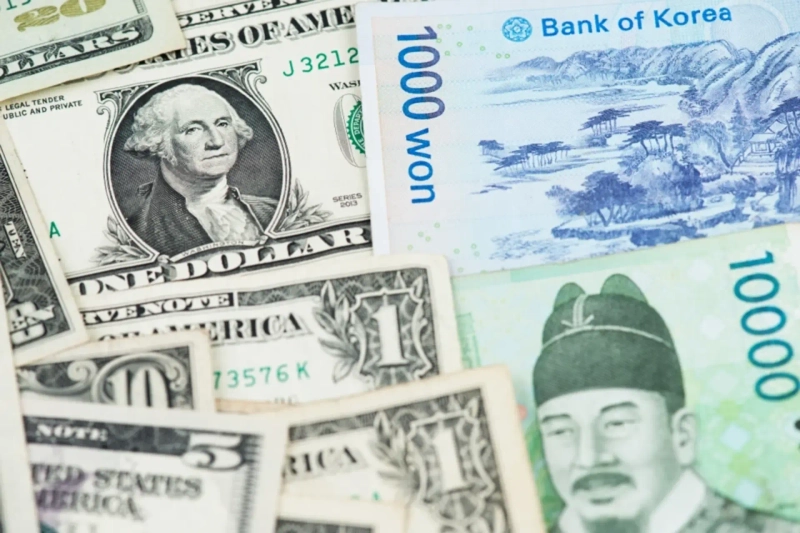
Market participants and South Korean foreign-exchange officials used that phrase to explain why the won is nearing 1,520 per dollar. Foreign investors have been net sellers of nearly 100 trillion won ($73.2 billion) of South Korean stocks this year, adding upward pressure on the won-dollar exchange rate.
The selling is being driven in part by portfolio rebalancing. Sharp gains in semiconductor shares such as Samsung Electronics and SK Hynix have increased Korea’s weight in global portfolios, prompting pension funds and passive funds to mechanically cut holdings to bring allocations back in line. Amid the heavy foreign selling, the won’s purchasing power has fallen to its weakest level since the aftermath of the global financial crisis 17 years ago.
According to the Seoul foreign-exchange market, the won closed at 1,517.4 per dollar at 2 a.m. on May 23, up 11.3 won from the previous session. That was 0.2 won higher than the regular daytime session close of 1,517.2 won at 3:30 p.m. on May 22. Based on the overnight close, it was the highest since March 30, when the won ended at 1,518.2 per dollar.
One driver of the move was a rise in US Treasury yields. The 30-year Treasury yield briefly climbed to 5.20% on May 19, the first time it had topped 5.2% since July 2007, just before the global financial crisis.
The 10-year Treasury yield also rose as high as 4.69%, the highest since January 2025. Long-term yields later eased, with the 30-year and 10-year ending May 22 at 5.06% and 4.56%, respectively. Markets viewed the move as reflecting renewed inflation concerns and the possibility of additional rate increases by the Federal Reserve.
Higher Treasury yields tend to draw global funds into the US on the prospect of better returns. That boosts demand for dollars and puts downward pressure on the won. Rising market rates also strengthen demand for haven assets, adding to the dollar’s advance.
Foreign investors’ rebalancing sales are compounding the won’s weakness. According to the Korea Exchange, foreign holdings of domestic stocks totaled 2,600.3578 trillion won ($1.90 trillion) as of May 22. That was more than triple the 711.9833 trillion won ($521.2 billion) recorded on May 22, 2025.
The increase reflects a surge in the market value of semiconductor stocks including Samsung Electronics and SK Hynix, which rapidly lifted Korea’s weighting in global emerging-market portfolios.
Many global pension funds and sovereign wealth funds tightly manage target allocations by country and asset class. When Korea’s weighting rises above target because of stock gains, they automatically trim Korean equities through rebalancing sales. Norway’s sovereign wealth fund, for example, sets a 70% target for equities and carries out mechanical rebalancing when the actual weighting deviates by more than 2 percentage points.
Foreign net selling is also having a direct impact on the foreign-exchange market. Investors who sell local stocks convert won proceeds into dollars, increasing pressure on the exchange rate. In the market’s view, dollar demand tied to foreign rebalancing is outweighing dollar-selling flows from Korean exporters such as Samsung Electronics and SK Hynix.
Against that backdrop, the won has fallen into the bottom tier among major currencies. According to the Bank for International Settlements, South Korea’s real effective exchange rate, or REER, stood at 85.06 in April, with 2020 set equal to 100. That extended a three-month decline from 87.02 in January and marked the lowest level since March 2009, when it stood at 79.31.
The REER measures a currency’s real purchasing power by reflecting exchange rates and prices against trading partners. A reading below 100 is typically seen as indicating that a currency is undervalued relative to the base year.
On a cross-country basis, the won is near the bottom of the rankings. Last month, South Korea ranked 63rd out of 64 countries in REER, second only to Japan, which stood at 65.7.
Kim Ik-hwan, Hankyung.com reporter, lovepen@hankyung.com

Korea Economic Daily
hankyung@bloomingbit.ioThe Korea Economic Daily Global is a digital media where latest news on Korean companies, industries, and financial markets.