PiCK
Bitcoin Long-Term Holders Distribute 15.2 Million BTC as Demand Falls to 2026 Low
Summary
- According to CryptoQuant, long-term holders, or LTHs, distributed about 15.2 million Bitcoin in the current cycle, bringing the total close to a historic high.
- Darkfost said Bitcoin's apparent demand has fallen to its most negative level since the start of the year (close to -147,000 BTC), making a sustained rally difficult without a recovery in spot demand.
- He said the current demand slowdown and pessimistic sentiment may look bearish in the short term, but could create an interesting environment for patient long-term investors.
Forecast Trend Report by Period


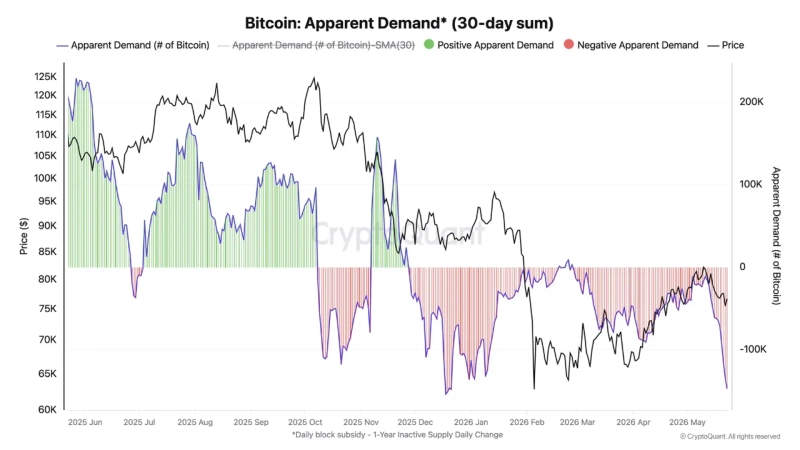
Bitcoin long-term holders have distributed about 15.2 million tokens in the current cycle, a figure nearing a historical peak, while demand has weakened to its lowest level of the year, raising doubts about the durability of any near-term rally.
CryptoQuant analyst Darkfost wrote in a Quicktake report published May 25 that long-term holders, or LTHs, distributed roughly 15.2 million Bitcoin during this cycle.
That total was not the highest on record for a cycle, despite expectations to the contrary, including his own. Still, the amount of Bitcoin spent by long-term holders was close to a historical record.
The figure remains below the more than 15.3 million BTC recorded in the 2021 cycle. Comparable totals were 13.7 million BTC in 2017 and 7.4 million BTC in 2013.
Under this methodology, Bitcoin is classified as long-term holder supply if it has not moved for six months. That means the same coin can be counted multiple times if it is sold and later reclassified as long-term holder supply.
Distribution by long-term holders is generally interpreted as Bitcoin moving from older holders to new investors. As Bitcoin's market depth and market capitalization have expanded, long-term holders, especially the oldest ones, have been able to distribute coins more efficiently without causing the kind of market shock seen in earlier cycles.
Darkfost described the process as a large-scale transfer of wealth from old hands to new ones. The 2021 and 2025 cycles stand out as the periods with the largest rotation on record.
On the demand side, the signal has turned clearly bearish. Bitcoin's apparent demand has dropped to its most negative level since the start of the year, with the current estimate approaching minus 147,000 BTC.
According to the report, one would have to go back to December 2025 to find a similarly weak reading.
Apparent demand is calculated by comparing new issuance with changes in supply that has remained unmoved for more than one year. The metric is used to assess whether structural accumulation demand is strong enough to absorb newly created supply on the network.
The trend suggests demand is continuing to shrink gradually. Without a meaningful recovery in spot demand, Bitcoin will struggle to sustain a lasting rally on futures-led momentum alone.
Futures can support short-term momentum and amplify price swings, but a sustainable bull market usually requires genuine spot demand. Derivatives alone cannot build a stable and resilient market foundation.
Even so, Darkfost said the current bearish backdrop could offer an opportunity for long-term investors. While conditions may appear weak in the short term, similar environments have historically created opportunities for patient investors.
Periods of sharply slowing demand and excessively pessimistic sentiment are often the moments that merit the closest attention, he added.

Minseung Kang
minriver@bloomingbit.ioBlockchain journalist | Writer of Trade Now & Altcoin Now, must-read content for investors.