Mirae Asset to List 2x Samsung Electronics, SK Hynix ETFs on May 27, Touting Liquidity
Summary
- Mirae Asset Global Investments said it will list the TIGER Samsung Electronics Single Stock Leverage ETF and TIGER SK Hynix Single Stock Leverage ETF, with a structure designed to track twice the daily returns of the two stocks.
- Mirae Asset Global Investments said it had attracted 329 billion won ($239 million) in foreign capital and adopted a cash creation method to maximize liquidity, highlighting its effect in narrowing bid-ask spreads and reducing tracking gaps.
- South Korea's financial authorities warned that single-stock leveraged products magnify gains and losses by 2 times the move in the underlying asset, raising the risk of large short-term losses and distortions in cumulative returns due to leverage effects and negative compounding.
Forecast Trend Report by Period


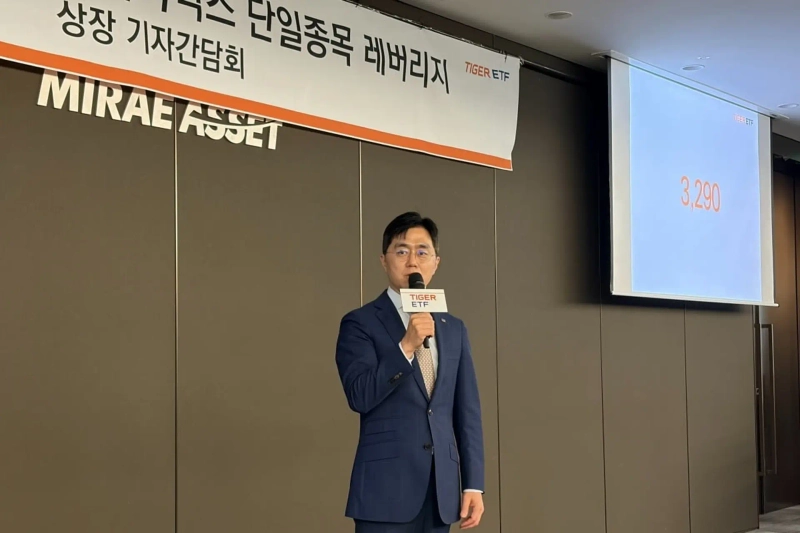
South Korea will introduce leveraged exchange-traded funds tied to single stocks on May 27, with products that aim to deliver twice the daily return of one underlying share. Ahead of the launch, Mirae Asset Global Investments Co. and Samsung Asset Management Co., two of the industry's leading firms, held separate press briefings. A total of eight asset managers are rolling out single-stock leveraged ETFs.
Mirae Asset held a press briefing on May 26 at its Center 1 building in central Seoul to outline the structure of its TIGER Samsung Electronics Single Stock Leverage ETF and TIGER SK Hynix Single Stock Leverage ETF, as well as key investor considerations. Attendees included Vice President Kim Nam-ki, Managing Director Lee Jung-hwan and division head Choi Chang-gyu.
The TIGER Samsung Electronics Single Stock Leverage ETF and TIGER SK Hynix Single Stock Leverage ETF are designed to track twice the daily return of Samsung Electronics Co. and SK Hynix Inc., respectively.
Mirae Asset touted ample liquidity as a key differentiator. Kim said the original purpose of introducing single-stock leveraged products was to help stabilize the won-dollar exchange rate. To align with that goal, the firm prepared by viewing overseas managers already offering similar products as its main competitors rather than domestic peers.
Kim said the single-stock leveraged products due to list on May 27 had attracted 329 billion won ($239 million) in foreign capital. He added that the inflows could make a significant contribution to stabilizing the won-dollar exchange rate. Some foreign investors specialize in trading ETFs, and many institutions may be entering the Korean stock market for the first time through these products.
Mirae Asset also highlighted its use of cash creation, saying the structure can maximize liquidity. Kim said narrowing bid-ask spreads is critical to boosting liquidity and that cash creation helps reduce tracking gaps. With in-kind creation, authorized participants must also bear securities transaction taxes and holding taxes, which can constrain their ability to provide quotes.
Samsung Asset Management also held a press briefing the same day at The Plaza hotel in central Seoul to introduce its KODEX Samsung Electronics and SK Hynix single-stock leveraged ETFs. The firm said the main feature of the two products is a cash-equity leveraged structure with in-kind creation.
Samsung Asset Management said it reduced the share of futures in the portfolio, lowering trading costs associated with monthly contract rollovers. It also said it was the first in the industry to structure subscriptions and redemptions for leveraged products as in-kind transactions, reducing hidden costs.
According to the industry, 10 of the 16 single-stock leveraged ETFs being launched are cash-equity products that use both stocks and futures. The remaining six are futures-based products managed solely through futures positions.
Still, single-stock leveraged products that seek to deliver twice a stock's daily return carry high investment risk. South Korea's financial authorities said in a statement on May 26 that investors in such products may face leverage effects and negative compounding.
The authorities said gains and losses are magnified to twice the move in the underlying asset, meaning investors can incur large losses over a short period. They also said repeated rises and declines in a single stock can erode principal, causing cumulative returns over the holding period to diverge from twice the underlying asset's move.
Lee Su, Hankyung.com reporter, 2su@hankyung.com

Korea Economic Daily
hankyung@bloomingbit.ioThe Korea Economic Daily Global is a digital media where latest news on Korean companies, industries, and financial markets.