PiCK
South Korea’s Parties Court Crypto Voters With Bitcoin ETF Push, Tax Repeal Pledge
Forecast Trend Report by Period


Ahead of South Korea’s June 3 local elections, the country’s two main parties have unveiled cryptocurrency policy pledges aimed at winning over digital-asset investors. Both included crypto proposals in their campaign platforms. While they share a broad commitment to putting the industry on a formal legal footing, they diverge on the details.
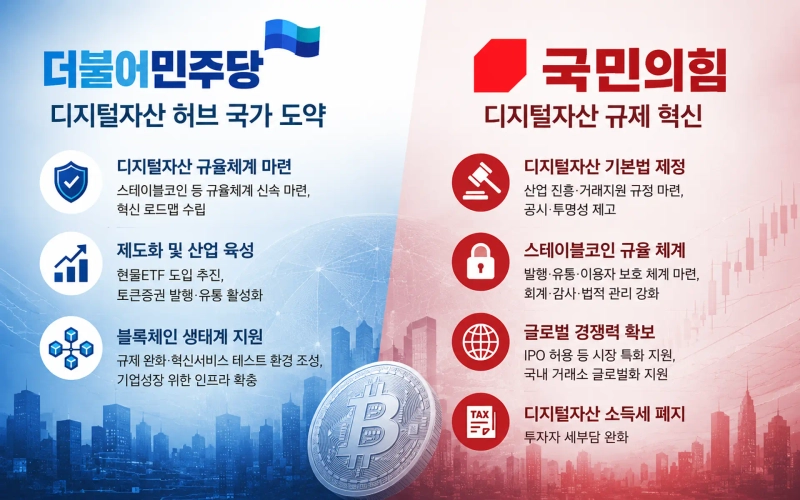
In policy books released for the ninth nationwide local elections, the Democratic Party and the People Power Party both called for enacting a Digital Asset Basic Act and establishing a regulatory framework for stablecoins. Both parties pledged to clarify entry and operating rules for virtual-asset service providers and swiftly create legal standards covering stablecoin issuance, reserve-asset management and user protection. The aim is to improve predictability for the industry and build a sound market foundation.
Ruling Party Pushes Bitcoin ETF, Opposition Targets Tax Repeal
The common ground largely ends there.
The Democratic Party laid out a vision of making South Korea a digital-asset hub, focusing on expanding the crypto market and fostering the industry. A central pledge is the gradual institutionalization of crypto-related products. The party said it would actively pursue spot exchange-traded funds based on digital assets and encourage issuance and trading of tokenized securities, or STOs, that can make use of smart contracts.
It also pledged to create conditions for freely testing innovative digital-asset services by identifying private-sector pilot projects and simplifying regulations. The platform also calls for making blockchain special zones more effective and expanding regional infrastructure to support business growth. Unlike its pledge in the previous general election to raise the tax-free threshold for crypto investment gains to 50 million won and allow loss offsets and carry-forwards, the party’s latest platform made no mention of crypto taxation.
The People Power Party, by contrast, put abolishing the tax on virtual-asset income at the center of its platform. Rather than emphasizing broader ecosystem expansion, it is focusing on eliminating what it sees as an immediate burden on investors. The party has already proposed a bill to scrap crypto taxation and formally adopted that position as party policy.
Its platform also included measures to improve market structure and strengthen transparency. The party said it would create digital-asset trading support rules and introduce a disclosure regime comparable to that of capital markets. On concentration in the exchange industry, it said it would encourage initial public offerings rather than intervene directly, with the goal of easing market dominance and helping firms expand overseas. In the public sector, it also pledged to introduce distributed ledger technology, or blockchain, to create what it described as a microscope-style verification system that would record every detail of budget execution for state-led projects on a digital ledger.
Smaller third-force parties have largely stepped back from the crypto issue. The Rebuilding Korea Party and the New Reform Party did not publish separate policy books for the local elections and have yet to present specific proposals on virtual assets or promotion of the blockchain industry.
Digital Asset Basic Act Remains the Key as Industry Awaits Faster Legislation
With both major parties backing a Digital Asset Basic Act, second-stage legislation is shaping up as the top priority for addressing the industry’s backlog of unresolved issues.
South Korea’s crypto market is currently operating under the first-stage Virtual Asset User Protection Act, which took effect in July 2024. The law created minimum safeguards, including penalties for unfair trading and obligations for service providers. But key measures needed to establish market order remain absent. Debate over second-stage legislation, which would cover won-denominated stablecoin issuance and distribution as well as the introduction of spot crypto ETFs, has stalled for more than a year because of disagreements over individual provisions.
Second-stage legislation is especially critical for the launch of spot ETFs. Such funds must legally track assets recognized under the law, and virtual assets are not currently recognized as eligible underlying assets. A Digital Asset Basic Act now pending in the National Assembly includes a provision that would allow crypto assets to be incorporated as underlying assets within regulated finance.
Industry participants are urging lawmakers to move quickly now that both parties have explicitly written passage of the basic law into their campaign platforms. They say clear rules governing crypto issuance and distribution are needed before more complex issues such as spot ETF approval and stablecoin issuance can be resolved. Politicians have also signaled a willingness to accelerate the legislative process after the local elections.
Rep. Ahn Do-geol of the Democratic Party said at a stablecoin forum hosted by the party’s Digital Asset Task Force on May 27 that once the local elections and other major National Assembly schedules are concluded, he would support proposing and advancing the bill in the second half of the year after consultations with relevant agencies on outstanding issues. Once the second-half membership of the National Assembly’s Political Affairs Committee is in place, he added, he would seek to make the bill a priority through bipartisan talks.
Rep. Kim Sang-hoon of the People Power Party said on May 12 that once the local elections are over, lawmakers would place review of the Digital Asset Basic Act on the agenda and begin deliberations immediately.
An official at the Democratic Party’s Digital Asset Task Force said four lawmakers from both parties, including Democratic Party Rep. Min Byoung-duck, are expected to travel to the US soon. The official said the trip could help speed up the bill by prompting active discussions on how US crypto regulations could be adapted for South Korea.

Doohyun Hwang
cow5361@bloomingbit.ioKEEP CALM AND HODL🍀