BOK Signals Second-Half Rate Hikes as Governor Shin Unveils Hawkish Stance
Summary
- The Bank of Korea formally signaled a benchmark rate hike in the second half and set the median of its dot plot at 3.0%, sending a strong hawkish signal to markets.
- The BOK raised its economic growth forecast for this year to 2.6% and its consumer inflation forecast to 2.7%, underscoring its determination to pursue a rate hike amid mounting upside pressure on prices.
- Markets are increasingly pricing in two benchmark rate hikes this year, including one in July, with government-bond yields rising across the board as expectations for higher rates spread.
Forecast Trend Report by Period


Shin Says Path for Policy Is Clear, Formalizes Second-Half Rate Hikes
Bank of Korea Delivers Hawkish Hold
Raises 2026 Growth Forecast to 2.6%
Markets See at Least Two Rate Hikes This Year
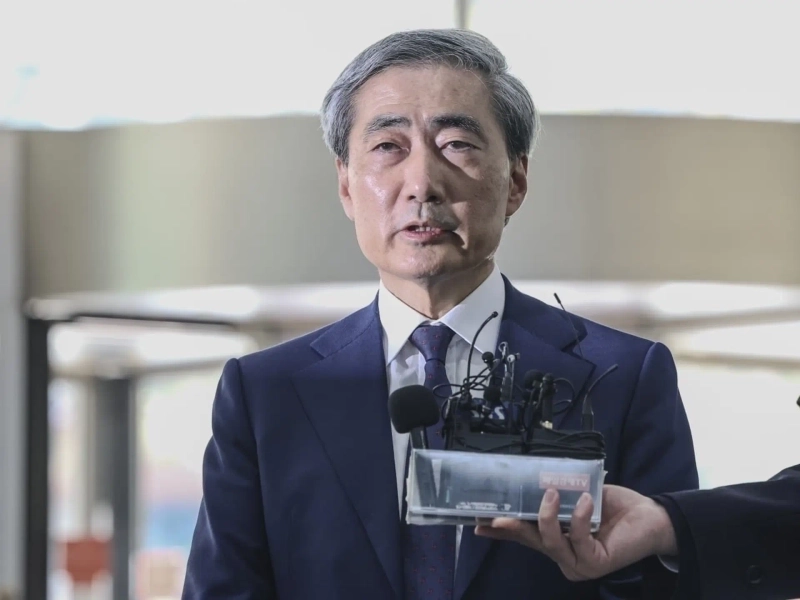
“The path ahead is clear whether you look at inflation, growth, the exchange rate or housing. We will raise the benchmark rate going forward and manage these factors consistently,” Bank of Korea Governor Shin Hyun-song said.
The Bank of Korea formally signaled benchmark-rate increases in the second half of 2026. Shin, presiding over his first Monetary Policy Board meeting since taking office, openly pointed to higher rates at a press briefing and struck a strongly hawkish tone. Markets are increasingly treating at least two rate hikes this year as a base case, with some investors looking for a move as early as July.
The Monetary Policy Board left the benchmark rate unchanged at 2.50% on May 28. The focus was less on the widely expected hold than on the dot plot and Shin’s guidance on the future rate path.
Of the 21 dots released that day, 19 were above the current policy rate. The chart shows each of the seven board members’ projections for the benchmark rate six months ahead, with three dots per member. Ten dots pointed to 3.0%, the largest cluster. Seven were at 2.75% and two at 3.25%. The median rose to 3.0% from 2.50% in February. Board members Rhee Sang-dae and Jang Yong-sung also dissented, arguing for an immediate increase to 2.75%.
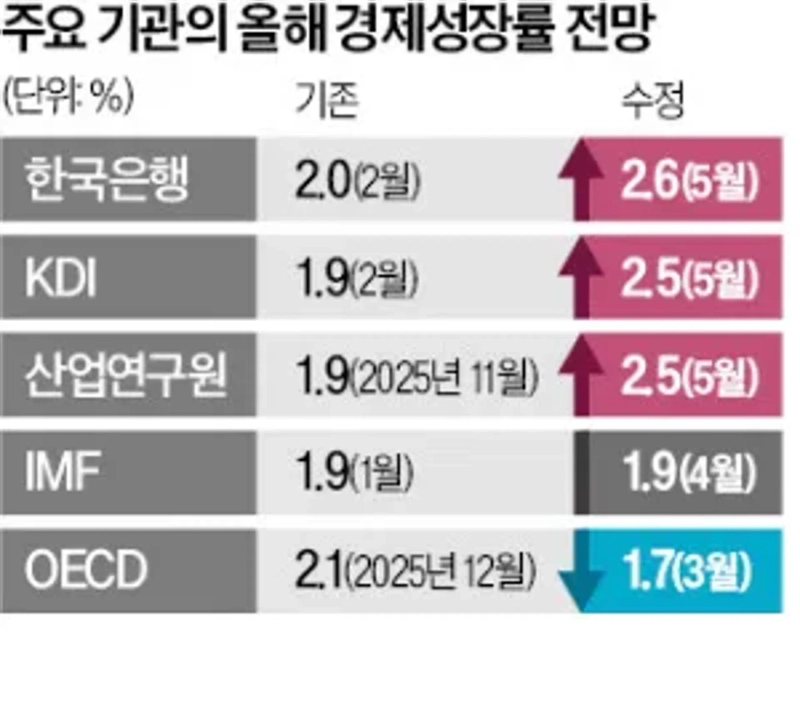
The BOK’s shift toward tightening reflects firm growth and rising price pressure. The central bank raised its 2026 growth forecast by 0.6 percentage point to 2.6%. It also lifted its forecast for consumer inflation this year to 2.7% from 2.2%.
Nineteen of 21 Dots Signal a Hike, With July in Play
“Semiconductor Boom to Last for Some Time ... Upside Pressure on Prices Is Quite High”
Shin’s decision to formally flag second-half rate hikes at his first policy meeting reflects persistent inflation and exchange-rate pressure tied to the prolonged Middle East war. A surge in semiconductor exports has also pushed growth well above earlier expectations, strengthening the case for higher borrowing costs.
Growth Forecast for Next Year Also Raised
In revised economic projections released on May 28, the BOK forecast real gross domestic product growth of 2.6% this year, up 0.6 percentage point from its February forecast of 2.0%. That is well above estimated potential growth of about 1.8% and would mark the fastest pace since 2022, when the economy grew 2.7%.
The BOK said the Middle East war would subtract 0.4 percentage point from growth this year, while strong semiconductor exports would add 0.7 percentage point. A supplementary budget and the stock-market rally would contribute 0.2 percentage point and 0.1 percentage point, respectively. Shin said growth could reach 2.7% this year if the Middle East conflict eases early.
The central bank projects the economy will expand 0.2% in the second quarter from the previous quarter, supported by exports. Growth would then slow to 0% in the third quarter because of energy supply-demand imbalances before recovering to 0.4% in the fourth quarter as energy supply chains normalize.
The BOK also raised its 2027 growth forecast to 2.1% from 1.8%. The revision reflects the view that the semiconductor supercycle will remain strong into next year. Shin said it was more appropriate to put weight on the view that the current growth cycle would last for a considerable period rather than treat it as temporary. He added that semiconductor output cannot be ramped up quickly, meaning prices could stay elevated for some time. Next year, the GDP gap — real growth minus potential growth — is also set to turn positive.
Rate Hikes Aimed at Blocking Second-Round Inflation Effects
Shin said he was highly alert to so-called second-round effects from the recent rise in prices. Recent inflation could stir inflation expectations. If higher global oil prices push inflation up further, workers may demand wage increases to protect real incomes. Companies, in turn, may raise prices for goods and services to offset higher labor costs, creating an inflation spiral. Rising grocery prices could also fuel expectations that inflation will remain elevated.
“The public’s perceived cost-of-living index rose to 2.9% last month,” Shin said. “There appears to be quite strong upside pressure on prices at the moment.” He added that inflation would peak roughly in the second half of this year. With consumer prices rising 2.6% in April, that implies inflation could climb well above 3% later this year.
The BOK’s signal on higher rates underscores its intent to act before inflation expectations rise too far. Shin said a rate increase at this meeting could have been justified persuasively. Even so, the dominant view was to place greater weight on uncertainty and wait for now.
After a more hawkish-than-expected meeting, markets are now looking to July for the BOK’s next move. Lim Jae-kyun, an analyst at KB Securities, said the central bank would raise the benchmark rate in July and then deliver one more increase later this year. In Seoul’s bond market, government-bond yields rose across the curve. The three-year Korean Treasury yield climbed 5.5 basis points to 3.766%, while the 10-year yield rose 4.5 basis points to 4.147%.
Shim Seong-mi, Korea Economic Daily reporter smshim@hankyung.com

Korea Economic Daily
hankyung@bloomingbit.ioThe Korea Economic Daily Global is a digital media where latest news on Korean companies, industries, and financial markets.