South Korea Pension Fund Raises Domestic Stock Target to 20.8%, Easing Selloff Fears
Summary
- The National Pension Service raised the target allocation for domestic stocks to 20.8% from 14.9%, easing fears of a pension-driven wave of selling.
- The National Pension Service adjusted the allowable SAA range for domestic equities and the daily rebalancing volume, reducing the likelihood that sell orders will be concentrated over a short period.
- The National Pension Service has reassessed domestic equities as a key asset class driving the fund’s overall returns and reflected that view in its medium-term asset allocation plan.
Forecast Trend Report by Period



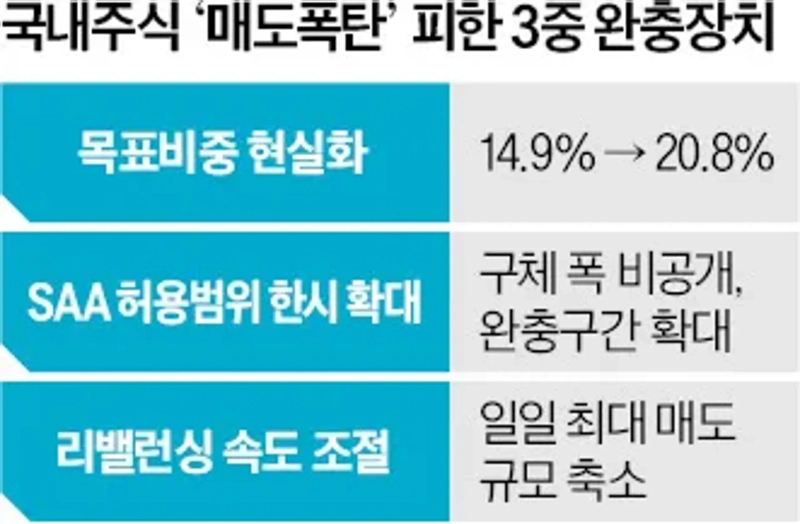
South Korea’s National Pension Service raised its target allocation to domestic equities to 20.8% from 14.9%, reflecting a sharp increase in the value of local stock holdings during this year’s rally in semiconductor shares. It also temporarily widened the allowable range for strategic asset allocation and trimmed the maximum daily rebalancing volume, easing concerns over a wave of pension-driven selling.
The National Pension Fund Management Committee under the Ministry of Health and Welfare approved the 2026 target weights for each asset class and a medium-term asset allocation plan for 2027 through 2031 at its fifth meeting on May 28 at the government complex in Seoul. The committee increased the 2026 target for domestic equities by 5.9 percentage points to 20.8% from 14.9%, citing the possibility of structural changes in the local stock market following revisions to the Commercial Act and the increase in the fund’s actual holdings.
The new domestic equity target will take effect at the end of June, when a temporary suspension of rebalancing expires. As of the end of 2026, the fund’s target allocation is set at 20.8% for domestic equities, 34.7% for overseas equities, 23.1% for domestic bonds, 7.4% for overseas bonds and 14.0% for alternative investments. Other asset-class targets were also adjusted to reflect the higher domestic equity weighting.
The committee also decided to temporarily widen the allowable band for strategic asset allocation, or SAA, for domestic stocks from the current plus or minus 3 percentage points. Combined with tactical asset allocation, or TAA, of plus or minus 2 percentage points, the framework means the National Pension Service could hold more than 25.9% in domestic equities. A wider SAA band gives the fund room to avoid immediate selling even if its actual weighting rises above target. The ministry did not disclose the new SAA band, citing fairness in fund management and the potential impact on financial-market stability. The committee separately decided to reduce the maximum daily rebalancing volume.
The pension fund’s domestic equity weighting has climbed rapidly this year as the local stock market rallied. In January, the committee raised this year’s target for domestic equities to 14.9% from 14.4% and suspended rebalancing through June. Since then, gains in large-cap shares including Samsung Electronics Co. and SK Hynix Inc. have sharply increased the marked-to-market value of domestic equities.
The latest asset-allocation change is set to support flows in the domestic stock market. The National Pension Service is the market’s biggest long-term investor, holding about 8% to 9% of total market capitalization and stakes of more than 5% in about 260 listed companies. Its current domestic equity weighting is above 27%, still higher than the new target, but the wider SAA band and lower daily rebalancing cap reduce the risk of concentrated selling over a short period.
How much domestic stock the pension fund can hold depends on the permissible ranges for SAA and TAA. Under the previous framework, the 14.9% target for domestic equities, combined with an SAA band of plus or minus 3 percentage points and a TAA band of plus or minus 2 percentage points, allowed the fund to hold as much as 19.9%. SAA permits a gap within set limits between target and actual holdings, while TAA allows the fund management arm to make short-term adjustments based on market conditions.
That buffer has widened under the latest decision. The domestic equity target was lifted to 20.8%, and the SAA band was also temporarily expanded. The ministry withheld the exact SAA range because disclosing the fund’s domestic stock thresholds could allow investors to price them in beforehand, undermining efforts to limit market disruption.
The change to the rebalancing rules is also significant. The National Pension Service normally buys or sells assets to bring holdings back within the allowable SAA range when allocations move outside that band. This time, it added another safeguard against market impact by cutting the maximum daily rebalancing amount. Even after the rebalancing suspension ends in late June, the fund will be able to adjust the pace in line with market conditions rather than trigger an immediate wave of large-scale selling.
The National Pension Service also signaled a change in its long-term roadmap for reducing domestic equity exposure. It had planned to lower the weighting of domestic stocks by 0.5 percentage point a year through 2030 as it prepared for an era of net fund outflows. The strategy was aimed at diversifying assets by increasing overseas stocks and alternative investments because disposing of domestic assets all at once would be difficult as pension payouts rise with population aging.
As South Korea’s stock market has been reassessed on optimism around semiconductors and artificial intelligence, domestic stocks have become harder to treat simply as assets to be reduced. Large semiconductor names such as Samsung Electronics and SK Hynix have led gains in the Kospi, while stronger shareholder returns and expectations for corporate value-up measures have turned domestic equities into a core asset class supporting the pension fund’s overall returns. The higher target for domestic stocks reflects those market changes in the long-term investment framework.
The committee also finalized the direction of its medium-term asset allocation plan. It kept its broader stance of expanding overseas and alternative investments while setting the end-2031 target at about 55% for equities, about 30% for bonds and about 15% for alternative investments. The target for domestic equities in 2027 will remain unchanged from 2026 at 20.8%. Other 2027 targets are 35.6% for overseas equities, 21.8% for domestic bonds, 7.4% for overseas bonds and 14.3% for alternative investments.
Some concerns remain over the pension fund, a long-term investor, revising its asset-allocation rules during a stock-market rally. The National Pension Service also widened the tolerance range for deviations from its domestic equity target in 2021 amid the retail-investing boom and political pressure to refrain from selling. At the time, the stated aim was to limit market shock, but global monetary tightening and a stock-market correction hit the following year, driving returns on domestic equities down 22.76%. Balancing short-term market stability with long-term asset-allocation principles remains a challenge.
Health and Welfare Minister Jeong Eun-kyeong said the medium-term asset allocation plan was designed to improve the National Pension Fund’s long-term returns and stability in response to recent market changes while also considering its effect on financial markets. The government will continue to closely monitor markets and seek a balance between principle and flexibility in managing the fund, she added.
Min Kyung-jin, Hankyung.com reporter min@hankyung.com

Korea Economic Daily
hankyung@bloomingbit.ioThe Korea Economic Daily Global is a digital media where latest news on Korean companies, industries, and financial markets.