Sold at Kospi 8,000? Brokerages Now See 9,000, With Some Mapping a 12,000 Scenario
Summary
- Domestic and global brokerages raised their Kospi targets to 9,000 to 12,000, arguing that AI and semiconductors are driving the bull market.
- The rally led by Samsung Electronics and SK Hynix is continuing as semiconductor earnings improve and EPS and PER metrics strengthen.
- Still, volatility risks remain, including interest rates and inflation, the AI investment cycle, and global IPOs, with some firms also presenting a downside scenario of 6,000.
Forecast Trend Report by Period


Kospi has surged more than 100% this year
AI and semiconductors have led the rally
Calls for 9,000 are growing
Some firms now see a path to 10,000 and beyond
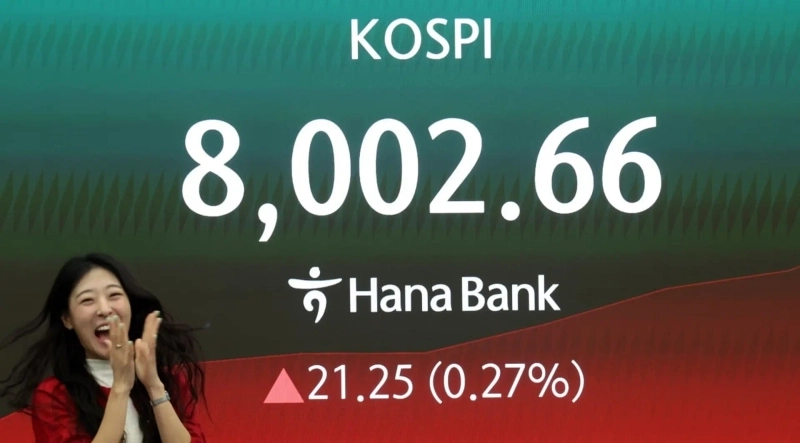
South Korea’s Kospi has continued its sharp climb this year, and brokerages are rapidly raising their targets for the benchmark index. Major domestic and global securities firms are now pointing to levels around 9,000, citing expanding artificial intelligence investment and higher profit forecasts for semiconductor companies. Some have gone further, laying out scenarios in which the index rises above 10,000.
Kospi Up More Than 100%
A June 1 compilation of Kospi forecasts from major domestic and global brokerages by Epic AI, an AI-based investment information platform operated by Hankyung, showed NH Investment & Securities and Goldman Sachs both targeting 9,000. Hyundai Motor Securities lifted its year-end target to 9,750, while Kyobo Securities, Hana Securities and LS Securities left open the possibility of 10,000.
The Kospi started the year at 4,224.53 and reached 8,476.15 on May 29, up about 100% from the start of the year. Monthly trading was volatile. The index rose 23.97% in January and 19.52% in February, breaking above 5,000. It then fell 19.08% in March after the US-Iran war, before rebounding 30.61% in April and 28.45% in May to fresh highs.
Semiconductor stocks were at the center of the advance. Expanding global AI investment and stronger demand for high-bandwidth memory, or HBM, lifted earnings expectations for Samsung Electronics and SK Hynix. Forecasts for Kospi earnings per share also moved sharply higher.
Even after the surge, brokerages argue valuations are not as stretched as expected. Profit estimates have risen along with share prices, leaving the market’s price-to-earnings ratio still below its historical average.
In a May 7 report, NH Investment & Securities raised its 12-month forward Kospi target to 9,000 from 7,300. Analyst Kim Byung-yeon wrote that while interest rates and risk premiums climbed after the war, corporate earnings estimates were rising even faster.
NH Investment & Securities cited a 36% increase in its Kospi EPS outlook, compared with the assumptions behind its earlier 7,300 target, as the main reason for the upgrade. The firm also pointed to core inflation that has remained more stable than expected after the war and to a steadier won-dollar exchange rate supported by the expansion of integrated foreign investor accounts.
Global investment banks are also turning more constructive on South Korean equities. Goldman Sachs raised its Kospi target to 9,000 and named South Korea its preferred market in Asia, saying the market still has room to climb after a strong rally.
JPMorgan said the supply-demand imbalance in memory semiconductors could widen further next year. It also noted that customers are bringing forward orders originally planned for 2027 because of supply shortage concerns.
More Calls for 10,000
Among domestic brokerages, Hyundai Motor Securities stands out. In its second-half investment strategy report, the firm set a year-end Kospi target of 9,750. Its base-case scenario assumes concerns over the durability of semiconductor earnings ease and valuations in the chip sector recover to their 2018 average.
Hyundai Motor Securities estimated the semiconductor sector’s market capitalization could rise 36% if a 12-month forward PER of 6.25 times is applied to its 2027 net profit estimate. On that basis, and converted to the broader market’s total capitalization, the Kospi would reach 9,750.
In a bullish scenario, the firm said the index could climb to 12,000. That assumes the semiconductor sector PER rises to 8 times, in line with Micron Technology, and non-chip shares also strengthen on retail investor inflows. It also presented a downside case in which the index falls to 6,000 if intensifying AI competition hurts investor sentiment and pushes the market into a downturn.
Kyobo Securities set a second-half Kospi band of 7,000 to 10,000. The firm said the first-half rally was driven by the AI-HBM cycle centered on Samsung Electronics and SK Hynix and by upward revisions to semiconductor earnings forecasts. In the second half, it expects earnings improvement to spread to non-semiconductor sectors.
Hana Securities said the Kospi could enter a 10,000 era. If the market is already pricing in 2027 net profit and current earnings estimates are realized, the index could move above 10,000. Based on the Kospi’s market capitalization, the firm sees a possible level of 10,380.
LS Securities also raised the top end of its Kospi range to 10,000 from 8,000. It cited a sustained AI growth cycle and continued inflows from retail investors. Even so, the firm said it would be hard to expect the same pace of record-setting gains seen earlier.
Daishin Securities said the Kospi could rise to 9,200 on valuation normalization alone. The firm argued the market has further upside as semiconductor net profit forecasts continue to move higher. It also pointed to a jump in 12-month forward EPS to 1,015 on May 29 from 611.6 at the end of February.
Meritz Securities presented the highest forecast in the data compiled by Epic AI. It projected the Kospi would reach 11,500 by year-end, based on 2027 net profit, return on equity, PER and price-to-book ratio. Its target PER was set at 9.2 times, below the average of the past 20 years.
Samsung Securities presented a June Kospi band of 7,200 to 9,200, based on a 12-month forward PER of 8 to 10.3 times. The firm said earnings trends in the global IT sector remain solid and that, absent a major shock, keeping a heavy weighting in IT and related infrastructure would be advantageous.
The Key Is Whether Semiconductor Earnings Can Keep Rising
The reasons behind the higher targets are broadly similar. Brokerages say stronger AI demand has pushed up earnings estimates for semiconductor companies and improved the Kospi’s profit base.
Samsung Electronics and SK Hynix have been leading the market higher. Expanding investment in AI servers and rising HBM demand are lifting both semiconductor prices and earnings forecasts. Some brokerages say the index has even more upside if profit growth in semiconductors spreads to non-chip sectors.
Still, firms are pairing bullish calls with warnings about volatility. Interest rates and inflation pressure, shifts in the pace of the AI investment cycle, and liquidity strain from large global initial public offerings are among the main risks.
LS Securities maintained a conditional view, saying a move to 10,000 would require a change in the policy backdrop, including Federal Reserve rate cuts. Hyundai Motor Securities also said a sharp correction cannot be ruled out if intensifying AI competition weakens investor sentiment.
Epic AI Copilot said forecasts from major domestic and global brokerages are clearly converging above 9,000, driven by surging AI demand and steep upward revisions to semiconductor earnings estimates.
On risks, it cited interest-rate and inflation pressure, noise in the AI investment cycle and the possibility that major global IPOs absorb market liquidity. It added that macro uncertainty and the durability of earnings momentum will be the key variables determining the index’s direction.
Hong Min-sung, Hankyung.com reporter mshong@hankyung.com

Korea Economic Daily
hankyung@bloomingbit.ioThe Korea Economic Daily Global is a digital media where latest news on Korean companies, industries, and financial markets.