Bitcoin Gives Back Two Months of Gains as Stock Rally, ETF Outflows Sap Momentum
Summary
- Bitcoin has lost momentum and fallen back to levels seen two months ago as ETF outflows and a rally in US stocks weighed on prices.
- Ten straight trading days of net outflows from US spot Bitcoin ETFs pushed investor sentiment into the fear zone.
- Weaker expectations for US rate cuts and the possibility of tighter liquidity could send Bitcoin lower, with one market watcher warning of a much deeper drop.
Forecast Trend Report by Period


Falls as chip stocks rally and ETF money exits
Focus shifts to US monetary policy and Treasury settlement schedule
Prices may face more pressure if sentiment weakens further

Bitcoin has lost momentum since mid-May and fallen back to levels seen about two months ago. Money has flowed into equities as US stocks extend their run of record highs, while spot Bitcoin exchange-traded funds have posted heavy outflows. Attention is now shifting to US monetary policy. A pullback in rate-cut expectations or a further deterioration in liquidity conditions could make a near-term rebound in Bitcoin harder.
Bitcoin rally loses steam
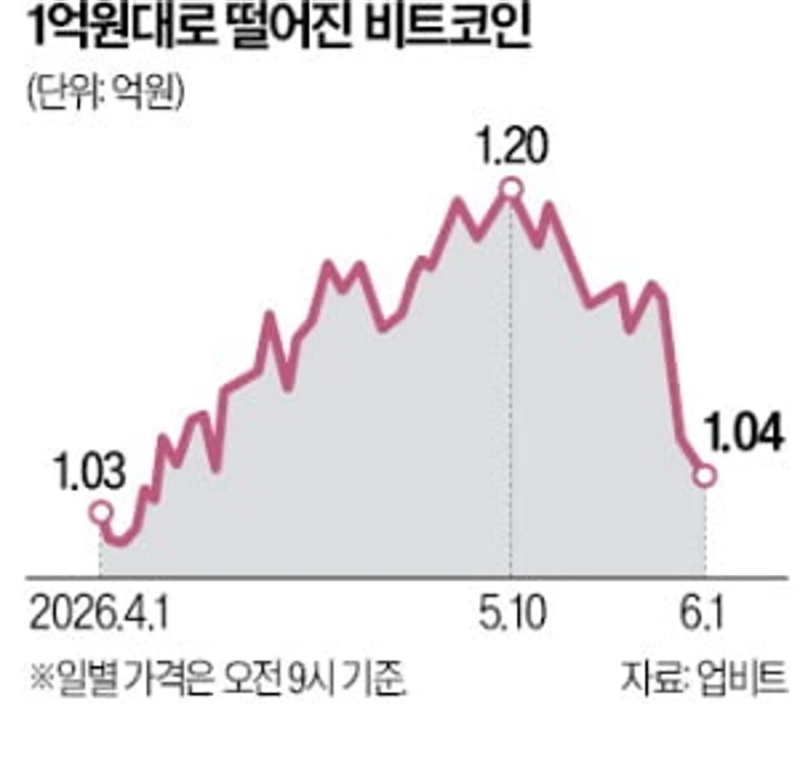
According to Upbit, Bitcoin ended trading at 104.14 million won, or about $75,464, on June 1. It was the first close in the 104 million won range on Upbit since April 5, when it settled at 104.28 million won, or about $75,565. The recent slide has also been pronounced. After reaching 114.89 million won, or about $83,254, on May 25, Bitcoin fell for four straight trading days.
Bitcoin began climbing in earnest in late March. It rose from 100.37 million won, or about $72,732, on March 29 to 110.45 million won, or about $80,036, on April 15. Sentiment improved in May after the US Senate Banking Committee passed the CLARITY Act, a cryptocurrency bill. Bitcoin reached 120.43 million won, or about $87,267, on May 10 and 120.09 million won, or about $87,022, on May 11, holding above 120 million won for two straight sessions at its highest level this year. A week later, on May 18, it had fallen to 114.32 million won, or about $82,849.
The trend has also weakened in overseas markets. CoinMarketCap data show Bitcoin traded at $82,499 on May 6 and $82,139 on May 11. By May 16, it had fallen below $80,000. As of June 1, it was trading around $73,000.
Stock rally and fund outflows add to pressure
Several external factors appear to have weighed on Bitcoin. One is the strength in equities, which has dulled relative enthusiasm for the token. Investors have been shifting money into stocks as US benchmarks continue to hit record highs. On June 1, the Dow Jones Industrial Average, S&P 500 and Nasdaq Composite all closed at all-time highs in New York. Gains in artificial intelligence and semiconductor shares have also continued.
Heavy ETF outflows have added to the pressure. Farside Investors data show 12 US-listed spot Bitcoin ETFs posted net outflows for 10 straight trading days from May 15 through May 29. A total of $2.9623 billion left the funds during that stretch. On May 27 alone, outflows reached $733.4 million.
Market participants have also grown more cautious than they were in early May. Alternative, a digital-asset data provider, put its Crypto Fear & Greed Index at 29 on June 1, a reading classified as fear. The closer the index is to zero, the stronger investor fear is considered to be. It stood at 50 on May 5 and 49 on May 12, both neutral readings. Since May 16, however, it has moved between the high 20s and low 30s, remaining in the fear zone.
Eyes on US monetary policy
The formal addition of Kevin Warsh, viewed as hawkish on monetary policy, to the Federal Reserve on May 22 is also seen as a source of pressure on Bitcoin. Cryptocurrencies tend to react sharply to changes in interest rates. When benchmark rates stay high, market liquidity shrinks and appetite for risk assets tends to weaken.
US inflation remains on an upward trend. The Commerce Department recently said the personal consumption expenditures price index rose 3.8% in April from a year earlier. The PCE price index is one of the indicators the Fed watches most closely in assessing inflation trends. If price pressures persist, the timing of any rate cut could be pushed back.
The Fed's restrictive stance is also a burden for the crypto market. Minutes from the Federal Open Market Committee released on May 20 showed many officials were concerned about prolonged inflation. Most participants expected it would take considerable time for inflation to return to the Fed's 2% target. That has been interpreted as a sign the Fed sees little chance of an early rate cut. Fading expectations for rate cuts could add pressure to risk assets including Bitcoin.
A further drain in liquidity is another scenario the market cannot ignore. Michael Kramer, chief executive officer of US investment research firm Mott Capital Management, estimated that $150 billion of liquidity could be pulled from markets by June 5 because of the US Treasury's settlement schedule for government debt. That would leave less money available for investment assets such as Bitcoin, he said. "If liquidity is absorbed by Treasury settlements, Bitcoin could fall to much lower levels," Kramer said.
Si-on Park, Hankyung.com reporter ushire908@hankyung.com

Korea Economic Daily
hankyung@bloomingbit.ioThe Korea Economic Daily Global is a digital media where latest news on Korean companies, industries, and financial markets.