US Proposes 12.5% Tariff on South Korea Over Forced-Labor Imports
Summary
- The Office of the United States Trade Representative said it has proposed tariffs of as much as 12.5% under Section 301 of the Trade Act on 60 trading partners, including South Korea, citing forced labor.
- If the 12.5% tariff is finalized and an additional 5% tariff is imposed later under the overcapacity investigation, the total reciprocal tariff applied to South Korea could reach 17.5%.
- The government said it would respond to the USTR's hearing and written-comment procedures to ensure that the existing US-South Korea tariff negotiations and balance of interests are not undermined.
Forecast Trend Report by Period


Alternative Tariff Route After Reciprocal Duties Ruled Unlawful
USTR Says Practices Burden US Commerce
As 10% Global Tariff Nears Expiration
Higher Tariffs Proposed for 60 Economies Including South Korea
Final Decision Expected After July Hearing
The US government said it plans to impose a 12.5% tariff on South Korean goods, citing Seoul's alleged failure to block imports made with forced labor. The move appears to be an alternative way to preserve trade barriers after the US Supreme Court ruled in February that President Donald Trump's reciprocal tariffs were unlawful.
10% to 12.5% Tariffs Proposed for 60 Economies
The Office of the United States Trade Representative released a statement on June 2 outlining the results of a Section 301 investigation. The measure calls for steep additional tariffs on 60 trading partners, including South Korea. The stated reason is that those economies did not do enough to prevent imports tied to forced labor, creating what the USTR described as unfair competitive conditions. The agency said it determined the practices were unreasonable and burdened or restricted US commerce.
The USTR classified 54 economies as jurisdictions that had either failed to introduce systems to block imports linked to forced labor or failed to enforce them effectively. That group includes South Korea, China, Japan, the UK, India and Russia. Those economies would face a 12.5% tariff. Six others — the European Union, Canada, Ecuador, Indonesia, Mexico and Pakistan — were judged to have relevant systems in place but weak enforcement and would be subject to a 10% tariff.
One international trade expert said the USTR had issued a preliminary determination tied to its forced-labor investigation. South Korea was assessed as having failed to properly enforce import bans on goods produced with forced labor, resulting in the proposed 12.5% duty. The USTR also said industrial essentials such as rare earths and aircraft parts, as well as products that affect US consumer prices including beef, coffee and vegetables, would be excluded from the tariff.
The proposed 12.5% tariff is not final. Requests to participate in the hearing are due by June 22, written comments are due by July 6, and a public hearing is scheduled for July 7. With those procedures still pending, and with a separate Section 301 investigation into overcapacity not yet complete, the final tariff rate for South Korea could still change.
Replacement for Reciprocal Tariffs Ruled Illegal
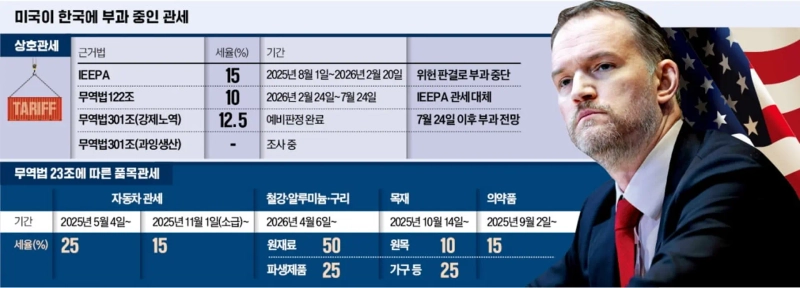
The measure comes about three months after the USTR opened the investigation on March 12. It marks the Trump administration's latest effort to rebuild tariff barriers after a court setback. In February, the US Supreme Court ruled that the reciprocal tariffs imposed last year under the International Emergency Economic Powers Act were unlawful. The administration then moved quickly to put in place a temporary 10% global tariff under Section 122 of the Trade Act. That measure can remain in effect for only up to 150 days without congressional approval and is set to expire on July 24.
The administration then turned to Section 301 of the Trade Act. The USTR began pursuing two Section 301 tracks immediately after the Supreme Court ruling. One was the investigation into inadequate regulation of imports tied to forced labor, which produced the latest determination. The other is a structural overcapacity probe. After congressional hearings and other procedures beginning in April, the administration announced the forced-labor tariff plan first. South Korea is also included in the Section 301 overcapacity investigation, meaning key industries such as semiconductors and automobiles could face additional tariff pressure depending on the outcome.
South Korea Nears Existing 15% Reciprocal Tariff
Last year, South Korea agreed to invest a total of $350 billion in the US as part of tariff negotiations with Washington, helping lower the reciprocal tariff threatened by the US from 25% to 15%. If the new 12.5% tariff is finalized, it would come close to the existing 15% reciprocal tariff level agreed by Seoul and Washington. If South Korea is later hit with an additional 5% tariff under the overcapacity case, the total tariff applied under Section 301 would rise to 17.5%. That would exceed the existing 15% reciprocal tariff.
The government said it would respond to the USTR's public-hearing and comment procedures and do its utmost to ensure that the balance of interests under the existing US-South Korea tariff agreement is not undermined.
Kim Ju-wan and Kim Dae-hoon, reporters; Lee Sang-eun, Washington correspondent, Hankyung, kjwan@hankyung.com

Korea Economic Daily
hankyung@bloomingbit.ioThe Korea Economic Daily Global is a digital media where latest news on Korean companies, industries, and financial markets.