Won Jumps to 1,540 Per Dollar on Oil Fears, Fresh US Tariff Uncertainty
Summary
- The won-dollar exchange rate’s jump to 1,540 was driven by oil supply concerns linked to a prolonged Middle East war and renewed US tariff uncertainty.
- Heavy foreign selling lifted this year’s net stock sales to 112 trillion won, leaving the won with the biggest decline among major Asian currencies.
- The government and industry say an August oil supply crisis and additional tariffs are unlikely, but the market still sees the exchange rate as having room to rise to 1,550.
Forecast Trend Report by Period


Won jumps to 1,540 per dollar
WTI climbs above $96 as war drags on
Foreign investors sell net 112.3 trillion won ($81.4 billion) of stocks this year
Won posts biggest drop among major Asian currencies
Market sees path to 1,550
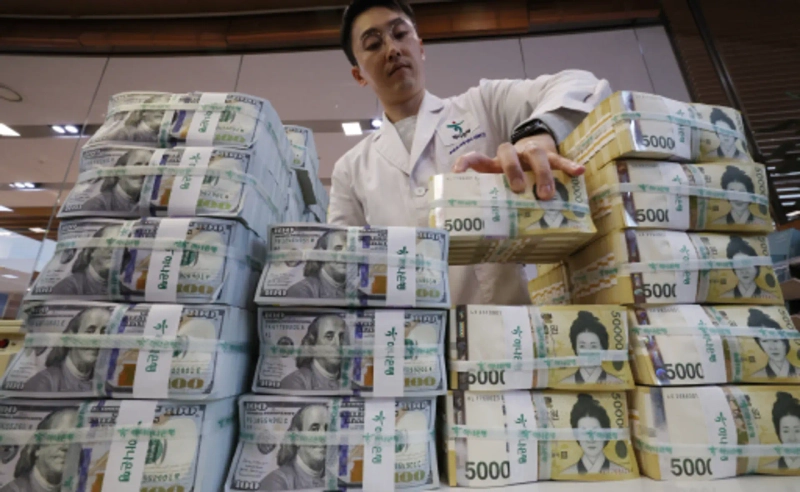
The won-dollar exchange rate surged as high as 1,540 in overnight trading on June 4 as fears over oil supplies from a prolonged war in the Middle East combined with uncertainty over US tariffs. The Korean currency has also fallen more sharply than those of other Asian economies that depend heavily on Middle Eastern crude, with foreign investors continuing to dump local stocks amid broad profit-taking.
The won, the weakest among global peers
The won-dollar rate has recently moved closely with international oil prices. When fighting in the Middle East intensifies and crude prices rise, the exchange rate has repeatedly jumped in tandem. That pattern played out again on June 4, when the won weakened to 1,540 per dollar during the session.
Min Kyung-won, an analyst at Woori Bank, said risk aversion persisted as markets placed higher odds on a prolonged stalemate than on a breakthrough in talks over the weekend. Park Sang-hyun, an analyst at iM Securities, added that concern over a possible oil inventory shortfall is increasing pressure on the won because South Korea is a crude-importing country.
Some in the market have raised an “August crisis” scenario, arguing that an oil supply crunch could emerge in August if a blockade of the Strait of Hormuz continues into midsummer, when crude demand typically rises.
Even so, the won’s slide has been unusually steep. Data from Seoul Money Brokerage Services show the currency fell 5.20% from Feb. 27, just before the Middle East war broke out, through June 3.
That was a larger drop than in Japan (-2.41%), Taiwan (-0.36%), Singapore (-1.35%), Thailand (-5.07%) and India (-4.95%). Markets have linked the move to heavy foreign selling of Korean equities. Foreign investors sold a net 112.3255 trillion won ($81.4 billion) worth of stocks this year through June 3, and dumped nearly 7 trillion won ($5.1 billion) more on the Kospi on June 4.
US tariff concerns, which had faded for a time, have also resurfaced. The Office of the United States Trade Representative on June 3 released the results of a Section 301 investigation related to forced labor and signaled a 12.5% tariff on South Korea. Another Section 301 decision tied to overproduction is still pending, fueling concern that the final tariff rate could exceed the 15% level agreed last year.
‘The one-way move looks excessive’
Some analysts argue the move in the exchange rate has gone too far. The South Korean government says the odds of an “August oil supply crisis” becoming reality are low. It has already secured about 75 million barrels for August, equivalent to 88% of the 85 million barrels the country imported in August last year. A government official said imports at 70% to 80% of normal levels would still be enough to keep essential domestic industries such as naphtha cracking centers, or NCCs, running and to maintain household consumption.
The market’s other concern — additional tariffs tied to overproduction — is also viewed as unlikely to materialize. Under Section 301, tariff rates are not capped in theory.
Still, Industry Minister Kim Jung-kwan wrote on social media on June 4 that he had held a video meeting a day earlier with US Commerce Secretary Howard Lutnick and received confirmation that tariffs on South Korea would not exceed the level agreed last year. He said Washington indicated it would stick to last year’s agreement, under which reciprocal tariffs were lowered to 15% in exchange for $350 billion of South Korean investment in the US.
Markets broadly expect the won to remain under pressure for now. Moon Da-woon, an analyst at Korea Investment & Securities, said it was difficult to gauge the next upper bound after the currency tested its previous post-war high in offshore trading. Some market participants also say the won could quickly strengthen into the low-1,400 range if ceasefire talks are concluded suddenly.
Seong-mi Shim / Dae-hoon Kim, Korea Economic Daily reporters smshim@hankyung.com

Korea Economic Daily
hankyung@bloomingbit.ioThe Korea Economic Daily Global is a digital media where latest news on Korean companies, industries, and financial markets.