Energy Shock, Rate Jolt Push Global Economy Into ‘Spikeflation’
Summary
- The recent Middle East war sent energy prices sharply higher, pushing the global economy into a spikeflation phase that has produced weak returns for stocks and bonds.
- During spikeflation, annual stock returns in the US fall below 2% and government bonds post annual losses of 2%, showing a deterioration in asset profitability.
- Experts said investors should diversify portfolios through commodity investments and include a range of inflation hedges amid the risk of persistently high inflation.
Forecast Trend Report by Period


Prices Jump Suddenly After Middle East War
‘Time to Rebalance Investment Portfolios’

The global economy is entering a phase of “spikeflation,” with inflation rising in sudden bursts after a long period of relative calm, as the recent war in the Middle East drives up costs, particularly through energy prices.
The Financial Times reported on June 4 that signs of spikeflation have appeared in the global economy since the Middle East war began in late February. Geopolitical, energy and supply-chain risks have combined with shocks from government fiscal policy, triggering abrupt price increases.
Global oil prices have climbed to their highest level in four years. The International Energy Agency has described the current energy crisis as “twice the shock” of the 1970s oil shock. The impact is already showing up in inflation data. The US personal consumption expenditures price index rose 3.8% in April from a year earlier, the biggest gain since May 2023.
That shift stands to hit asset markets directly. An FT analysis of asset-price performance across inflation regimes since 1915 found that stocks and bonds delivered weak returns during spikeflation periods. Government bond yields have also surged recently, sending prices sharply lower. The yield on 30-year US Treasuries climbed to 5.2% in May, the highest since 2007.
Trevor Greetham, head of multi-asset at Royal London Asset Management, said other asset prices, including equities, showed a similar pattern during spikeflation periods. While the S&P 500 has recently reached record highs, the risk from persistently elevated inflation remains, he added. Investors need broader portfolio diversification, including commodities, to guard against that risk.
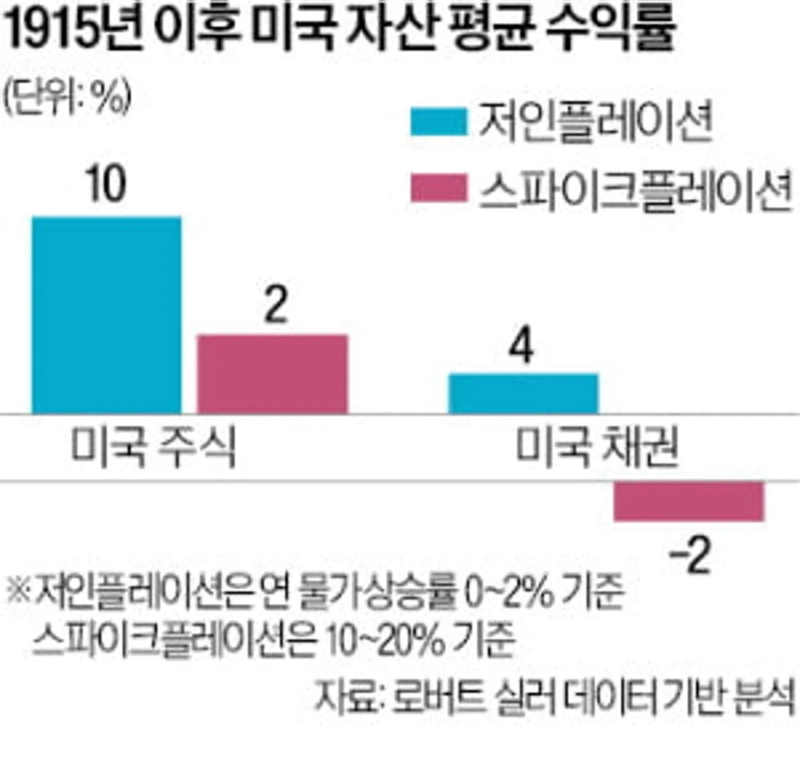
US Stocks Return 10% a Year in Stable Inflation Periods
But That Shrinks to 2% During Inflation Spikes
Spikeflation refers to a sudden jump in inflation after a prolonged period of subdued price growth, driven by factors such as geopolitical shocks, energy bottlenecks, excessive fiscal spending and supply-chain disruption. A lengthy stretch of low inflation is effectively a precondition. That, in turn, magnifies the impact on the economy and financial markets.
G20 Inflation Forecast to Rise 4.0%
The Organization for Economic Cooperation and Development said on June 4 that consumer inflation across the Group of 20 is projected to rise to 4.0% this year from 3.4% last year because of the recent Middle East conflict.
If disruptions to Middle East energy production and exports persist through the second half of next year, inflation could rise by an additional 0.4 percentage point this year and 1.3 percentage points next year, the OECD said. Under that scenario, global growth would slow to 2.1% this year and 1.8% next year.
Governments have limited room to respond. In its April Fiscal Monitor, the International Monetary Fund said global public debt had jumped to 94% of gross domestic product last year. It projects that figure will reach 100% by 2029. The increase reflects simultaneous rises in spending on social programs, defense, strategic industries and interest on government debt.
The IMF also said the recent Middle East conflict would deepen fiscal vulnerabilities across countries. That helps explain why governments may struggle to cushion the inflation shock through fiscal spending.
The shift is also undermining investment returns. Royal London Asset Management found that US stocks returned more than 10% a year on average during periods when inflation stayed below 2%. US Treasuries generated average annual returns of 4%. During spikeflation, however, stock returns fell below 2% a year and Treasuries posted annual losses of 2%.
Unusual Stock Gains Also Pose a Risk
Markets are already beginning to reflect the effects of spikeflation. The yield on 10-year US Treasuries has recently risen to 4.45%, while the 30-year yield climbed to around 5%. At a May auction, the yield on 30-year debt topped 5% for the first time since 2007. That translates into weaker returns for Treasury investors.
US homeowners pulled 5.8% of all homes listed for sale off the market in April. Expectations have grown that the Federal Reserve will raise its benchmark interest rate to the highest level since the Covid-19 pandemic. Higher rates push buyers to demand lower home prices, and sellers who refuse often withdraw their listings.
The S&P 500, however, has returned 14% this year, helped by a boom in artificial intelligence-related investment. Vanguard’s S&P 500 ETF, VOO, recently became the first exchange-traded fund to surpass $1 trillion in assets under management. Because the S&P 500 is weighted by market capitalization, rallies in AI and large-cap technology stocks increase those companies’ weight in the portfolio.
A Royal London Asset Management official said investors risk losses if they fail to respond properly when markets are hit by shocks tied to persistently high inflation. Portfolios should include commodities and other inflation hedges to reduce that risk, the official said.
Kim Ju-wan, Hankyung.com reporter kjwan@hankyung.com

Korea Economic Daily
hankyung@bloomingbit.ioThe Korea Economic Daily Global is a digital media where latest news on Korean companies, industries, and financial markets.