Gold Overtakes US Treasuries in Central Bank Reserves for First Time Since 1996
Summary
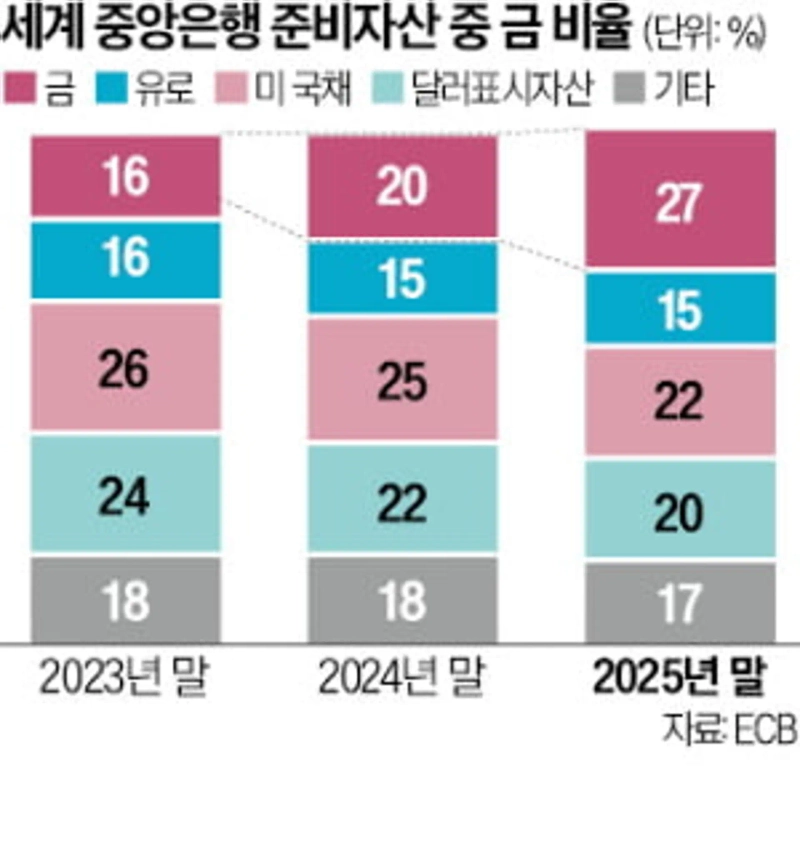
- It said gold's share of global central bank reserve assets rose to 27%, surpassing US Treasuries at 22%.
- It said demand for alternatives to the dollar from countries including China and Russia, along with geopolitical tensions, is driving strong gold buying and higher bullion prices.
- It said dollar-denominated assets still account for the largest share at 42%, and gold's move past US Treasuries does not mean the status of dollar assets has suddenly been undermined.
Forecast Trend Report by Period


Gold Accounts for 27% of Reserves, Surpassing US Treasuries for First Time in 29 Years
Gold Share Jumps 7 Percentage Points in a Year
US Treasury Share Falls to 22% From 25%
China, Russia Drive Gold Buying as Dollar Alternative
Concerns Over US Fiscal Health Also Cited
Gold has overtaken US Treasuries in reserve assets held by central banks worldwide. It is the first time since 1996 that gold's share has exceeded that of US government debt. The shift underscores a broad effort to reduce reliance on the dollar and hedge against geopolitical risks.
Demand for Dollar Alternatives Lifts Gold's Share
The European Central Bank said on June 3 that gold accounted for 27% of global central bank reserve assets at the end of last year, up sharply from 20% a year earlier. Over the same period, the share of US Treasuries fell to 22% from 25%.
The ECB said the change reflected both sustained central-bank buying and a surge in bullion prices, which nearly doubled over the past two years. Gold hit a record above $5,500 a troy ounce in January. US Treasuries, by contrast, lost relative share as geopolitical tensions drove bond yields higher and prices lower.
The ECB added that if the effect of rising gold prices is stripped out and holdings are recalculated using end-2023 prices, gold's share stood at 16% at the end of last year. That matched the euro's 16% share and remained below the 26% share of US Treasuries.
The ECB said the shift in reserve composition was driven in part by demand from countries such as China and Russia for alternatives to the dollar. Reserve assets are highly liquid holdings that central banks use to defend their currencies and meet international payment obligations. Efforts to reduce dependence on dollar assets have accelerated since 2022. One catalyst was the US freeze on Russia's dollar reserves after Moscow's full-scale invasion of Ukraine. Demand for alternatives to the dollar also spilled into euro-area assets. Euro-denominated sovereign bond issuance reached about 1 trillion euros last year, a record high.
ECB President Christine Lagarde wrote in the report that geopolitical tensions were driving strong demand for gold among central banks. The ECB said central banks globally hold more than 36,000 tons of gold. That is close to the level seen when the Bretton Woods system was established in 1944. At the time, gold was fixed at $35 an ounce, and countries increased their holdings to underpin currency stability. Total holdings reached 38,000 tons.
Dollar Assets Still Hold the Top Spot
Since 2022, the biggest increases in gold holdings have come from China, Poland, Turkey and India, in that order. Many of those countries have had disputes with the US and face the risk of financial sanctions.
Still, the pace of central-bank gold buying has slowed somewhat recently. Central banks were net buyers of more than 1,000 tons a year for the three years through 2024, but last year's total was 850 tons. Some central banks have also started selling gold this year. Turkey bought about 220 tons of gold after Russia's invasion of Ukraine in 2022. But after the Iran war began earlier this year, it sold or lent about 130 tons to defend its currency. The ECB said Turkey's case was among the largest reserve drawdowns in recent years. Gold served both as a safe asset and a source of liquidity in times of crisis, it added.
Analysts said concerns about US fiscal health and the independence of the Federal Reserve have shaken investor confidence in long-dated Treasuries. Even so, dollar-denominated assets still account for 42% of global reserve assets, the largest share. The Financial Times said gold may have overtaken US Treasuries, but that does not mean the standing of dollar assets has suddenly been undermined.
Global demand for gold continues to rise. The World Gold Council said first-quarter demand increased 2% from a year earlier to 1,230.9 tons. The increase reflected a surge in demand for bars and coins and a 3% rise in central-bank purchases, while jewelry demand fell 23%.
Kim Dong-hyun, Hankyung.com reporter, 3code@hankyung.com

Korea Economic Daily
hankyung@bloomingbit.ioThe Korea Economic Daily Global is a digital media where latest news on Korean companies, industries, and financial markets.