PiCK
Middle East Tensions, ETF Outflows and Strategy Sale Push Bitcoin Into Fear-Driven Slide at $62,850
Forecast Trend Report by Period



Bitcoin remained under heavy downward pressure as fading hopes for an end to the Iran conflict, rising Middle East tensions, ETF outflows and selling by Strategy weighed on sentiment. In the near term, the risk of further losses remains open, with risk management centered on whether Bitcoin can defend the $60,000 level.
As of 6:30 p.m. on June 4, Bitcoin was trading at $62,850 on Binance's USDT market, down about 5.9% from a day earlier. On Upbit, it traded at 93.82 million won. The kimchi premium, which measures the price gap between domestic and overseas exchanges, was minus 2.96%.
Trump Says He May Reconsider Ceasefire if U.S. Troops Are Killed, Deepening Middle East Jitters
Global financial markets shifted into risk-off mode as military clashes between the U.S. and Iran intensified again. Hopes for ceasefire talks faded. Oil prices and U.S. Treasury yields rose together, while global stocks fell.
The Wall Street Journal reported on June 3, citing U.S. officials, that President Donald Trump told aides he would consider ending the ceasefire if Iran killed American troops. The newspaper said Trump was reluctant to restart the war and appeared willing to tolerate limited clashes to prevent a broader conflict in the Middle East.
Retaliatory exchanges have continued. Iran's Islamic Revolutionary Guard Corps said it attacked a U.S. air base in Kuwait and the U.S. Navy's Fifth Fleet base in Bahrain in response to strikes on an Iranian oil tanker and a communications tower on Qeshm Island. U.S. Central Command disputed that account, saying the Iranian attack had failed.
Cost pressures tied to the conflict are also filtering into financial markets. The Federal Reserve's Beige Book, released that day, cited rising energy costs linked to the Middle East conflict as a major source of price pressure. Concerns over prolonged high oil prices are also weighing on global bond markets.
Markets are now focused on the U.S. May employment report due at 9:30 p.m. Korea time on June 5. Nonfarm payrolls are forecast to have increased by 95,000 in May, slowing from 115,000 in the previous month. If the labor data comes in stronger than expected, concerns over inflation and the path of interest rates could persist.
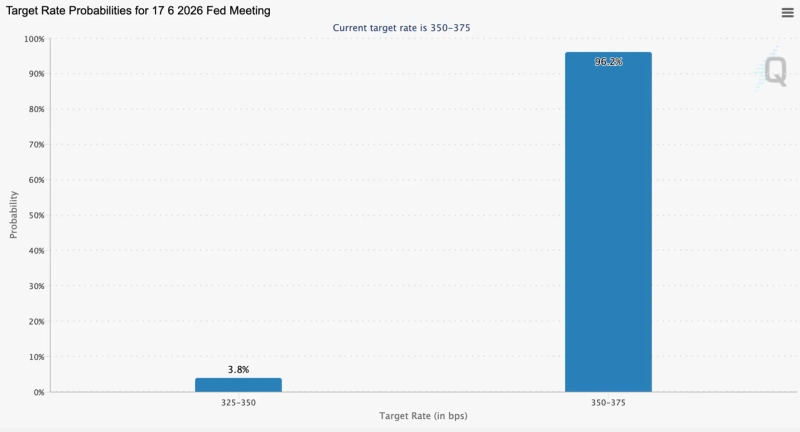
In monetary policy, a pause remains the dominant view. CME FedWatch data as of 6 p.m. on June 4 showed a 96.3% probability that the Federal Open Market Committee would leave rates unchanged at its June meeting. It will be the first meeting chaired by new Fed Chair Kevin Warsh, and markets are watching for the central bank's policy direction as Middle East tensions and price pressures build.
Bitcoin ETF Outflows Persist as Strategy Sale Adds to Pressure
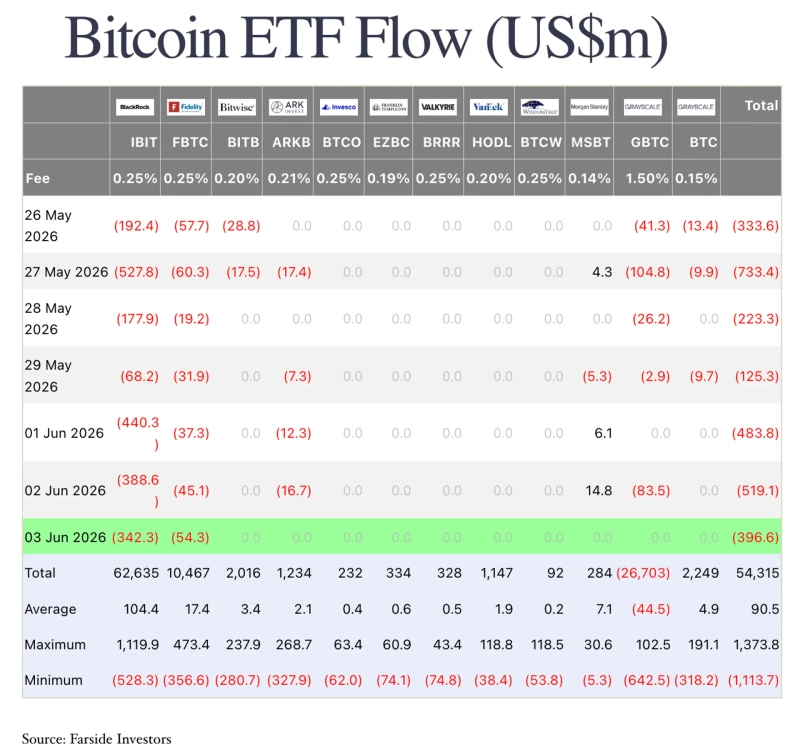
Against that backdrop, flows into spot Bitcoin exchange-traded funds also weakened. U.S.-listed spot Bitcoin ETFs posted net outflows of $1.4156 billion last week, and the withdrawals have continued since then. News that Strategy, the world's largest Bitcoin treasury company, sold 32 Bitcoin added to the pressure. Reports of Bitcoin transfers tied to Mt. Gox also heightened caution as investors weighed the possibility of remaining repayments.
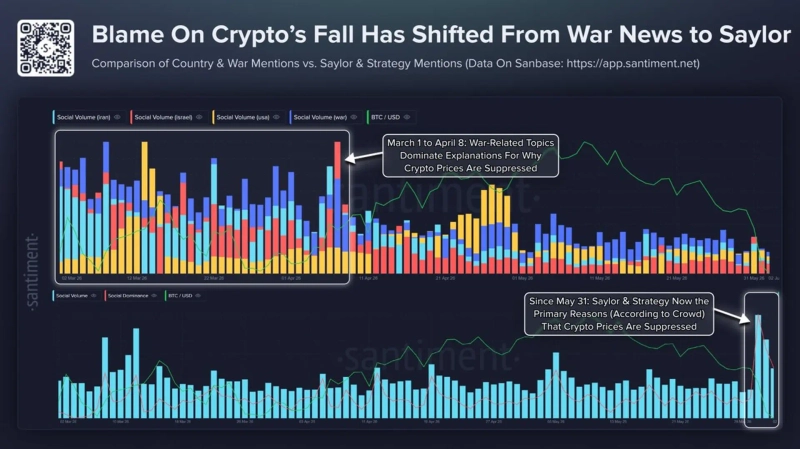
Bitfinex said in a weekly report that Strategy's sale of 32 Bitcoin was negligible relative to its holdings, but it triggered a reassessment of the company's treasury strategy. After the news broke, about $854 million of liquidations hit the Bitcoin perpetual futures market on June 2. The exchange said the latest selling was driven more by mechanical flow factors such as ETF redemptions and leveraged liquidations than by a large-scale exit from long-term holders.
Binance Research said the recent weakness in digital assets may have more to do with capital crowding into equities than with crypto-specific negatives. Bitcoin is losing the liquidity battle as several themes, including artificial intelligence, defense and energy, absorb investor capital at the same time, it said. In past episodes without a crypto-specific crisis, Bitcoin took an average of about two weeks to form a bottom. That suggests the current correction may also prove temporary and tied to fund rotation, allowing for a faster recovery.
Wintermute said stocks are extending gains on expectations for AI-driven earnings, but the digital-asset market lacks a clear buying catalyst. The key variable in the current stretch will be whether spot ETF inflows recover on a sustained basis.
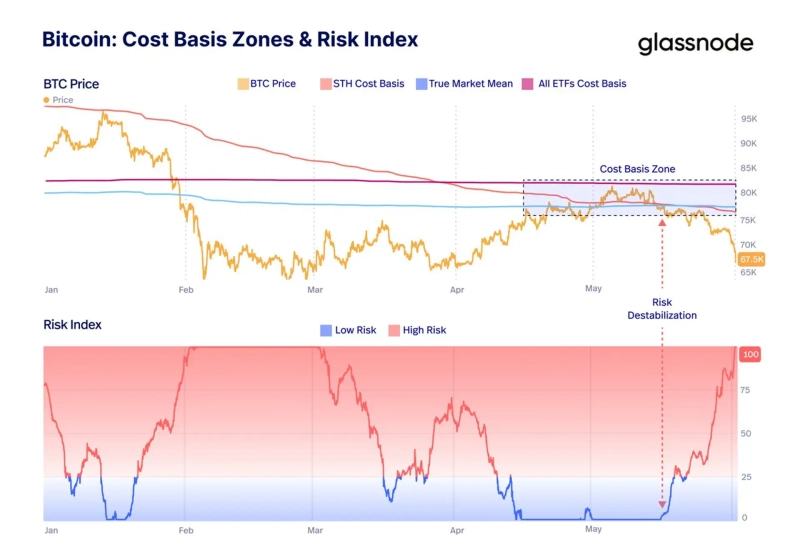
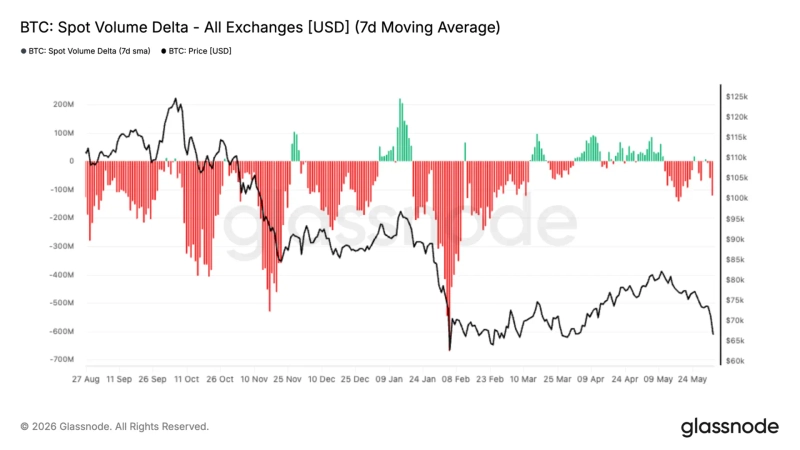
On-chain indicators also point to mounting pressure on support levels. Glassnode said in a weekly research report that Bitcoin has fallen more than 13% over the past week, a pattern resembling the later stages of a bear market, while spot selling pressure is regaining the upper hand. It added that short-term holders who bought near $78,000 are increasingly realizing losses, and volatility premiums in derivatives markets have climbed to their highest level in three months.
Bitcoin's $60,000 Support Looks Fragile as Analysts Warn of Deeper Losses
Bitcoin's slide toward $65,000 has made defense of the $60,000 level the key variable for the near-term trend.
Ayush Jindal, an analyst at NewsBTC, said Bitcoin failed to hold support at $70,000 and extended its short-term downtrend after breaking below $68,000 and then $65,000. If the $62,000 level gives way, the next support zones are $61,200 and $60,500. A drop to $60,000 could make a near-term recovery more difficult, he said.
For any rebound, Bitcoin first needs to reclaim resistance at $64,000 and $65,000, Jindal added. On the one-hour chart, a descending trend-line resistance has formed around $65,200, and failure to break above that area could bring selling pressure back.
Concern is also growing over the risk of another sharp drop. Alex Kuptsikevich, chief analyst at FxPro, said total crypto market capitalization fell as low as $2.21 trillion intraday over a 24-hour period, while the Fear & Greed Index dropped to 11. Bitcoin's decline toward $65,000 has brought it into a zone similar to the one seen just before the sharp selloff in early February. If stop-loss selling in long positions is triggered, volatility in the altcoin market could intensify.

Rakesh Upadhyay, an analyst at Cointelegraph, said Bitcoin could fall further to $65,000 and then $60,000 if it fails in the near term to reclaim the 20-day exponential moving average of $75,702. To confirm a bullish signal, it would need to recover $77,310.
Katie Stockton, founder of Fairlead Strategies, said technical signals suggest the decline could deepen further. Bitcoin has broken below key daily-chart support, confirming a bearish signal. Even if the move proves to be only a short-term correction, it suggests losses could deepen for some time.
Kang Min-seung, Bloomingbit reporter, minriver@bloomingbit.io

Minseung Kang
minriver@bloomingbit.ioBlockchain journalist | Writer of Trade Now & Altcoin Now, must-read content for investors.