Won Weakens Past 1,540 Per Dollar to Highest Since 2009 Crisis; Korean Stocks Under Pressure
Forecast Trend Report by Period


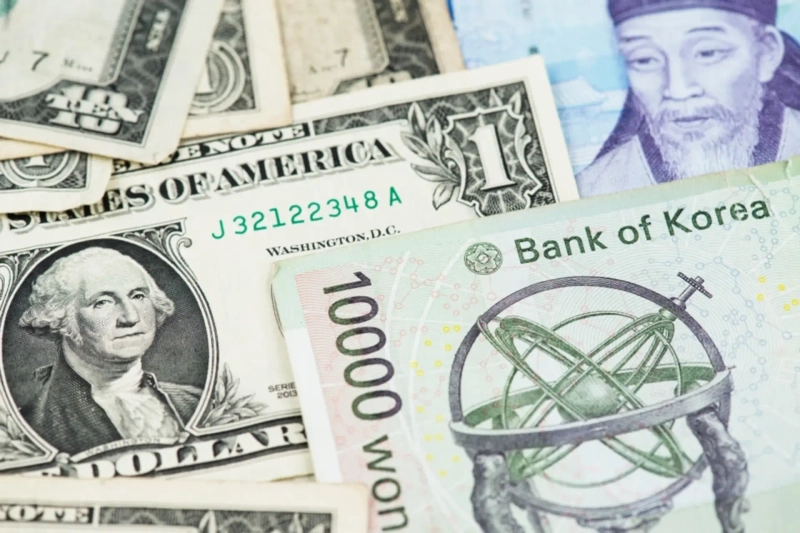
The won weakened past 1,540 per dollar on June 5 as Middle East geopolitical tensions and foreign investor outflows combined to rattle South Korea’s financial markets. The move took the currency to its highest level since the global financial crisis.
A stronger dollar fueled by surging oil prices and selling pressure in domestic equities has blunted repeated verbal intervention from the government and the Bank of Korea. After jumping into the 1,540 won range in overnight trading on June 4, the exchange rate climbed back above 1,540 won in daytime trading on June 5.
At 9:53 a.m. in Seoul, the won was trading at 1,540.60 per dollar. That was the highest level since March 10, 2009, when it reached 1,561 won intraday during the financial crisis. The currency opened at 1,529 won, down 0.7 won from the previous daytime close, then turned higher and extended its losses.
The won had already traded in the 1,540 won range in overnight trading after the daytime session ended on June 4. It rose as high as 1,540.40 won at about 5:05 p.m.
Through June 4, the won had finished in the 1,500 won range for 13 straight trading days. That marks the longest such stretch since the 1997-1998 Asian financial crisis.
The latest rise came as oil prices climbed amid expanding military clashes and stalled negotiations to end the war between the U.S. and Iran. On June 3, West Texas Intermediate crude futures settled up 2.41% at $96.02 a barrel, while Brent crude futures rose 1.89% to $97.81. The dollar also strengthened as investors sought safe-haven assets. The dollar index, which tracks the greenback against six major currencies, moved above 99.5.
Continued foreign selling of South Korean stocks added to upward pressure on the exchange rate. Since May 7, overseas investors have been net sellers for 19 straight trading days, with cumulative net sales exceeding 66 trillion won. Renewed uncertainty over U.S. tariff policy also weighed on the won.
Weakness in equities, driven by a drop in U.S. semiconductor shares, also spilled into the foreign-exchange market. Broadcom, the U.S. fabless chip designer, reported solid earnings overnight, but the lack of higher guidance helped trigger a broader selloff in chip stocks. Foreign investors were also selling nearly 800 billion won of Kospi shares, deepening net outflows.
With domestic and external pressures mounting, market-stabilization steps such as verbal intervention appear to be losing their effect. Deputy Prime Minister and Finance Minister Koo Yun-cheol said at a market-monitoring meeting on June 4 that authorities would immediately take necessary action against excessive one-way moves. On May 28, Bank of Korea Governor Shin Hyun-song also said the central bank would respond firmly to exchange-rate crowding. Even so, the won has shown little sign of stabilizing.
Financial markets expect the strong-dollar, weak-won environment to persist for now as the Middle East conflict drags on. Lee Min-hyuk, an economist at KB Kookmin Bank, said the won-dollar rate would show sharp volatility in the 1,520 won to 1,540 won range on June 5. Falling oil prices and improving risk appetite are easing pressure from offshore dollar strength, but supply-demand strains from foreign equity selling are likely to support the lower end, he added.
Kim Yoo-mi, an analyst at Kiwoom Securities, said the biggest burden remains foreign selling of domestic stocks. If Middle East geopolitical uncertainty eases and foreign net selling slows, the won could fall back into the 1,400 won range, she said. If foreign outflows continue, however, the exchange rate’s downward rigidity is likely to persist for a considerable period even as the current-account surplus widens.
Kang Kyung-ju, Hankyung.com reporter qurasoha@hankyung.com

Korea Economic Daily
hankyung@bloomingbit.ioThe Korea Economic Daily Global is a digital media where latest news on Korean companies, industries, and financial markets.