Retail Investors Rattled by Chip Slide as Pensions, Foreigners Buy Consumer and Energy Stocks
Summary
- Broadcom's AI chip revenue guidance shock triggered profit-taking in Samsung Electronics and SK Hynix.
- Analysts said fund flows leaving semiconductors could shift to the retail, cosmetics, apparel and energy sectors.
- Samsung Electronics and SK Hynix, however, still have the earnings momentum, narrative, liquidity and productization potential of market leaders.
Forecast Trend Report by Period


AI Peak-Out Fears Flare Up Again: What Comes After Samsung Electronics and SK Hynix?
Broadcom Shock Sends Global Memory-Chip Stocks Lower
Money Leaving Semiconductors May Shift to Consumer and Energy Shares
Investors Need to Accept Chip Concentration as Samsung Electronics, SK Hynix Still Lead
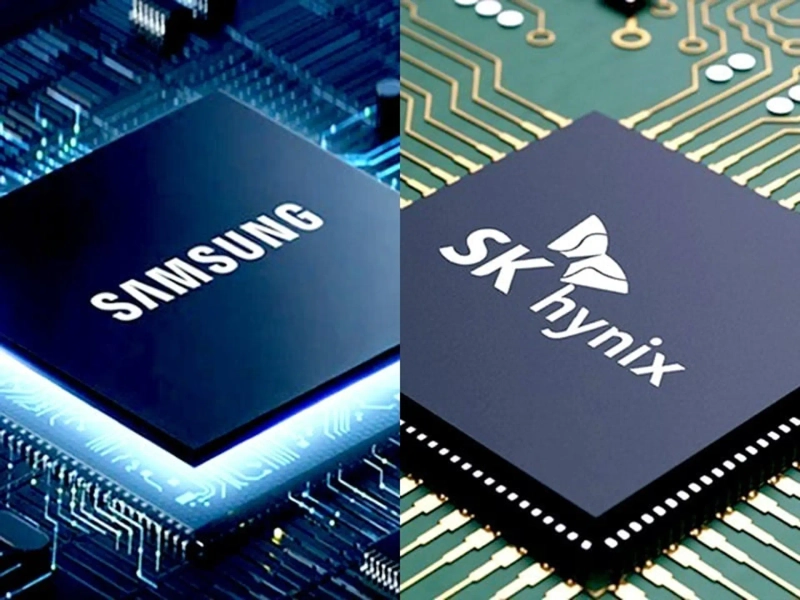
Concern is resurfacing that investment in artificial intelligence may have passed its peak. Broadcom, the custom-chip designer that makes application-specific integrated circuits, or ASICs, to customer specifications, issued AI chip revenue guidance that fell short of market expectations. The miss unleashed profit-taking in semiconductor shares, which had rallied sharply as the market's favored AI trade.
Among market strategists, some see the pullback as a potential catalyst for easing the heavy concentration in chip stocks. Others say investors should accept that concentration when setting strategy. Their argument is that no obvious successor has emerged with the same combination of earnings momentum, growth narrative, liquidity and suitability for investment products.
Broadcom Guidance Shock Sparks Profit-Taking in Chip Stocks
According to the Korea Exchange, Samsung Electronics closed 6.4% lower at 329,000 won on June 5, while SK Hynix fell 9.92% to 207,000 won. Both had already declined in the previous session on June 4, when Samsung Electronics lost 2.5% and SK Hynix dropped 2.63%, extending the weakness into a second day.
The selloff in the two market leaders that had powered gains in South Korean equities followed Broadcom's earnings conference call. Chief Executive Officer Hock Tan said after the close of regular trading in New York on June 3 that the company expects third-quarter AI chip revenue of $16 billion. The market expectation had been $17.2 billion. The shortfall was only about 7%, but it revived concerns that the expansion in AI investment may be losing momentum and dragged down large South Korean chip stocks.
Broadcom plunged 12.59% in New York trading on June 4 as investors reacted to the call. Micron Technology, which alongside Samsung Electronics and SK Hynix forms the global memory-chip top three, fell 7.74%.
Seo Sang-young, an executive director at Mirae Asset Securities, said the shock from Broadcom's AI chip revenue guidance did not stem from weak demand for AI semiconductors. He attributed it instead to delays in expanding infrastructure such as power grids. Even so, investor anxiety had already been building over valuations in memory-chip and AI-chip shares, which had climbed to peak levels this year. Once the possibility of a slower pace of spending by big tech companies came into view, profit-taking orders poured out.
If Chip Concentration Eases, Focus on Earnings Plays Favored by Pensions and Foreigners
As profit-taking hits large-cap semiconductor shares, investors are searching for sectors that may attract the next wave of inflows. On June 4, the Kospi fell 1.84%, but 398 stocks rose, outnumbering the 389 that declined. That suggests active buying interest in shares seen as potential new leaders.
Kang Jin-hyuk, an analyst at Shinhan Securities, said investors need to consider both earnings and fund flows to determine where money leaving semiconductors may head next. He named retail, cosmetics, apparel and energy as sectors that could draw fresh inflows. The basis for that view is that earnings estimates have recently been revised higher while foreign investors and the National Pension Service have both been buying those groups.
Kang said retail, cosmetics and apparel are poised for solid earnings as more tourists visit South Korea and the wealth effect supports spending. Energy, meanwhile, stands to benefit from a supply shock linked to conflict in the Middle East and from stronger seasonal demand as summer nears. He added that foreign ownership has risen sharply in all three sectors over the past month.
Samsung Electronics and SK Hynix Are the Only Pair That Meet All the Requirements for Market Leadership
Still, some strategists argue that any investment strategy should start by acknowledging the market's concentration in semiconductors. Noh Dong-gil, another analyst at Shinhan Securities, said investors should build their strategies on the assumption that large-cap chip stocks will continue to lead the market. Their earnings momentum and fund flows remain the strongest.
Earnings momentum stands out most clearly in the domestic stock market. Data compiled by FnGuide show that the combined annual controlling-shareholder net profit forecast for Kospi-listed companies this year stands at 713.0073 trillion won. Samsung Electronics accounts for 40.39% of that total, or 288.09 trillion won, while SK Hynix makes up 29.97%, or 213.6986 trillion won. Together, the two companies account for more than 70% of the total.
That consensus reflects a growth narrative that the semiconductor supercycle will be prolonged as chip prices soar amid a race by big tech companies to expand AI capital expenditure.
Flows into investment products such as exchange-traded funds have also been cited as a driver of semiconductor concentration. Because Samsung Electronics and SK Hynix account for more than half of the market capitalization in the benchmark stock market, a large share of money flowing into products tied to South Korean equities is directed to the two chipmakers. Noh said this creates a self-reinforcing structure: as the stocks rise and their index weighting increases, an even larger share of future inflows is allocated to them.
Noh said Samsung Electronics and SK Hynix are almost the only combination that meets all the requirements for market leadership, including liquidity as large-cap stocks, upward earnings revisions, a clear narrative and suitability for investment products. Beyond being simple market leaders, he added, they also serve as common underlying holdings for a wide range of ETF products.
Kyung-woo Han, Hankyung.com reporter case@hankyung.com

Korea Economic Daily
hankyung@bloomingbit.ioThe Korea Economic Daily Global is a digital media where latest news on Korean companies, industries, and financial markets.