Forecast Trend Report by Period


The won has broken through 1,550 per dollar, a level widely seen as a psychological barrier. The average won-dollar exchange rate in the second quarter has climbed to its highest level in 28 years, since the Asian financial crisis, underscoring the Korean currency’s sharp decline. A record current-account surplus driven by booming semiconductor exports and a surge in equities are paradoxically adding pressure on the won, the article said.
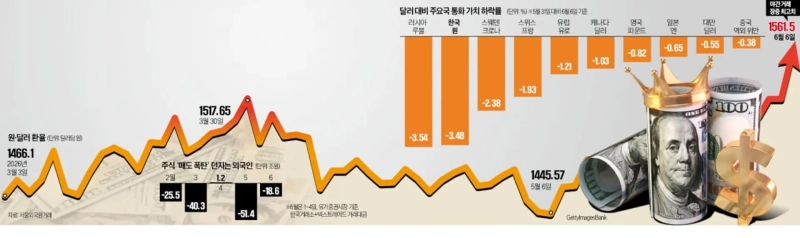
According to the Seoul foreign-exchange market, the won weakened to as low as 1,561.5 per dollar in night trading on June 6. That was the highest level since March 6, 2009, when the exchange rate reached 1,597.0 during the global financial crisis. Trading ended at 2 a.m. on June 7 at 1,559.0 won per dollar, up 1.43%, or 19.9 won, from the daytime close of 1,539.1 won. From the start of the second quarter through June 5, the average exchange rate stood at 1,490.98 won per dollar, the highest since the first quarter of 1998, when the average was 1,596.88 won.
The biggest reason the exchange rate remains elevated despite the semiconductor boom is net selling of Korean stocks by foreign investors. Sharp gains in chip shares increased the weight of Samsung Electronics Co. and SK Hynix Inc. in portfolios, prompting mechanical selling. Investors who bought semiconductor stocks on expectations of further gains have also sold won to hedge currency risk, adding to pressure on the Korean currency. Meanwhile, exporters flush with dollars have been reluctant to convert them into won as they reinvest overseas, leaving little dollar selling, or won buying, in the market.
Foreign Investors Hold Korean Stocks but Sell Won, Deepening FX Imbalances
Stronger Stocks and Exports Are Now Pushing the Won Lower
An export boom and a stock-market rally, once powerful supports for the won, are now weighing on the currency instead. As the Kospi rises, foreign investors are selling won to rebalance portfolios and hedge currency exposure. Dollars earned from semiconductor exports are also being reinvested abroad rather than flowing into the domestic foreign-exchange market. Some analysts have gone so far as to argue that semiconductors are replacing oil as a source of dollar liquidity, ushering in a “DRAM dollar” era in place of the petrodollar.
Foreign Investors Blunt National Pension Service Hedging
According to the Bank of Korea, the average won-dollar exchange rate this year through June 5 stood at 1,477.06 won per dollar. That was more than 50 won above last year’s record annual average of 1,420.97 won. So far this month, the won-dollar rate has jumped 3.48% in a week. That was the second-biggest increase among currencies against the dollar after the Russian ruble’s 3.54% rise.
The won’s drop has been driven by record selling of Korean stocks by foreign investors. The Kospi stood at 8,160.59 on June 5, up 94% from the start of the year. Shares of Samsung Electronics and SK Hynix, the country’s two leading chipmakers, have climbed at an unusually rapid pace. That temporarily drove up Korea’s weight in global funds, particularly in semiconductor stocks. Global funds are generally known to rebalance when a single stock exceeds 10% of a portfolio or when the combined weighting of stocks with individual weights above 5% rises above 40%.
As the weight of Samsung Electronics and SK Hynix rose, foreign investors taking profits in those stocks converted proceeds into dollars and exited the market rather than moving into other Korean shares. That has intensified won selling. South Korea has drawn about $18.7 billion in foreign inflows since April on its inclusion in the World Government Bond Index, and since the introduction of the Return to Korea Investment Account, overseas-focused retail investors had brought back 1.9443 trillion won through May 19. Even that was not enough.
Foreign investors’ currency hedging has also added to pressure on the won. In effect, overseas investors remain bullish on Korean chip stocks while selling the won on concerns the currency will weaken further. The National Pension Service has been selling dollars as part of its hedging operations to help stabilize the exchange rate, but the scale of foreign investors’ hedging in the opposite direction has been large enough to dilute that effect. The Korea-US interest-rate gap has made such hedging even more attractive because investors can also capture a hedge premium from the rate differential.
‘Semiconductor Dollars’ Have Erased Won Buying
Another factor behind the disappearance of won buying is that Korean chipmakers are reinvesting in the US the dollars they earned from the artificial-intelligence boom. Brad Setser, a senior fellow at the Council on Foreign Relations, has described the phenomenon as “DRAM dollars.” The idea is that East Asia’s information-technology exports, including semiconductors, are taking over the role oil once played in the petrodollar era, when Middle Eastern producers sold crude in dollars and reinvested the proceeds in the US, helping sustain dollar hegemony.
That means even a sharp increase in semiconductor exports and the current-account surplus no longer translates into won buying in Korea’s foreign-exchange market.
Repeated verbal intervention by the authorities has also had little impact. The article attributed that to increasingly self-fulfilling expectations, with market participants buying dollars in advance because they believe the exchange rate will rise, which then pushes it higher.
On June 7, Deputy Prime Minister and Finance Minister Koo Yun-cheol held an emergency market-monitoring meeting and ordered inspections of suspected speculative or market-disruptive activity through the Bank of Korea and the Financial Supervisory Service. Authorities also said they would examine whether exporters and importers engaged in illegal transactions by advancing import payments or excessively delaying export receipts to benefit from the weaker won.
Jeong Yeong-hyo / New York correspondent Bin Nan-sae hugh@hankyung.com

Korea Economic Daily
hankyung@bloomingbit.ioThe Korea Economic Daily Global is a digital media where latest news on Korean companies, industries, and financial markets.