PiCK
Jensen Huang Targets South Korea as Key Partner in Nvidia’s Physical AI Push
Summary
- Jensen Huang's meetings with Samsung Electronics and SK Group executives on HBM4, data-center infrastructure and semiconductor supply-chain coordination underscored Nvidia's push to build an Nvidia-centered value chain.
- He identified robotics as South Korea's most promising investment sector and discussed broad partnership plans linking Hyundai Motor Group's and Doosan Group's capabilities in autonomous driving, collaborative robots and industrial humanoids.
- He also laid out a plan to absorb the technical know-how behind Krafton's and NCSOFT's 3D physics engines and virtual simulation platforms to secure leadership in the physical AI market.
Forecast Trend Report by Period


Series of meetings with chip, robotics and gaming executives during Seoul visit
Tapping Korean companies’ manufacturing and software infrastructure
Bid to build an Nvidia-centered value chain
"Vision for leadership in physical AI comes into focus"
Samsung talks on HBM supply slated for June 8
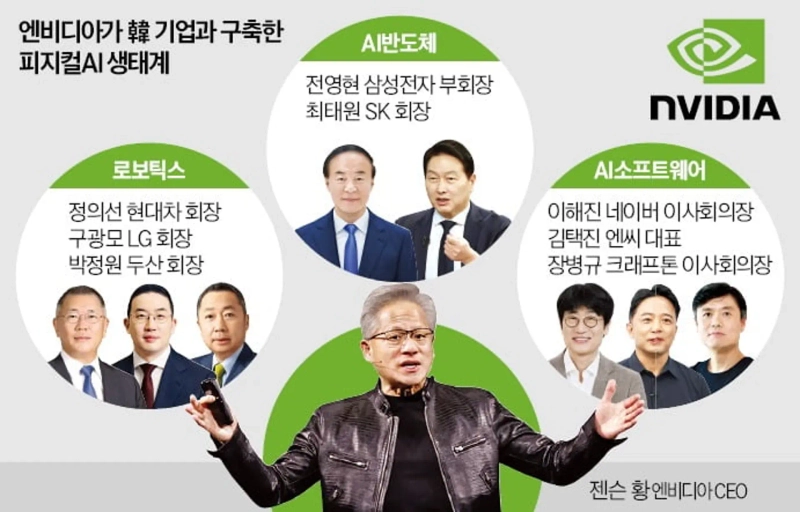
On the third day of his visit to South Korea, Nvidia Chief Executive Officer Jensen Huang met a string of Korean business leaders as he moved to build a "physical AI" ecosystem. On June 7, he traveled across Jongno, Jamsil and Gangnam for back-to-back meetings with executives from the semiconductor, robotics and gaming industries.
The meetings went beyond a goodwill tour. Huang appears to be trying to tie together leading Korean companies in memory chips, robotics hardware and gaming software into a broad value chain centered on Nvidia. For Korean companies, the outreach offers a chance to leverage their manufacturing and software strengths to claim a leading role in the global physical AI ecosystem.
◇Meetings With Samsung and SK Center on Securing HBM4 Supply
Huang has described semiconductor supply-chain coordination as the top priority of his trip. Surging AI demand has tightened memory supply, leaving Nvidia under pressure to lock in sixth-generation high bandwidth memory, or HBM4, for its next-generation Vera Rubin AI accelerators.
On the evening of June 7, Huang met SK Group Chairman Chey Tae-won, SK hynix Chief Executive Officer Kwak Noh-jung and SK Telecom Chief Executive Officer Ryu Young-sang at a Kkanbu Chicken restaurant in Seoul's Samseong-dong, in what the article described as a second "Kkanbu meeting."
The gathering was Huang's third meeting with Chey in roughly a week. At Computex 2026 in Taiwan on June 2, Huang wrote "Please make more HBM" on an SK hynix HBM4E wafer. The two sides are said to have discussed HBM4 supply volumes and cooperation with SK Telecom on data-center infrastructure.
Huang is scheduled to meet Samsung Electronics semiconductor executives near the Shilla Hotel in Seoul's Jangchung-dong on the morning of June 8, including Jun Young-hyun, vice chairman and head of the company's Device Solutions division. Jun will attend in place of Samsung Electronics Chairman Jay Y. Lee, who is overseas on a business trip. The talks are set to cover a detailed timetable and volumes for Samsung's HBM4 supply. For Nvidia, securing stable HBM output from Samsung, the world's largest memory maker, is a priority, and the meeting is expected to focus on nailing down an effective supply plan.
◇"South Korea Is a Cradle of Robotics"
Huang identified robotics as South Korea's most promising investment area and praised the maturity of the country's ecosystem. Nvidia, which has marked physical AI as a future growth driver, used the trip to meet robotics players connected to Hyundai Motor Group, LG Group and Doosan Group, each with different strengths.
On the morning of June 7, Huang met Hyundai Motor Group Executive Chair Euisun Chung at Uraeok in Jongno for what the article described as a surprise naengmyeon lunch. The meeting was viewed as a check on follow-up measures including the establishment of an AI technology center in South Korea. With capabilities in both autonomous driving and robotics manufacturing, Hyundai Motor Group ranks among Nvidia's most important prospective hardware partners.
Later in the day, Huang traveled to Jamsil Baseball Stadium for a meeting with Doosan Group Chairman Park Jeong-won. Huang took the mound in a Doosan Bears jersey with the number 93, a nod to Nvidia's 1993 founding year, and greeted Korean baseball fans. Park wore a No. 96 jersey marking Doosan's 1896 founding year and handled the ceremonial first pitch. Before his appearance on the mound, Huang said, "Nvidia and Korea's IT industry, we are one."
The event was portrayed as more than a publicity appearance, serving as a public display of the importance of a future alliance between the two sides. In the meeting that followed, they discussed broad partnership plans built around Doosan Robotics' capabilities in collaborative robots and industrial humanoid development.
◇Using Game Companies to Build Software Know-How
Another core pillar of Nvidia's physical AI ecosystem is software used to design virtual worlds. On the afternoon of June 7, Huang visited a PC cafe near Sinnonhyeon Station in Seoul and separately met Krafton Chairman Chang Byung-gyu and NCSOFT Chief Executive Officer Kim Taek-jin to deepen ties.
His outreach to gaming executives reflects Nvidia's interest in their expertise in 3D physics engines. NCSOFT and Krafton have accumulated software capabilities in technologies such as Unreal Engine and Unity that replicate the laws of physics in virtual environments. Because physical AI must learn those laws through hundreds of millions of trial-and-error runs in digital worlds, the know-how of Korean game developers could serve as a premier virtual test bed for Nvidia.
"One interpretation is that Jensen Huang has revealed a plan to preempt South Korea's infrastructure across the board, from hardware to virtual simulation platforms, and seize the initiative in the physical AI market," an industry official said.
Kim Chae-yeon, No Yoo-jung, Huh Jin and Kang Hae-ryeong, Hankyung.com reporters why29@hankyung.com

Korea Economic Daily
hankyung@bloomingbit.ioThe Korea Economic Daily Global is a digital media where latest news on Korean companies, industries, and financial markets.