SK Telecom, Nvidia Pursue Full-Stack AI Cloud Partnership, Target 2027 Korea AI Factory Debut
Summary
- SK Telecom said it is seeking to become Asia’s leading AI cloud provider through a full-stack AI cloud partnership based on Nvidia’s DSX platform and Blackwell GPUs.
- The companies said they plan to start operating their first gigawatt-scale AI factory in South Korea in 2027 and jointly develop next-generation AI factory architecture aimed at achieving the lowest token cost and the highest performance per watt.
- SK Telecom said it will join Nvidia’s Cloud Partner ecosystem and work with the chipmaker to address GPU, memory and energy issues to build competitiveness across the full AI infrastructure stack in Asia.
Forecast Trend Report by Period


First AI factory in South Korea to begin operating in 2027
Partnership expands beyond HBM to the full AI infrastructure stack
Goal is to become Asia’s leading AI cloud provider
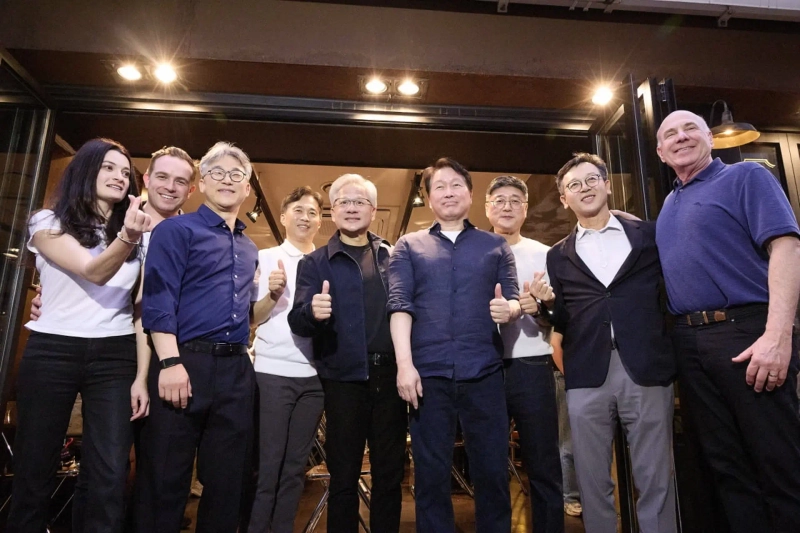
SK Telecom Co. is teaming up with Nvidia Corp. to build global AI infrastructure. The companies plan a full-stack AI cloud partnership based on Nvidia’s DSX platform, spanning everything from chips to data-center operations. SK Telecom aims to expand gigawatt-scale AI factories in phases and emerge as a leading AI cloud provider in Asia.
SK Telecom said SK Group Chairman Chey Tae-won and Nvidia Chief Executive Officer Jensen Huang agreed at a meeting in Taiwan on June 1 to pursue group-wide cooperation on AI infrastructure. SK Telecom, the main vehicle for the partnership, plans to begin operating its first AI factory in South Korea in 2027.
The company described an AI factory as a next-generation data center that uses power and data as inputs to continuously produce tokens, the core unit of AI. It said the concept goes beyond conventional data centers focused on general-purpose computing.
SK Telecom said it will support AI training and inference starting with Nvidia’s Blackwell GPUs. It also plans to adopt the Vera Rubin platform in phases after supply begins in the second half of this year. The company will also join Nvidia Cloud Partner, Nvidia’s global partner ecosystem program. Its goal is to achieve the lowest token cost and the highest performance per watt.
Beyond HBM to the Full AI Infrastructure Stack
Earlier cooperation between SK and Nvidia focused on semiconductors such as SK Hynix Inc.’s high-bandwidth memory, or HBM. Under the new agreement, the partnership will broaden to cover the full AI infrastructure stack, including the construction and operation of AI factories.
SK Group and Nvidia also announced plans to conduct research on next-generation AI factory architecture. That includes joint work on a new computing architecture designed to improve GPU and memory performance from the design stage. The two sides plan to form a joint consultative body for the effort.
The companies are also expanding cooperation in physical AI. During a keynote speech at GTC Taipei on June 1, SK Telecom’s large-scale digital twin technology built on Nvidia Omniverse was introduced. SK Telecom is applying the technology to semiconductor manufacturing processes at SK Hynix.
In robotics, the company is advancing its robot simulation and training platform based on Nvidia Cosmos and the humanoid AI model Isaac Groot.
Chey said the partnership with Nvidia has given SK Group full-stack AI infrastructure capabilities spanning chips to data-center operations. By working together on GPU, memory and energy challenges, the two companies aim to go beyond service provision and become a leading AI cloud provider driving AI ecosystem development across Asia, he added.
Huang said telecommunications networks are evolving into national AI infrastructure. Through Nvidia’s DSX platform, SK Telecom will be able to build a large-scale AI cloud and provide agentic AI, enterprise AI and physical AI to companies and industries in South Korea and around the world, he said.
Hong Min-seong, Hankyung.com reporter, mshong@hankyung.com

Korea Economic Daily
hankyung@bloomingbit.ioThe Korea Economic Daily Global is a digital media where latest news on Korean companies, industries, and financial markets.