PiCK
US Chip, FX Shock Batters Seoul Stocks as 97 of Top 100 Fall, Kospi Drops 8.3%
Forecast Trend Report by Period


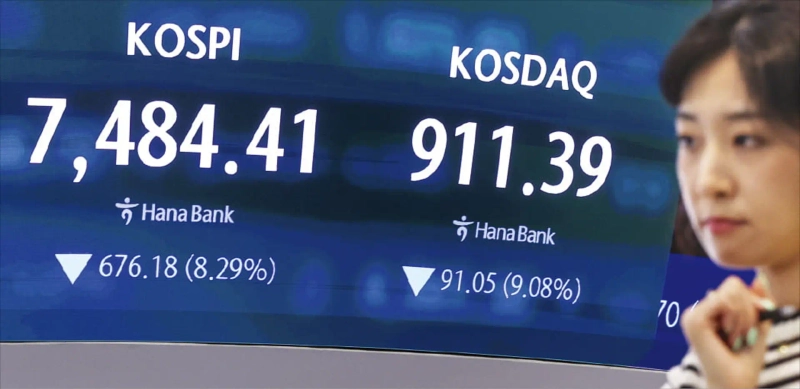
The Kospi tumbled more than 8% on June 8, breaking below 7,500, while the Kosdaq sank 9% to its lowest level in about six months. Global equities came under pressure on concern over the semiconductor cycle and rising expectations for interest-rate hikes. South Korean stocks, which had rallied rapidly, were swept into the correction. The market capitalization of the KOSPI market has shrunk by 1,083 trillion won ($785 billion) from its June 2 peak.
The Kospi closed down 8.29% at 7,484.41. A marketwide circuit breaker was triggered at 9:03 a.m., shortly after the open, when the index's decline reached 8.40%, according to Korea Exchange. Trading in all stocks was halted for 20 minutes.
The Kosdaq fell 9.08% to 911.39, dropping back below the 1,000 level. It was the lowest since Dec. 18, when the index closed at 901.33. A circuit breaker was also triggered on the Kosdaq at 2:36 p.m. It was the first time in three months that trading on both the KOSPI and Kosdaq was halted on the same day, after the first trading session following the outbreak of the US-Iran war on March 4.
In an emergency survey by the Korea Economic Daily of research heads at seven major securities firms, strategists put the low point of the current correction at around 7,000 on the Kospi. They viewed it as a short-term pullback rather than the start of a broader bear market.
Kospi Plunges More Than 8%; Third Circuit Breaker This Year
Samsung Falls Below 300,000 Won, SK Hynix Loses 2 Million Won Mark; Samsung Leverage Products Drop More Than 20%
A circuit breaker, which temporarily halts trading to prevent panic-driven selling on the benchmark market, has been triggered only nine times since the system was introduced in 1998. After it was used during the Sept. 11, 2001, attacks, it was not activated again for 19 years until the Covid-19 shock in 2020.
The mechanism, which was not triggered even during the 2008 global financial crisis, has now been used for a third time this year. Sharp pullbacks have become more frequent after the market's steep run-up, fueling investor anxiety.
Heavy Selling in Samsung, SK Hynix; Leverage Products Down 20%
Of the 922 stocks listed on the benchmark market on June 8, 876, or 95.01%, fell on the day a circuit breaker was triggered. A first-stage circuit breaker is activated when the Kospi drops more than 8% from the previous session and stays there for at least one minute. Trading is then suspended for 20 minutes.
The first-stage halt was triggered at 9:03 a.m., when the index fell 8.4% to 7,474.74. It was the first such move in six months, after back-to-back halts on March 4 and March 9 tied to the war. The market did not slide far enough to trigger the second stage, which kicks in after a drop of more than 15%. After trading resumed, the Kospi recovered modestly and moved in a 7,500-7,800 range. It turned lower again around 2:30 p.m. and finished in the 7,400s.
Ninety-seven of the top 100 stocks by market capitalization ended lower, with Naver and LG Uplus among the few exceptions. Samsung Electronics plunged 10.18% to 295,500 won. The stock fell back below 300,000 won just six trading days after topping that level on May 29. SK Hynix dropped 7.68% to 1.911 million won, giving up the 2 million won mark and leaving even the 1.9 million won range looking fragile.
The two companies also saw their market values shrink sharply. Samsung Electronics' market capitalization, including preferred shares, fell by 210 trillion won ($152 billion) in a day to 1,882 trillion won ($1.36 trillion). In the global market-cap rankings, it slipped to 11th, dropping behind Tesla and Meta after having overtaken Meta and moved within reach of Tesla. SK Hynix lost 113 trillion won ($81.9 billion) in market value over the same period, leaving it at 1,361.9742 trillion won ($987 billion). The company also dropped out of the $1 trillion market-cap club it had recently joined.
The slide in both stocks doubled losses for investors using leverage to bet on what local investors call "Samjeonix," a combined wager on Samsung Electronics and SK Hynix. Single-stock leveraged products tied to Samsung Electronics at major asset managers fell by more than 20%, while those linked to SK Hynix dropped about 15% to 16%.
There Was a Jensen Huang Effect
Asked about the stock-market drop at a June 8 news conference, Nvidia Chief Executive Officer Jensen Huang said investors should be "very happy" because they could buy at discounted prices. The broader market still tumbled, but the so-called Jensen Huang effect showed up in a handful of names. Huang met SK Group Chairman Chey Tae-won, LG Group Chairman Koo Kwang-mo and Naver board Chairman Lee Hae-jin on June 8, announcing investment plans and emphasizing collaboration.
Naver rose 9.20% to close at 279,000 won. The stock climbed as high as 290,000 won intraday after news that Naver and Nvidia would build a gigawatt-scale global artificial intelligence factory.
Among SK Group stocks, SK Networks, which is seeking to transform itself into an AI company, hit the daily 30% limit-up. SK Telecom ended slightly higher, up 0.28%. LG Uplus gained 2.61%, joining Naver as one of the few advancers among heavyweight shares.
Foreign investors were net sellers of 273.5 billion won ($198 million) on the day. Selling continued, but the scale was sharply smaller than the previous session's 3.7948 trillion won ($2.75 billion) net outflow. They were net buyers of rising stocks such as Naver, at 89.6 billion won ($65 million), and SK Networks, at 32.5 billion won ($23.6 million). They dumped Samsung Electronics, at 451.2 billion won ($327 million), and SK Hynix, at 313.4 billion won ($227 million).
Retail investors were net buyers of 2.7626 trillion won ($2 billion). They scooped up 1.4475 trillion won ($1.05 billion) of Samsung Electronics shares and 412.5 billion won ($299 million) of SK Hynix stock sold by foreigners.
Kang Jin-kyu, Korea Economic Daily reporter, josep@hankyung.com

Korea Economic Daily
hankyung@bloomingbit.ioThe Korea Economic Daily Global is a digital media where latest news on Korean companies, industries, and financial markets.