USTR Chief, Washington Post Spar Over US Forced-Labor Tariffs of 10% to 12.5%
Summary
- The Washington Post and the USTR chief are clashing over the justification for the US government’s move to impose tariffs of 10% to 12.5% on 60 countries, including South Korea.
- The Washington Post said the tariffs grouped together countries like China, where forced labor is evident, and countries where it is not, showing that the motive was not ending the exploitation of foreign workers.
- According to nonprofit Walk Free, the G20 imports $468 billion worth of products tied to forced labor each year, and the US accounts for $169.6 billion of that total.
Forecast Trend Report by Period


The Washington Post and US Trade Representative Jamieson Greer are trading barbs over the justification for US tariffs of 10% to 12.5% imposed last month on 60 countries, including South Korea, on the grounds that they were not doing enough to block the flow of goods made with forced labor.
The dispute began with a Washington Post editorial published on June 3. The newspaper called forced labor “a form of modern slavery” and an “abhorrent practice.” It said the US has banned it under the 13th Amendment and Title 18 of the federal code, and has maintained laws barring imports made with forced labor for nearly a century.
One leading example is the Uyghur Forced Labor Prevention Act. Enacted in 2021, the law recognizes China’s abuses against Muslim minorities in Xinjiang and bars products made there from entering the US.
The editorial argued that the latest tariffs undercut the claim that they are meant to curb exploitation of foreign workers because they lump together countries such as China, where forced labor is evident, with countries where that is not the case. It said the measure was adopted in April last year as the administration searched for an alternative basis for tariffs.
Greer responded forcefully. In a letter sent to the Washington Post on June 11, he wrote that “the Washington Post may stand alone in defending a laissez-faire approach to modern slavery.” He also argued that the newspaper’s opposition clearly stemmed from hostility toward the president.
Greer said President Donald Trump had focused on forced labor beginning in his first term and had moved to address it. As an example, he cited efforts during Trump’s first term that led Mexico and Canada to adopt import bans on goods made with forced labor. He also said nine countries joined reciprocal trade agreements after the US required the issue to be included.
US companies and workers are bearing heavy compliance costs to eliminate forced labor from American supply chains, while other countries are not, Greer said.
Still, despite Greer’s defense of Trump, there is broad recognition in Washington that the purpose of the latest forced-labor tariffs is relatively clear. Trump himself has repeatedly signaled that he wants to find substitute tariffs. In the end, the issue is how persuasive the rationale is, and that question appears to carry less weight than it once did.
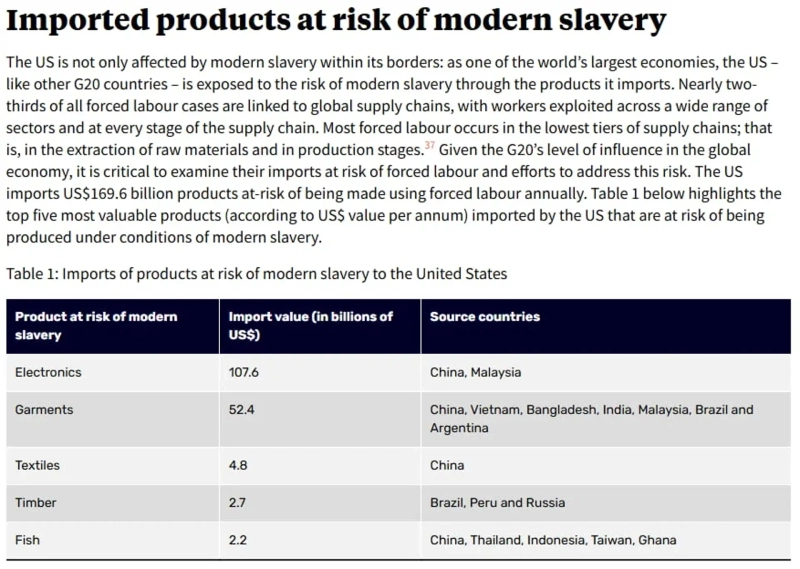
Forced labor is a global problem, and advanced economies benefit from it through cheap goods. According to 2023 data from Walk Free, the Group of 20 imports $468 billion of products tied to forced labor each year. The US alone accounts for $169.6 billion of that total, roughly half. Walk Free said the main categories were electronics, clothing, palm oil, solar panels and textiles.
Several G20 countries also have large forced-labor populations. India has 11 million people in forced labor, followed by China with 5.8 million, Russia with 1.9 million, Indonesia with 1.8 million, Turkey with 1.3 million and the US with 1.1 million. North Korea, though not a G20 member, has 2.6 million, and Pakistan has 2.3 million. North Korea in particular was identified as the country where forced labor is most prevalent.
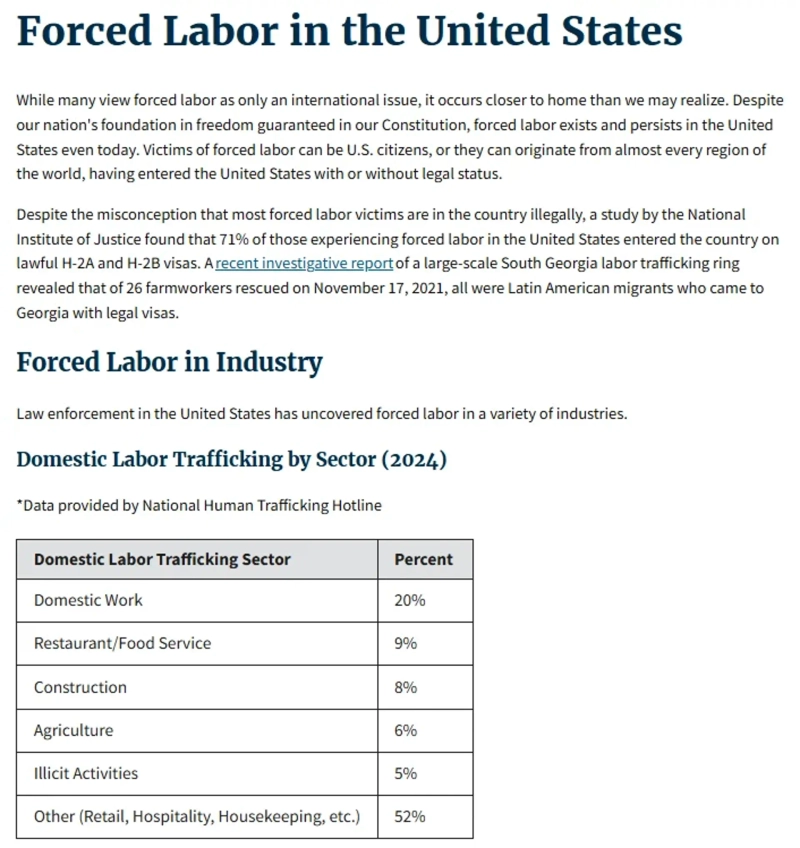
The US figure of 1.1 million may look relatively low by comparison, but it suggests the country is not free of forced labor or human trafficking. The Labor Department also acknowledges that human trafficking and forced labor occur inside the US. Labor Secretary Markwayne Mullin said on the department’s website that many people see forced labor as only an international issue, but it is happening closer to home than many think. Despite freedoms guaranteed by the Constitution, forced labor still exists in the US today, he said. Citing data from the National Human Trafficking Hotline, the department said about half of labor-trafficking cases are reported in retail and housekeeping, while 20% involve domestic work, 9% restaurants and 8% construction.
Lee Sang-eun, Washington correspondent, Hankyung.com, selee@hankyung.com

Korea Economic Daily
hankyung@bloomingbit.ioThe Korea Economic Daily Global is a digital media where latest news on Korean companies, industries, and financial markets.