Samsung Foundry Eyes Google Order for Next-Generation AI Chip
Summary
- Samsung’s foundry division is likely to produce the AI chip I/O component for Google’s next-generation, 10th-generation TPU, code-named Icefish.
- Google is pursuing a foundry diversification strategy under which the main processor would be made on TSMC’s 1.4-nanometer process, while the I/O chip would be assigned to Samsung Electronics.
- Samsung is accelerating efforts to expand foundry market share and win large AI chip orders from big tech clients including Google and Tesla, backed by its turnkey solution, HBM and packaging services.
Forecast Trend Report by Period


Move would add another big-tech chip contract after Tesla
Helping cement its position in leading-edge 2-nanometer manufacturing
From HBM to packaging services
Pushing its turnkey-solution strategy
Samsung Electronics Co. is poised to produce part of Google’s next-generation artificial-intelligence chip, according to industry officials. After winning business from Tesla, Samsung sees a potential Google order as a way to bolster its position in foundry manufacturing for leading-edge 2-nanometer processes. Google, which is seeking to reduce its dependence on Nvidia in AI semiconductors, is also pushing to work more closely with Samsung as it tries to lessen reliance on Taiwan Semiconductor Manufacturing Co., the world’s largest foundry.
Pursuing an order for an I/O chip
Samsung’s foundry division stands to manufacture a key component for Google’s 10th-generation Tensor Processing Unit, code-named Icefish, which is targeted for mass production in 2028, industry officials said on June 12. The part under discussion is an input/output, or I/O, chip. It links the main processor with adjacent high-bandwidth memory, or HBM. That role is becoming increasingly important in AI semiconductors, where vast amounts of data move between chips.
Google is also positive about working with Samsung’s foundry division, the officials said. The company is pursuing a plan in which the main processor would be made on TSMC’s 1.4-nanometer process, while Samsung would produce the I/O chip. Samsung said it could not confirm whether it was collaborating with a customer.
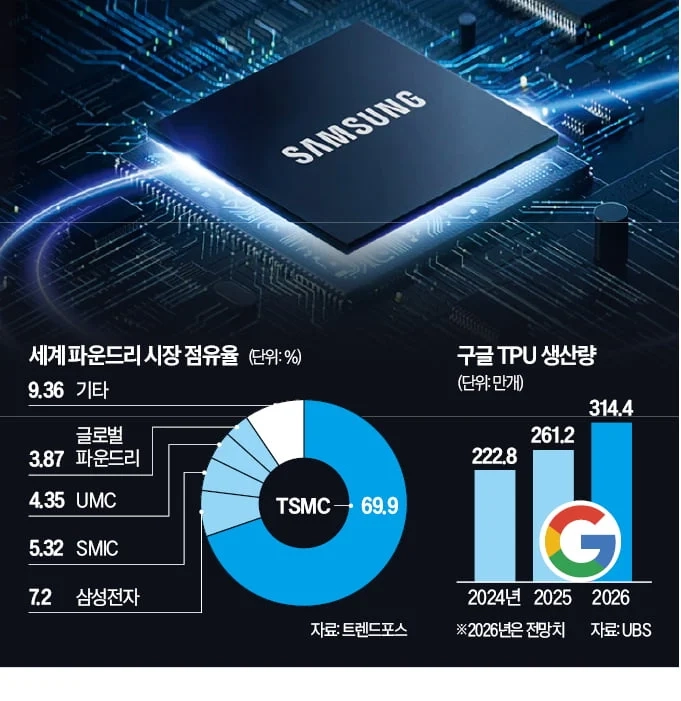
Samsung is pushing aggressively to join Google’s TPU production project as it seeks to strengthen its position in the foundry market. The company ranks second globally behind TSMC. Its market share is only about 7%, versus about 70% for TSMC, leaving a gap of more than 60 percentage points. Intel in the US and China’s SMIC are also looking for chances to take share from Samsung. Securing a big-tech client such as Google and proving mass-production capability are essential for sustained growth, an industry official said.
Google is also pursuing a foundry-diversification strategy. TSMC has recently faced an unprecedented supply shortage as orders for custom AI chips have surged from Nvidia as well as other global AI companies. It has also been raising process-service prices. Splitting orders between suppliers has emerged as a way to improve price competitiveness and reduce production risk. That is also why Google has approached not only Samsung’s foundry division but also Intel for a potential contract.
Stepping up efforts to win more big-tech business
Samsung is expected to use a contract win from Google as momentum to pursue more orders from other big-tech companies. Google is also expected to make active use of Samsung’s differentiated turnkey-solution strategy. Industry officials say an integrated offering spanning HBM, front-end fabrication and packaging services could cut both production time and costs.
Cooperation between Samsung’s foundry division and big-tech companies has increased noticeably in recent months. Last year, Samsung won a $16.5 billion contract from Tesla to produce the next-generation AI6 chip. To support that volume, it is building a leading-edge semiconductor manufacturing facility in Taylor, Texas.
Samsung has also continued to land large contracts, including one to manufacture Groq’s language processing unit, or LPU, for use on Nvidia’s platform. Jun Young-hyun, vice chairman and head of Samsung’s Device Solutions division, which oversees the chip business, said after meeting Nvidia Chief Executive Officer Jensen Huang on June 8 that the companies are cooperating on autonomous-driving chips and LPUs. He added that they are also discussing next-generation cooperation.
Kang Hae-ryeong, Hankyung reporter hr.kang@hankyung.com

Korea Economic Daily
hankyung@bloomingbit.ioThe Korea Economic Daily Global is a digital media where latest news on Korean companies, industries, and financial markets.